115195
论文已发表
注册即可获取德孚的最新动态
IF 收录期刊
- 3.6 Breast Cancer (Dove Med Press)
- 4.3 Clin Epidemiol
- 2.6 Cancer Manag Res
- 3.2 Infect Drug Resist
- 4.1 Clin Interv Aging
- 6.1 Drug Des Dev Ther
- 4.1 Int J Chronic Obstr
- 8.7 Int J Nanomed
- 2.5 Int J Women's Health
- 3.2 Neuropsych Dis Treat
- 2.4 OncoTargets Ther
- 2.6 Patient Prefer Adher
- 2.6 Ther Clin Risk Manag
- 3.1 J Pain Res
- 3.5 Diabet Metab Synd Ob
- 4.5 Psychol Res Behav Ma
- 3.4 Nat Sci Sleep
- 2.4 Pharmgenomics Pers Med
- 2.6 Risk Manag Healthc Policy
- 4.6 J Inflamm Res
- 2.3 Int J Gen Med
- 3.9 J Hepatocell Carcinoma
- 3.3 J Asthma Allergy
- 2.5 Clin Cosmet Investig Dermatol
- 3.0 J Multidiscip Healthc

在初次用药恐慌症的首次发作中,顶上小叶功能改变与感知意识相关:初步的 fMRI 研究
Authors Jin H, Zhang B, Cui H, Li W, Li H, Hu Q, Wang J, Li C
Received 5 February 2020
Accepted for publication 15 June 2020
Published 3 July 2020 Volume 2020:16 Pages 1653—1659
DOI https://doi.org/10.2147/NDT.S248453
Checked for plagiarism Yes
Review by Single-blind
Peer reviewer comments 2
Editor who approved publication: Professor Jun Chen
Background: Biased fear-related perception is one main characteristic in patients with panic disorder (PD) and their prominent cardiovascular symptoms associated with enhanced heartbeat perception.
Patients and Methods: We investigated interoceptive perception in 18 first-onset drug-naïve PD patients and 21 age- and gender-matched healthy controls (HC). Moreover, we compared blood oxygen level-dependent (BOLD) responses between the two groups during a heartbeat perception (interoception) task to assess task-evoked activity and its relationship with heartbeat perception scores (HPSs).
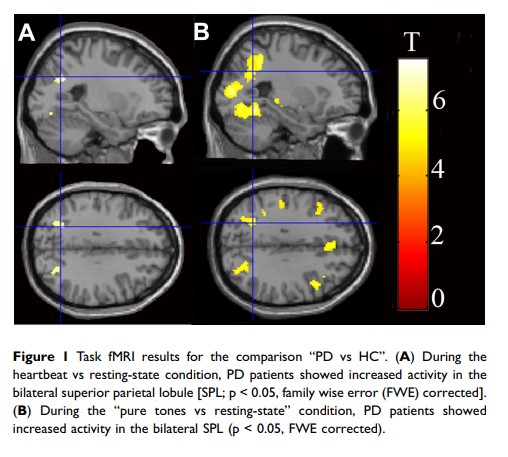
Results: We found that patients with PD compared to HCs revealed a trend higher but insignificant HPSs. Higher activity in the bilateral superior parietal lobule (SPL) was observed in PD patients compared to HCs during the perception of both heartbeats and pure tones compared to rest. Furthermore, patients with PD exhibited a significant positive correlation between BOLD activity in the left SPL during heartbeat > resting-state and HPS.
Conclusion: Using a sample of first-episode drug-naïve patients, our study reports that patients with PD show altered activation in the bilateral SPL during both interoceptive and exteroceptive perception. The increased activation during interoceptive stimuli might render PD patients more engaged in processing information associated with their internal states.
Keywords: panic disorder, MRI, perception, superior parietal lobule