115195
论文已发表
注册即可获取德孚的最新动态
IF 收录期刊
- 3.6 Breast Cancer (Dove Med Press)
- 4.3 Clin Epidemiol
- 2.6 Cancer Manag Res
- 3.2 Infect Drug Resist
- 4.1 Clin Interv Aging
- 6.1 Drug Des Dev Ther
- 4.1 Int J Chronic Obstr
- 8.7 Int J Nanomed
- 2.5 Int J Women's Health
- 3.2 Neuropsych Dis Treat
- 2.4 OncoTargets Ther
- 2.6 Patient Prefer Adher
- 2.6 Ther Clin Risk Manag
- 3.1 J Pain Res
- 3.5 Diabet Metab Synd Ob
- 4.5 Psychol Res Behav Ma
- 3.4 Nat Sci Sleep
- 2.4 Pharmgenomics Pers Med
- 2.6 Risk Manag Healthc Policy
- 4.6 J Inflamm Res
- 2.3 Int J Gen Med
- 3.9 J Hepatocell Carcinoma
- 3.3 J Asthma Allergy
- 2.5 Clin Cosmet Investig Dermatol
- 3.0 J Multidiscip Healthc

中国华北地区自 2016 年 4 月至 2017 年 10 月之间 164 例侵袭性肺炎链球菌抗生素耐药性、血清型分布和遗传特征调查
Authors Zhao C, Xie Y, Zhang F, Wang Z, Yang S, Wang Q, Wang X, Li H, Chen H, Wang H
Received 9 April 2020
Accepted for publication 9 June 2020
Published 3 July 2020 Volume 2020:13 Pages 2117—2128
DOI https://doi.org/10.2147/IDR.S256663
Checked for plagiarism Yes
Review by Single-blind
Peer reviewer comments 2
Editor who approved publication: Professor Suresh Antony
Background: Streptococcus pneumoniae infections are the major cause of global morbidity and mortality among children and patients aged more than 65 years. This study aimed to investigate the antimicrobial resistance, bacterial serotype distribution, and genetic characteristics of invasive S. pneumoniae from different cities in North China.
Materials and Methods: A total of 164 invasive S. pneumoniae strains were collected from 8 hospitals in 5 regions of North China between April 2016 and October 2017. Minimum inhibitory concentrations (MICs) were determined using the agar dilution method. Capsular serotypes were identified using the Quellung reaction test. Molecular epidemiology was investigated using multilocus sequence typing.
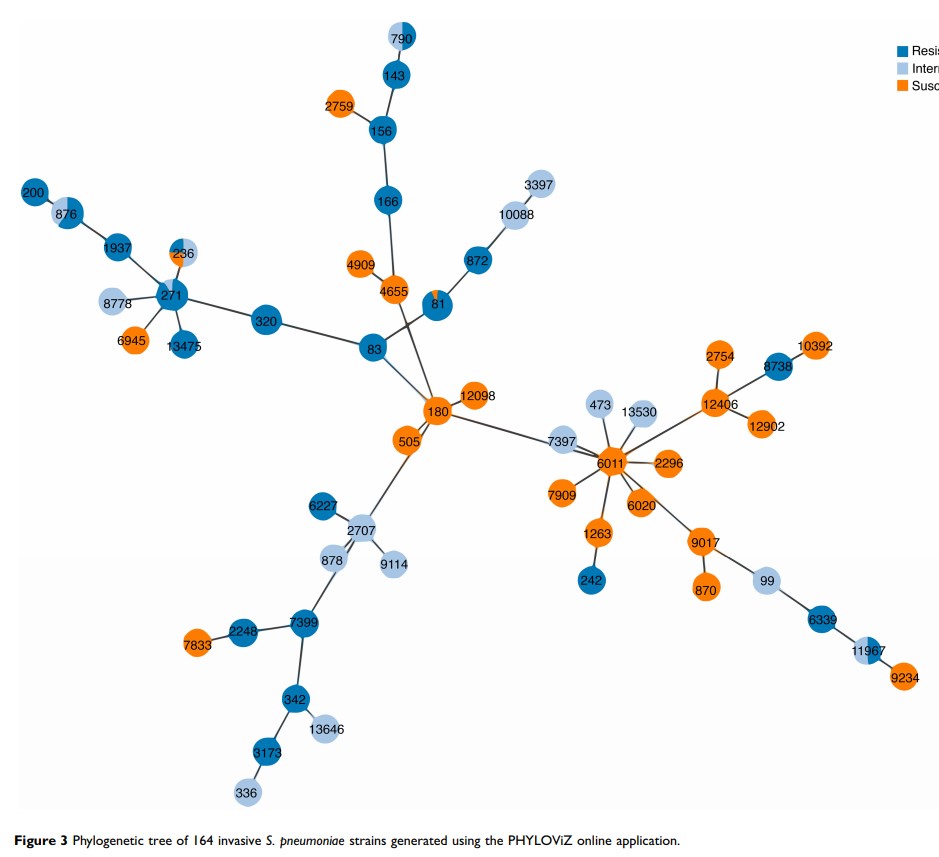
Results: S. pneumoniae isolates were highly resistant to macrolides, clindamycin, and tetracycline in all age groups. The overall rate of resistance to penicillin was 56.7%. However, fluoroquinolones and vancomycin maintained excellent antimicrobial activities. The rate of resistance to β-lactam in strains isolated from children aged less than 18 years was significantly higher than that in strains from other age groups. The most prevalent serotypes were 14 (22.6%), 19F (16.5%), non-vaccine types (14.0%), 19A (9.8%), and 23F (9.1%). The coverage for PCV10 and PCV13 was 59.8% and 75.6%, respectively. The vaccine coverage rate was the highest among children aged less than 5 years. The proportion of penicillin-resistant isolates was higher among vaccine-covered strains compared with non-covered strains. S. pneumoniae showed considerable clonal dissemination, and ST876 (28, 17.1%), ST271 (22, 13.4%), ST81 (17, 10.4%) and ST320 (14, 8.5%) were the major STs.
Conclusion: All the 164 invasive S. pneumoniae isolates demonstrated high resistance to antibiotics. The coverage of S. pneumoniae vaccine was higher in children than in adults.
Keywords: antimicrobial resistance, multilocus sequence typing, serotyping, Streptococcus pneumoniae