115195
论文已发表
注册即可获取德孚的最新动态
IF 收录期刊
- 3.6 Breast Cancer (Dove Med Press)
- 4.3 Clin Epidemiol
- 2.6 Cancer Manag Res
- 3.2 Infect Drug Resist
- 4.1 Clin Interv Aging
- 6.1 Drug Des Dev Ther
- 4.1 Int J Chronic Obstr
- 8.7 Int J Nanomed
- 2.5 Int J Women's Health
- 3.2 Neuropsych Dis Treat
- 2.4 OncoTargets Ther
- 2.6 Patient Prefer Adher
- 2.6 Ther Clin Risk Manag
- 3.1 J Pain Res
- 3.5 Diabet Metab Synd Ob
- 4.5 Psychol Res Behav Ma
- 3.4 Nat Sci Sleep
- 2.4 Pharmgenomics Pers Med
- 2.6 Risk Manag Healthc Policy
- 4.6 J Inflamm Res
- 2.3 Int J Gen Med
- 3.9 J Hepatocell Carcinoma
- 3.3 J Asthma Allergy
- 2.5 Clin Cosmet Investig Dermatol
- 3.0 J Multidiscip Healthc

肿瘤坏死因子-α 调节人成牙本质细胞样细胞中的 TRPA1 表达
Authors Liu J, Que K, Liu Y, Zang C, Wen J
Received 25 March 2020
Accepted for publication 19 June 2020
Published 6 July 2020 Volume 2020:13 Pages 1655—1664
DOI https://doi.org/10.2147/JPR.S255288
Checked for plagiarism Yes
Review by Single-blind
Peer reviewer comments 2
Editor who approved publication: Dr Michael E Schatman
Purpose: Transient receptor potential cation channel, subfamily A, member 1 (TRPA1) is a promiscuous chemical nociceptor involved in the perception of cold hypersensitivity, mechanical hyperalgesia and inflammatory pain in human odontoblasts (HODs). Here, we aimed to study the underlying mechanism in which inflammatory cytokine tumor necrosis factor (TNF)-α regulated the expression of TRPA1 channel at both cellular and subcellular levels.
Materials and Methods: Immunohistochemistry was used to confirm the expression of TRPA1 channel in HODs. Dental pulp cells were induced and differentiated to HOD-like cells and used in succedent experiments. Real-time quantitative polymerase chain reaction assay and Western blotting were used to examine the expression changes of TRPA1 channel with the presence and absence of TNF-α and TNF receptor (TNFR) inhibitor, R 7050. Finally, immunoelectron microscopy (IEM) and quantitative analysis were performed to directly display the TNF-α-regulated distribution change of TRPA1 channel in HOD-like cells.
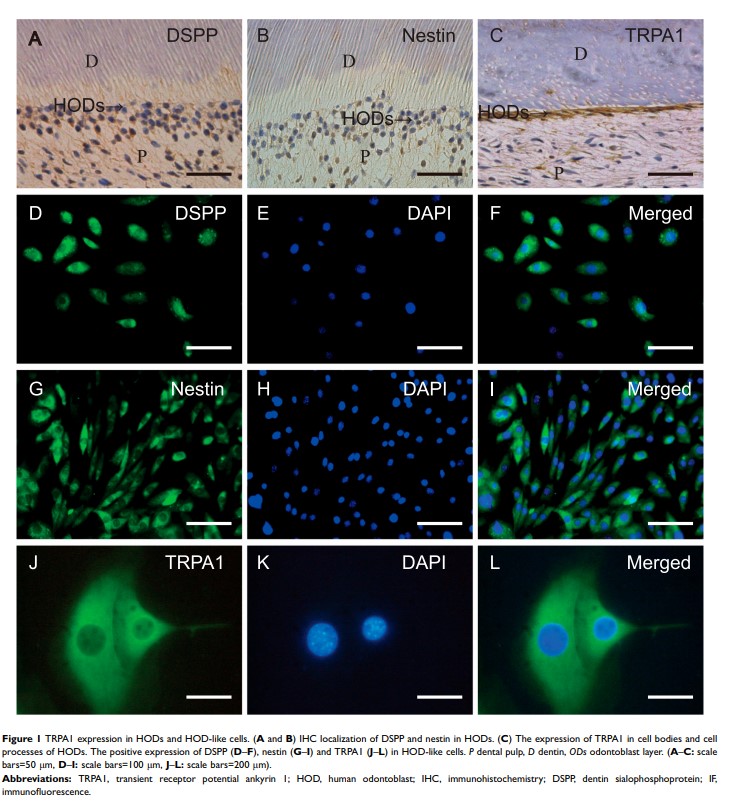
Results: TRPA1 channel was positively expressed in the cell bodies and processes of HODs. The expression TRPA1 channel was significantly up-regulated by high concentration of TNF-α, which could be suppressed by R 7050. Under IEM, TNF-α treatment could increase the expression of TRPA1 in the ER membrane, cytoplasm and mitochondria.
Conclusion: Our study demonstrated that TRPA1 expression in HOD-like cells was evidently upregulated by TNF-α, presumably via TNFR1. TNF-α induced significant increasement in the intracellular distributions of TRPA1 proteins, with increases in the cytoplasm, ER membrane, and mitochondria, to actively participate in noxious external stimuli perception and transduction of hyperalgesia.
Keywords: human odontoblasts, transient receptor potential ankyrin 1, tumor necrosis factor-α, immunoelectron microscopy