115195
论文已发表
注册即可获取德孚的最新动态
IF 收录期刊
- 3.6 Breast Cancer (Dove Med Press)
- 4.3 Clin Epidemiol
- 2.6 Cancer Manag Res
- 3.2 Infect Drug Resist
- 4.1 Clin Interv Aging
- 6.1 Drug Des Dev Ther
- 4.1 Int J Chronic Obstr
- 8.7 Int J Nanomed
- 2.5 Int J Women's Health
- 3.2 Neuropsych Dis Treat
- 2.4 OncoTargets Ther
- 2.6 Patient Prefer Adher
- 2.6 Ther Clin Risk Manag
- 3.1 J Pain Res
- 3.5 Diabet Metab Synd Ob
- 4.5 Psychol Res Behav Ma
- 3.4 Nat Sci Sleep
- 2.4 Pharmgenomics Pers Med
- 2.6 Risk Manag Healthc Policy
- 4.6 J Inflamm Res
- 2.3 Int J Gen Med
- 3.9 J Hepatocell Carcinoma
- 3.3 J Asthma Allergy
- 2.5 Clin Cosmet Investig Dermatol
- 3.0 J Multidiscip Healthc

分离自粪便和感染的手术伤口的鼠伤寒沙门氏菌的分子相关性
Authors Qin H, Guo Y, Li Y, Zheng R
Received 28 February 2020
Accepted for publication 16 June 2020
Published 6 July 2020 Volume 2020:13 Pages 2139—2144
DOI https://doi.org/10.2147/IDR.S251695
Checked for plagiarism Yes
Review by Single-blind
Peer reviewer comments 2
Editor who approved publication: Professor Suresh Antony
Purpose: Salmonella enterica serovar Typhimurium infection is common in foodborne diseases, but its isolation from surgical incisions is rare. Our aim in this study was to trace the transmission source of a surgical incision infected with S . Typhimurium in a Yunnan Province hospital patient and elucidate the underlying molecular mechanisms of antibiotic resistance.
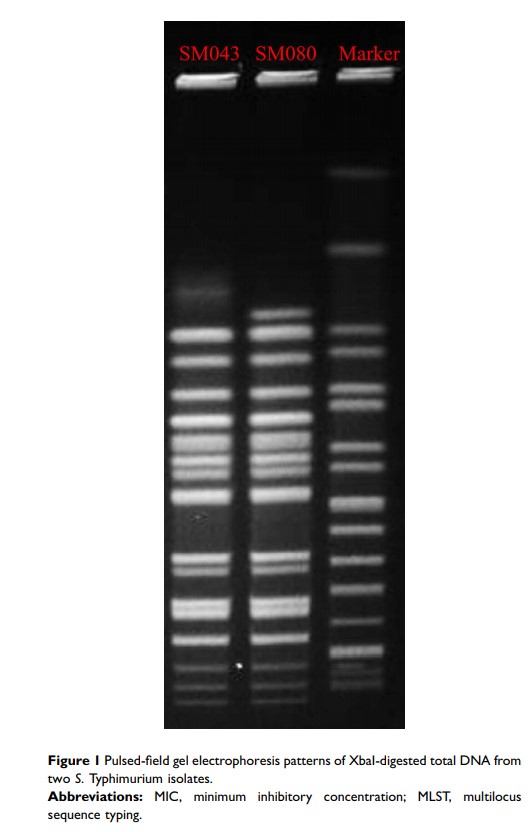
Methods: Primers were designed to amplify the drug-resistance genes using polymerase chain reaction (PCR). Susceptibility to antibiotics was determined using Etest strips. Macrorestriction profiles were analyzed using pulsed-field gel electrophoresis (PFGE) and XbaI. The two isolates were characterized using agglutination tests and multilocus sequence typing (MLST).
Results: MLST analysis revealed that S . Typhimurium isolates SM043 and SM080 belonged to the same genotype, ST34, and PFGE revealed that SM043 and SM080 had high similarity. The isolates were both resistant to third-generation cephalosporins. SM043 harbored the antibiotic resistance genes blaCTX-M-15, blaTEM-1, qnrS-1, qnrB , and acc-3 , whereas blaCTX-M-15, blaTEM-1, blaCMY-2, qnrS-1 , and acc-3 were detected in SM080.
Conclusion: The surgical incision infection by S . Typhimurium may have been hospital-acquired. Thus, it is critical to strengthen hospital sanitation by addressing hand hygiene and sterilization of the operational environment to avoid outbreaks of nosocomial Salmonella infections.
Keywords: Salmonella , healthcare-associated infection, cephalosporins, antibiotic resistance, nosocomial infection