115195
论文已发表
注册即可获取德孚的最新动态
IF 收录期刊
- 3.6 Breast Cancer (Dove Med Press)
- 4.3 Clin Epidemiol
- 2.6 Cancer Manag Res
- 3.2 Infect Drug Resist
- 4.1 Clin Interv Aging
- 6.1 Drug Des Dev Ther
- 4.1 Int J Chronic Obstr
- 8.7 Int J Nanomed
- 2.5 Int J Women's Health
- 3.2 Neuropsych Dis Treat
- 2.4 OncoTargets Ther
- 2.6 Patient Prefer Adher
- 2.6 Ther Clin Risk Manag
- 3.1 J Pain Res
- 3.5 Diabet Metab Synd Ob
- 4.5 Psychol Res Behav Ma
- 3.4 Nat Sci Sleep
- 2.4 Pharmgenomics Pers Med
- 2.6 Risk Manag Healthc Policy
- 4.6 J Inflamm Res
- 2.3 Int J Gen Med
- 3.9 J Hepatocell Carcinoma
- 3.3 J Asthma Allergy
- 2.5 Clin Cosmet Investig Dermatol
- 3.0 J Multidiscip Healthc

CXCR4 拮抗剂 AMD3100 可逆转间质干细胞介导的复发/难治性急性淋巴细胞白血病耐药性
Authors Wang S, Wang X, Liu S, Zhang S, Wei X, Song Y, Yin Q
Received 12 February 2020
Accepted for publication 7 June 2020
Published 6 July 2020 Volume 2020:13 Pages 6583—6591
DOI https://doi.org/10.2147/OTT.S249425
Checked for plagiarism Yes
Review by Single-blind
Peer reviewer comments 2
Editor who approved publication: Dr Sanjay Singh
Purpose: To investigate the role of the CXCR4/CXCL12 axis in chemotherapy resistance in refractory/relapsed (R/R) ALL patients.
Methods: CXCR4 expression on ALL cells from newly diagnosed or R/R ALL patients were detected using flow cytometry. The CXCR4/CXCL12 signaling pathway was blocked by the CXCR4 inhibitor AMD3100 in a co-culture model of primary drug-resistant ALL cells and umbilical cord mesenchymal stem cells (UCMSCs). Surface CXCR4 expression, apoptosis rate, and apoptosis-related protein expression in primary ALL cells under various treatments were detected.
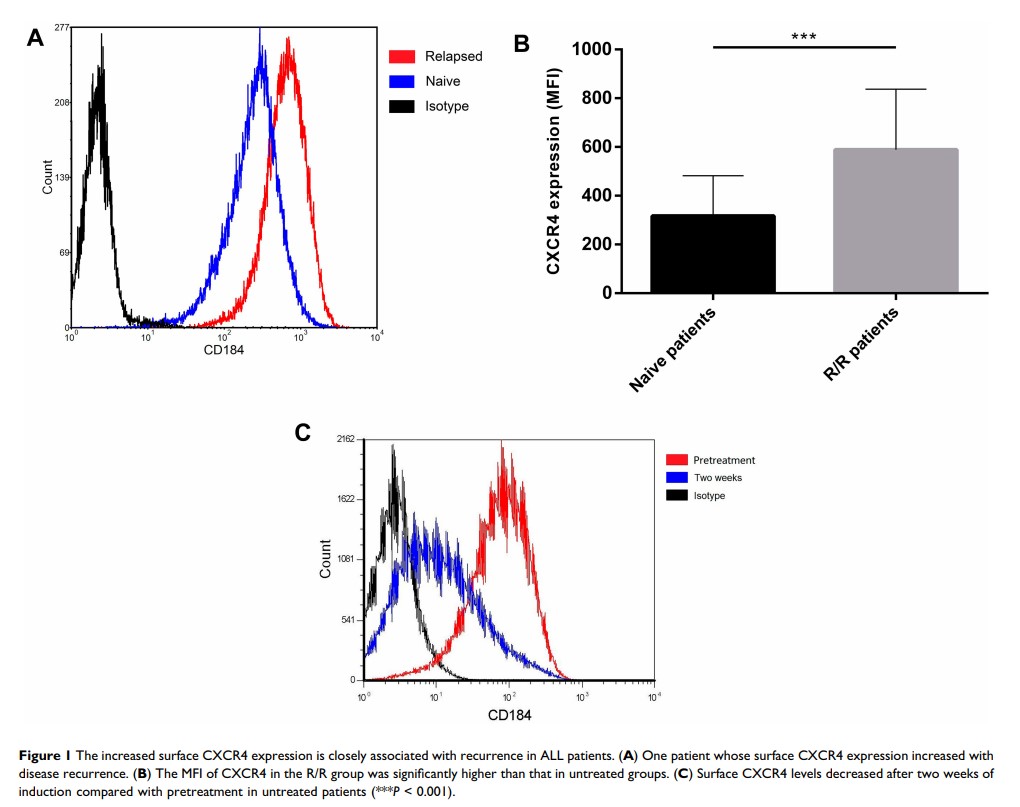
Results: Of the 37 ALL patients examined, CXCR4 expression was higher in R/R patients than that in those with newly diagnosed disease. Similarly, in in vitro co-cultures of drug-resistant ALL cells with UCMSCs, the expression of CXCR4 was increased in the presence of vincristine (VCR), but reduced when VCR was combined with the CXCR4 antagonist AMD3100. Additionally, the supernatants of ALL-UCMSC co-cultures contained high CXCL12 concentrations, which were upregulated by VCR and significantly decreased by the combination of VCR plus AMD3100. Furthermore, the apoptosis rate of ALL cells significantly decreased, Bax expression was downregulated, and Bcl-2 was upregulated when ALL was co-cultured with UCMSCs compared with ALL cells alone. With the addition of VCR, the apoptosis rate mildly increased, Bax was upregulated, and Bcl-2 was downregulated. Nevertheless, the above results were further intensified, particularly Bax expression, when VCR was combined with AMD3100.
Conclusion: The CXCR4 antagonist could effectively reverse MSC-mediated drug resistance by blocking the CXCR4/CXCL12 axis and sensitizing leukemic cells from R/R ALL patients to chemotherapy drugs.
Keywords: acute lymphoblastic leukemia, relapsed/refractory, CXCR4/CXCL12 signaling, bone marrow microenvironment, drug resistance