115195
论文已发表
注册即可获取德孚的最新动态
IF 收录期刊
- 3.6 Breast Cancer (Dove Med Press)
- 4.3 Clin Epidemiol
- 2.6 Cancer Manag Res
- 3.2 Infect Drug Resist
- 4.1 Clin Interv Aging
- 6.1 Drug Des Dev Ther
- 4.1 Int J Chronic Obstr
- 8.7 Int J Nanomed
- 2.5 Int J Women's Health
- 3.2 Neuropsych Dis Treat
- 2.4 OncoTargets Ther
- 2.6 Patient Prefer Adher
- 2.6 Ther Clin Risk Manag
- 3.1 J Pain Res
- 3.5 Diabet Metab Synd Ob
- 4.5 Psychol Res Behav Ma
- 3.4 Nat Sci Sleep
- 2.4 Pharmgenomics Pers Med
- 2.6 Risk Manag Healthc Policy
- 4.6 J Inflamm Res
- 2.3 Int J Gen Med
- 3.9 J Hepatocell Carcinoma
- 3.3 J Asthma Allergy
- 2.5 Clin Cosmet Investig Dermatol
- 3.0 J Multidiscip Healthc

大肝细胞癌老年患者接受大部肝切除术:一项多中心回顾性观察研究
Authors Chen ZL, Zhang CW, Liang L, Wu H, Zhang WG, Zeng YY, Gu WM, Chen TH, Li J, Zhang YM, Wang H, Zhou YH, Li C, Diao YK, Lau WY, Wu MC, Shen F, Yang T, Liang YJ
Received 14 April 2020
Accepted for publication 12 June 2020
Published 9 July 2020 Volume 2020:12 Pages 5607—5618
DOI https://doi.org/10.2147/CMAR.S258150
Checked for plagiarism Yes
Review by Single-blind
Peer reviewer comments 3
Editor who approved publication: Dr Ahmet Emre Eskazan
Background: With an increase in life expectancy and improvement of surgical safety, more elderly patients with hepatocellular carcinoma (HCC), even with large tumors, are now considered for hepatectomy. This study aimed to clarify the impact of age on short- and long-term outcomes after major hepatectomy (≥ 3 segments) for large HCC (≥ 5 cm).
Patients and Methods: Using a multicenter database, patients who underwent curative-intent major hepatectomy for large HCC between 2006 and 2016 were identified. Postoperative morbidity and mortality, overall survival (OS) and recurrence-free survival (RFS) were compared between the elderly (≥ 65 years) and younger (< 65 years) patients. Univariable and multivariable Cox-regression analyses were performed to identify the risk factors of OS and RFS in the entire and elderly cohorts, respectively.
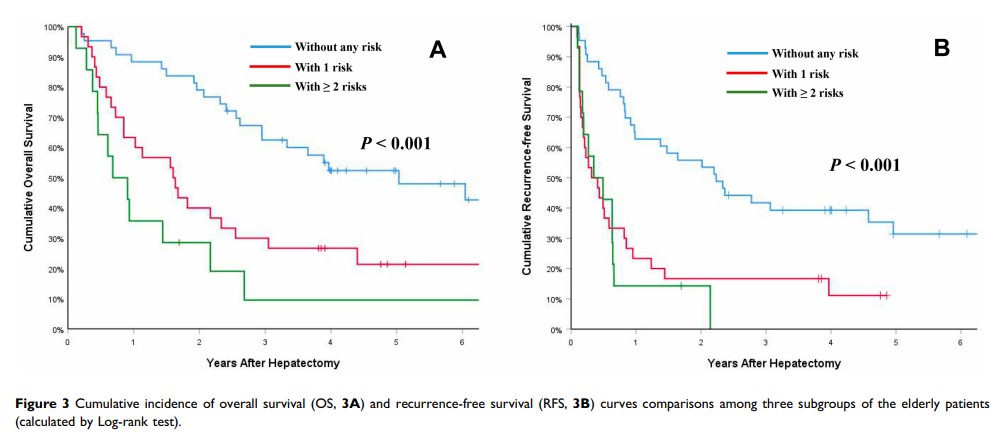
Results: Of 830 patients, 92 (11.1%) and 738 (88.9%) were elderly and younger patients, respectively. There were no significant differences in postoperative 30-day mortality and morbidity between the two groups (5.4% vs 2.6% and 43.5% vs 38.3%, both P> 0.05). The 5-year OS and RFS rates in elderly patients were also comparable to younger patients (35.0% vs 33.2% and 20.0% vs 20.8%, both P> 0.05). In the entire cohort, multivariable Cox-regression analyses identified that old age was not independently associated with OS and RFS. However, in the elderly cohort, preoperative alpha-fetoprotein level > 400 μg/L, multiple tumors, macrovascular invasion and microvascular invasion were independently associated with decreased OS and RFS.
Conclusion: Carefully selected elderly patients benefited from major hepatectomy for large HCC as much as younger patients, and their long-term prognosis was determined by preoperative alpha-fetoprotein level, tumor number and presence of macro- or micro-vascular invasion.
Keywords: hepatocellular carcinoma, hepatectomy, survival, recurrence, elderly