115195
论文已发表
注册即可获取德孚的最新动态
IF 收录期刊
- 3.6 Breast Cancer (Dove Med Press)
- 4.3 Clin Epidemiol
- 2.6 Cancer Manag Res
- 3.2 Infect Drug Resist
- 4.1 Clin Interv Aging
- 6.1 Drug Des Dev Ther
- 4.1 Int J Chronic Obstr
- 8.7 Int J Nanomed
- 2.5 Int J Women's Health
- 3.2 Neuropsych Dis Treat
- 2.4 OncoTargets Ther
- 2.6 Patient Prefer Adher
- 2.6 Ther Clin Risk Manag
- 3.1 J Pain Res
- 3.5 Diabet Metab Synd Ob
- 4.5 Psychol Res Behav Ma
- 3.4 Nat Sci Sleep
- 2.4 Pharmgenomics Pers Med
- 2.6 Risk Manag Healthc Policy
- 4.6 J Inflamm Res
- 2.3 Int J Gen Med
- 3.9 J Hepatocell Carcinoma
- 3.3 J Asthma Allergy
- 2.5 Clin Cosmet Investig Dermatol
- 3.0 J Multidiscip Healthc

癌症恶病质:定义、分期和新兴治疗
Authors Ni J, Zhang L
Received 11 May 2020
Accepted for publication 26 June 2020
Published 9 July 2020 Volume 2020:12 Pages 5597—5605
DOI https://doi.org/10.2147/CMAR.S261585
Checked for plagiarism Yes
Review by Single-blind
Peer reviewer comments 4
Editor who approved publication: Dr Sanjeev Srivastava
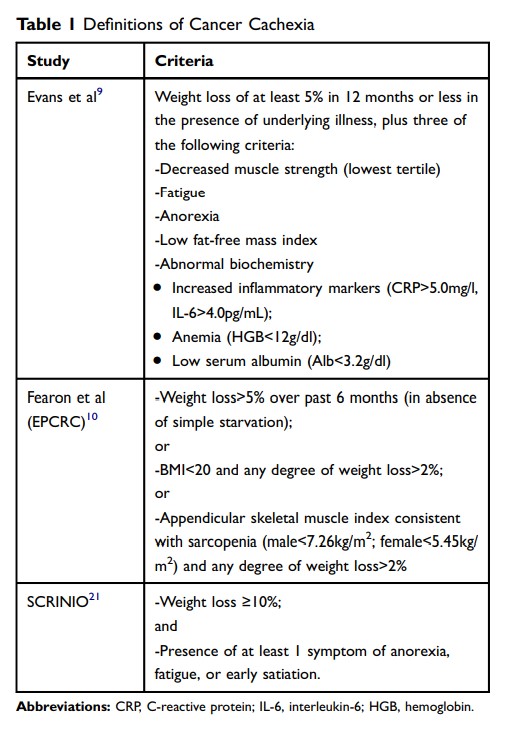
Abstract: Cachexia is a multifactorial disease characterized by weight loss via skeletal muscle and adipose tissue loss, an imbalance in metabolic regulation, and reduced food intake. It is caused by factors of catabolism produced by tumors in the systemic circulation as well as physiological factors such as the imbalanced inflammatory activation, proteolysis, autophagy, and lipolysis that may occur with gastric, pancreatic, esophageal, lung cancer, liver, and bowel cancer. Cancer cachexia not only negatively affects the quality of life of patients with cancer but also reduces the effectiveness of anti-cancer chemotherapy and increases its toxicity, leading to increased cancer-related mortality and expenditure of medical resources. Currently, there are no effective medical interventions to completely reverse cachexia and no approved drugs. Adequate nutritional support is the main method of cachexia treatment, while drugs that target the inhibition of catabolism, cell damage, and excessive activation of inflammation are under study. This article reviews recent advances in the diagnosis, staging, and evaluation of cancer cachexia.
Keywords: cancer cachexia, disease staging, metabolic dysfunction