115195
论文已发表
注册即可获取德孚的最新动态
IF 收录期刊
- 3.6 Breast Cancer (Dove Med Press)
- 4.3 Clin Epidemiol
- 2.6 Cancer Manag Res
- 3.2 Infect Drug Resist
- 4.1 Clin Interv Aging
- 6.1 Drug Des Dev Ther
- 4.1 Int J Chronic Obstr
- 8.7 Int J Nanomed
- 2.5 Int J Women's Health
- 3.2 Neuropsych Dis Treat
- 2.4 OncoTargets Ther
- 2.6 Patient Prefer Adher
- 2.6 Ther Clin Risk Manag
- 3.1 J Pain Res
- 3.5 Diabet Metab Synd Ob
- 4.5 Psychol Res Behav Ma
- 3.4 Nat Sci Sleep
- 2.4 Pharmgenomics Pers Med
- 2.6 Risk Manag Healthc Policy
- 4.6 J Inflamm Res
- 2.3 Int J Gen Med
- 3.9 J Hepatocell Carcinoma
- 3.3 J Asthma Allergy
- 2.5 Clin Cosmet Investig Dermatol
- 3.0 J Multidiscip Healthc

声波刺猬信号通过激活大鼠中的 BDNF/TrkB 信号通路引起开胸术后慢性疼痛
Authors Yang Y, Wang X, Zhang X, You S, Feng L, Zhang Y, Shi Y, Xu Y, Zhang H
Received 10 January 2020
Accepted for publication 16 June 2020
Published 10 July 2020 Volume 2020:13 Pages 1737—1746
DOI https://doi.org/10.2147/JPR.S245515
Checked for plagiarism Yes
Review by Single-blind
Peer reviewer comments 4
Editor who approved publication: Dr E Alfonso Romero-Sandoval
Purpose: Some patients undergoing thoracotomy may suffer from chronic post-thoracotomy pain (CPTP). Treatment of CPTP has been a clinical challenge and the underlying mechanisms of CPTP remain elusive. Recently, sonic hedgehog (Shh) signaling has been shown to be associated with various pain states but its role in the pathogenesis of CPTP is still unclear.
Methods: CPTP was induced in rats by thoracotomy. Rats were divided into CPTP group and non-CPTP group based on the mechanical withdrawal threshold (MWT). Rats were administered with Shh signaling inhibitor cyclopamine and activator smoothened agonist (SAG), and then evaluated by MWT and cold allodynia testing. The expressions of Shh signaling (Shh ligand, patched and smoothened receptor, Gli transcription factors), brain-derived neurotrophic factor (BDNF), tropomyosin-related kinase receptor B (Trk-B), phosphatidylinositol 3-kinase (PI3K) and protein kinase B (Akt) in rat T4-5 spinal cord dorsal horn (SDH) were detected by Western blotting and immunohistochemistry.
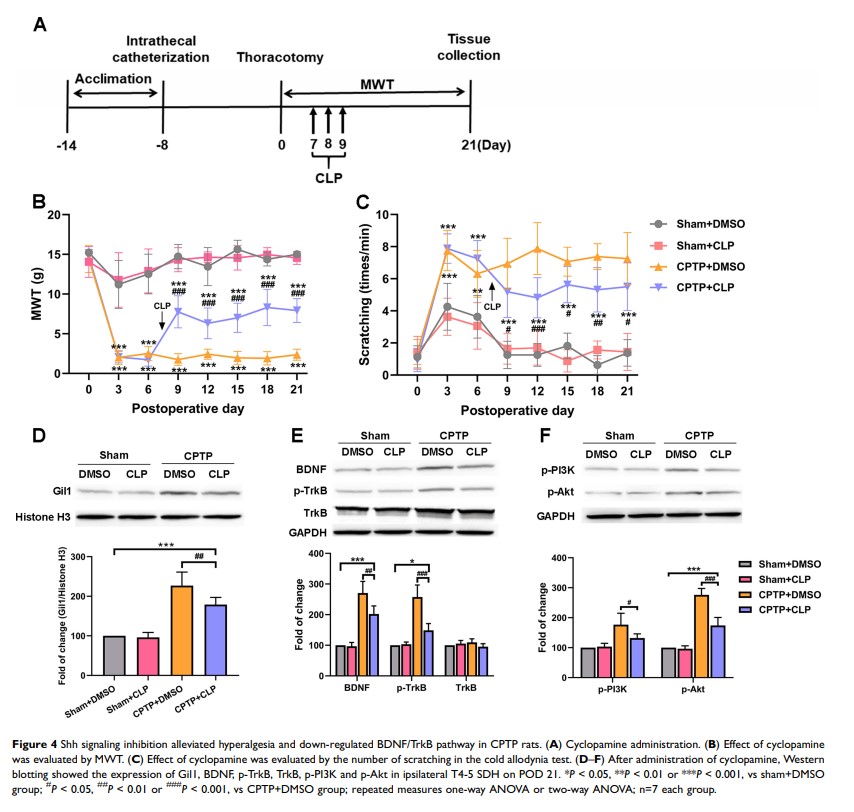
Results: The expression of Shh signaling significantly increased and the BDNF/TrkB pathway was activated in T4-5 SDH of CPTP rats. Cyclopamine attenuated hyperalgesia and down-regulated the expressions of Gil1, BDNF, p-TrkB, p-PI3K and p-Akt in CPTP rats. SAG induced hyperalgesia in non-CPTP rats and elevated the expressions of Gil1, BDNF, p-TrkB, p-PI3K and p-Akt.
Conclusion: Shh signaling may contribute to CPTP via activating BDNF/TrkB signaling pathway, and inhibition of Shh signaling may effectively alleviate CPTP.
Keywords: sonic hedgehog, chronic post-thoracotomy pain, brain-derived neurotrophic factor, spinal cord dorsal horn, PI3K, Akt