115195
论文已发表
注册即可获取德孚的最新动态
IF 收录期刊
- 3.6 Breast Cancer (Dove Med Press)
- 4.3 Clin Epidemiol
- 2.6 Cancer Manag Res
- 3.2 Infect Drug Resist
- 4.1 Clin Interv Aging
- 6.1 Drug Des Dev Ther
- 4.1 Int J Chronic Obstr
- 8.7 Int J Nanomed
- 2.5 Int J Women's Health
- 3.2 Neuropsych Dis Treat
- 2.4 OncoTargets Ther
- 2.6 Patient Prefer Adher
- 2.6 Ther Clin Risk Manag
- 3.1 J Pain Res
- 3.5 Diabet Metab Synd Ob
- 4.5 Psychol Res Behav Ma
- 3.4 Nat Sci Sleep
- 2.4 Pharmgenomics Pers Med
- 2.6 Risk Manag Healthc Policy
- 4.6 J Inflamm Res
- 2.3 Int J Gen Med
- 3.9 J Hepatocell Carcinoma
- 3.3 J Asthma Allergy
- 2.5 Clin Cosmet Investig Dermatol
- 3.0 J Multidiscip Healthc

棘白菌素类药物与两性霉素 B 用于治疗患有嗜中性白血球低下症的成人血液病人的热带假丝酵母菌菌血症的比较:一项多中心回顾性队列研究
Authors You L, Yao C, Yang F, Yang Q, Lan J, Song X, Shen J, Sheng X, Chen X, Tang H, Jiang H, Wu H, Qian S, Meng H
Received 18 April 2020
Accepted for publication 25 June 2020
Published 10 July 2020 Volume 2020:13 Pages 2229—2235
DOI https://doi.org/10.2147/IDR.S258744
Checked for plagiarism Yes
Review by Single-blind
Peer reviewer comments 3
Editor who approved publication: Professor Suresh Antony
Background: Candida tropicalis is the most common non-albicans Candida species identified in immunocompromised patients, which often appears with high mortality. However, data on the outcomes of treatment for Candida tropicalis fungemia in patients with neutropenia remain limited.
Methods: In the present study, 90 neutropenic adult patients with proven Candida tropicalis fungemia, who received initial antifungal therapy, were retrospectively analyzed.
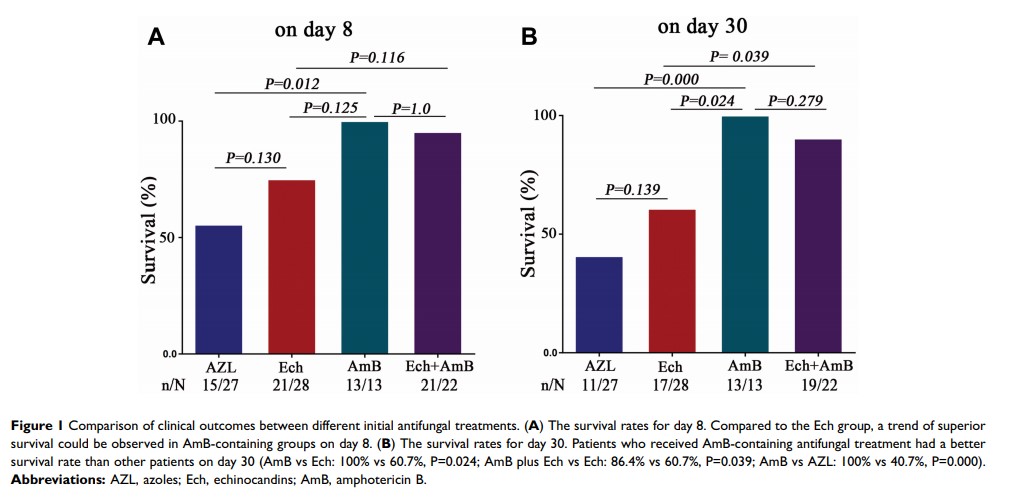
Results: These results revealed that the overall 8-day and 30-day mortality among patients in the entire data set were 22.2% and 33.3%, respectively. However, there was no significant difference between the survival and death group, in terms of baseline characteristics. The univariate analysis of risk factors identified the treatment with azole as a predictor of mortality, while treatments that containing amphotericin B were associated with reduced mortality. In addition, the survival rate on day 30 was observed in 60.7% (17/28) of patients who were initially treated with echinocandins, while this was observed in 86.4% (19/22, P= 0.039) and 100% (13/13, P= 0.024) of patients treated with amphotericin B plus echinocandins and amphotericin B, respectively.
Conclusion: These data indicate for the first time that the initial therapy with amphotericin B-based agents was associated with a better survival rate and could be assessed as the optimal strategy for the treatment of Candida tropicalis fungemia in patients with neutropenia.
Keywords: Candida tropicalis , candidemia, hematological malignancy, neutropenia, amphotericin B, echinocandins