115195
论文已发表
注册即可获取德孚的最新动态
IF 收录期刊
- 3.6 Breast Cancer (Dove Med Press)
- 4.3 Clin Epidemiol
- 2.6 Cancer Manag Res
- 3.2 Infect Drug Resist
- 4.1 Clin Interv Aging
- 6.1 Drug Des Dev Ther
- 4.1 Int J Chronic Obstr
- 8.7 Int J Nanomed
- 2.5 Int J Women's Health
- 3.2 Neuropsych Dis Treat
- 2.4 OncoTargets Ther
- 2.6 Patient Prefer Adher
- 2.6 Ther Clin Risk Manag
- 3.1 J Pain Res
- 3.5 Diabet Metab Synd Ob
- 4.5 Psychol Res Behav Ma
- 3.4 Nat Sci Sleep
- 2.4 Pharmgenomics Pers Med
- 2.6 Risk Manag Healthc Policy
- 4.6 J Inflamm Res
- 2.3 Int J Gen Med
- 3.9 J Hepatocell Carcinoma
- 3.3 J Asthma Allergy
- 2.5 Clin Cosmet Investig Dermatol
- 3.0 J Multidiscip Healthc

稳定期重度慢性阻塞性肺疾病患者中 n-6 和 n-3 多不饱和脂肪酸代谢物与营养水平的关联性研究
Authors Xue M, Cai C, Guan L, Xu Y, Lin J, Zeng Y, Hu H, Chen R, Wang H, Zhou L, Sun B
Received 11 January 2020
Accepted for publication 30 April 2020
Published 10 July 2020 Volume 2020:15 Pages 1633—1642
DOI https://doi.org/10.2147/COPD.S245617
Checked for plagiarism Yes
Review by Single-blind
Peer reviewer comments 2
Editor who approved publication: Prof. Dr. Chunxue Bai
Background and Objective: Severe chronic obstructive pulmonary disease (COPD) is the terminal stage of the disease characterized by declined lung function, malnutrition, and poor prognosis. Such patients cannot tolerate long-time sports rehabilitation owing to dyspnea and fail to achieve the desired therapeutic effect; therefore, increasing nutritional support will be an important strategy for them. The present study applied metabolomics technology to evaluate the correlation between serum concentrations of polyunsaturated fatty acid (PUFA) metabolites, nutritional status, and lung function in patients with COPD to provide a theoretical basis for accurate nutritional support.
Materials and Methods: We enrolled 82 patients with stable severe COPD in our hospital. The general characteristics including height, weight, and lung function were recorded. Metabolomics was used to detect the concentrations of serum metabolites of n-3 and n-6 at baseline and at 24 and 52 weeks after enrollment. The correlations between nutrition level and pulmonary function and clinical indicators were evaluated.
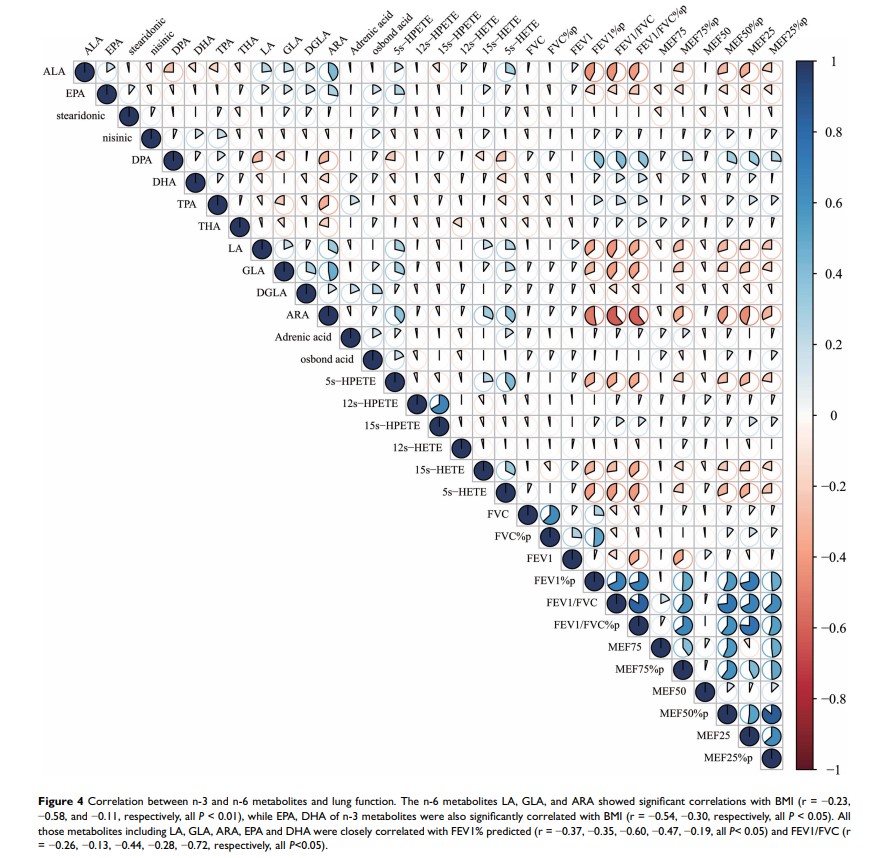
Results: The concentrations of n-3 and n-6 increased over time along with the progression of COPD. Body mass index (BMI) and percent of ideal body weight (IBW%) decreased with disease development, and BMI was found to be significantly correlated with FEV1% predicted and FEV1/FVC. Serum levels of n-6 metabolites such as linoleic acid (LA), γ-linoleic acid (GLA), and arachidonic acid (ARA) (all P < 0.01) and the n-3 metabolites such as eicosapentaenoic acid (EPA) and docosahexaenoic acid (DHA) (all P < 0.05) showed significant correlations with BMI and were closely correlated with FEV1% predicted and FEV1/FVC of lung function (all P < 0.05).
Conclusion: This study demonstrates that malnutrition in patients with severe COPD is progressive and is positively correlated with n-3 and n-6 polyunsaturated fatty acids and lung function.
Keywords: chronic obstructive pulmonary disease, metabolomics, nutritional level