115195
论文已发表
注册即可获取德孚的最新动态
IF 收录期刊
- 3.6 Breast Cancer (Dove Med Press)
- 4.3 Clin Epidemiol
- 2.6 Cancer Manag Res
- 3.2 Infect Drug Resist
- 4.1 Clin Interv Aging
- 6.1 Drug Des Dev Ther
- 4.1 Int J Chronic Obstr
- 8.7 Int J Nanomed
- 2.5 Int J Women's Health
- 3.2 Neuropsych Dis Treat
- 2.4 OncoTargets Ther
- 2.6 Patient Prefer Adher
- 2.6 Ther Clin Risk Manag
- 3.1 J Pain Res
- 3.5 Diabet Metab Synd Ob
- 4.5 Psychol Res Behav Ma
- 3.4 Nat Sci Sleep
- 2.4 Pharmgenomics Pers Med
- 2.6 Risk Manag Healthc Policy
- 4.6 J Inflamm Res
- 2.3 Int J Gen Med
- 3.9 J Hepatocell Carcinoma
- 3.3 J Asthma Allergy
- 2.5 Clin Cosmet Investig Dermatol
- 3.0 J Multidiscip Healthc

在咳嗽超过两周的人当中,与追求健康的偏好相关的因素:中国东南部的一项横断面研究
Authors Wang W, Wang F, Peng Y, Liu K, Chen X, Chai C, Wang X, Chen B
Received 10 April 2020
Accepted for publication 19 June 2020
Published 12 July 2020 Volume 2020:14 Pages 1173—1183
DOI https://doi.org/10.2147/PPA.S257722
Checked for plagiarism Yes
Review by Single-blind
Peer reviewer comments 2
Editor who approved publication: Dr Naifeng Liu
Background: The health-seeking preference of people with a cough > 2 weeks had not been extensively researched in southeast China. The study aimed to explore factors associated with health-seeking preference, which could provide more evidence to improve individuals’ appropriate health-seeking behavior.
Materials and Methods: From October 2018 to December 2018, this cross-sectional study was conducted in Zhejiang, China. A questionnaire was used to collect information on sociodemographic characteristics, knowledge of tuberculosis (TB), and health-seeking preference. The chi-square test and multivariable logistic regression were performed to evaluate factors associated with health-seeking preference.
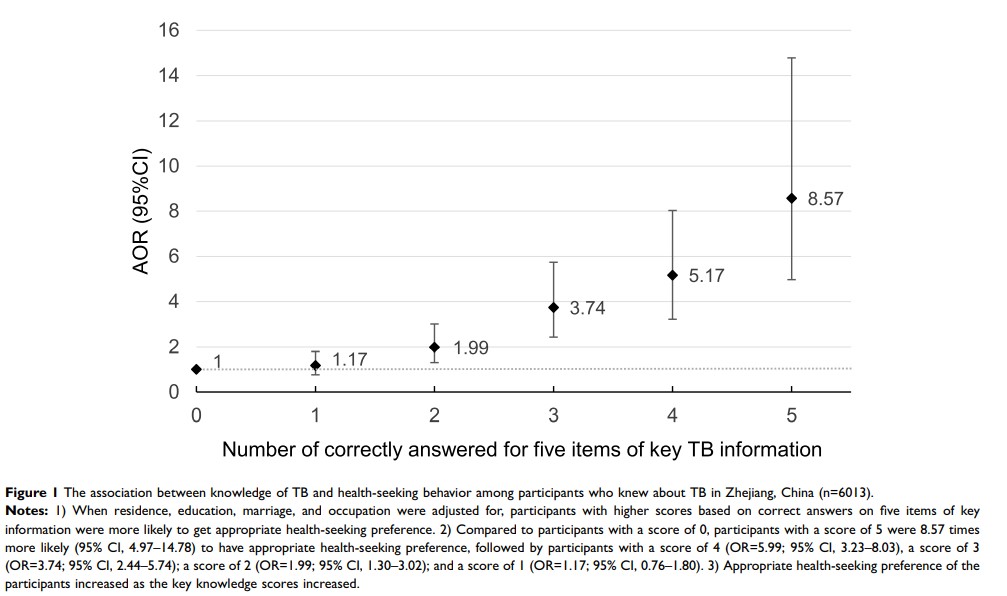
Results: Of the 7174 participants, 3321 (46.3%) were men, 6148 (85.7%) were married, and 6013 (83.8%) knew about TB. Appropriate health-seeking preference was reported by 6229 (86.8%) participants. Respondents knowing about TB were more likely to seek appropriate care than those did not (89.6% vs 72.4%, p< 0.001). Of the 6013 participants knowing about TB, respondents with higher scores on five key items of TB knowledge were more likely to get appropriate health-seeking preference. About 805 (96.6%) participants with 5 scores on TB knowledge had appropriate care preference. Only 97 (72.4%) participants with a score of 0 reported an appropriate preference. Multivariable logistic regression showed residence, marital status, education level, occupation, and awareness of TB knowledge were predictors of appropriate health-seeking preference. Compared to participants with a score of 0 on five TB key knowledge, participants with a score of 5 were 8.57 times more likely to have appropriate health-seeking preference (95% confidence interval [CI]: 4.97– 14.78), followed by a score of 4 (odds ratio [OR]=5.99, 95% CI, 3.23– 8.03); 3 (OR=3.74, 95% CI, 2.44– 5.74); 2 (OR=1.99, 95% CI, 1.30– 3.02) and 1 (OR=1.17, 95% CI, 0.76– 1.80).
Conclusion: Participants with little knowledge of TB had a low level of appropriate health-seeking preference. Appropriate health-seeking preference of the participants improved with increased key knowledge level of TB.
Keywords: tuberculosis, health care-seeking behavior, cough