115195
论文已发表
注册即可获取德孚的最新动态
IF 收录期刊
- 3.6 Breast Cancer (Dove Med Press)
- 4.3 Clin Epidemiol
- 2.6 Cancer Manag Res
- 3.2 Infect Drug Resist
- 4.1 Clin Interv Aging
- 6.1 Drug Des Dev Ther
- 4.1 Int J Chronic Obstr
- 8.7 Int J Nanomed
- 2.5 Int J Women's Health
- 3.2 Neuropsych Dis Treat
- 2.4 OncoTargets Ther
- 2.6 Patient Prefer Adher
- 2.6 Ther Clin Risk Manag
- 3.1 J Pain Res
- 3.5 Diabet Metab Synd Ob
- 4.5 Psychol Res Behav Ma
- 3.4 Nat Sci Sleep
- 2.4 Pharmgenomics Pers Med
- 2.6 Risk Manag Healthc Policy
- 4.6 J Inflamm Res
- 2.3 Int J Gen Med
- 3.9 J Hepatocell Carcinoma
- 3.3 J Asthma Allergy
- 2.5 Clin Cosmet Investig Dermatol
- 3.0 J Multidiscip Healthc

具有不同水平的氟喹诺酮敏感性的志贺氏菌分离株中 GyrA 突变表达谱和质粒介导的喹诺酮抗性基因
Received 11 April 2020
Accepted for publication 25 June 2020
Published 12 July 2020 Volume 2020:13 Pages 2285—2290
DOI https://doi.org/10.2147/IDR.S257877
Checked for plagiarism Yes
Review by Single-blind
Peer reviewer comments 2
Editor who approved publication: Professor Suresh Antony
Purpose: Fluoroquinolone-resistant Shigella is considered a serious public health problem and has been put on the WHO global priority list of antibiotic-resistant bacteria. This study was aimed to investigate the fluoroquinolone resistance in Shigella and its relevant genetic mechanisms.
Materials and Methods: Shigella isolates that were isolated from diarrheal patient’s feces in Ningbo China from 2011 to 2018 were tested for susceptibility to ampicillin, gentamicin, tetracycline, nalidixic acid, ciprofloxacin, and cefotaxime. Genes related to quinolone resistance were amplified by PCR.
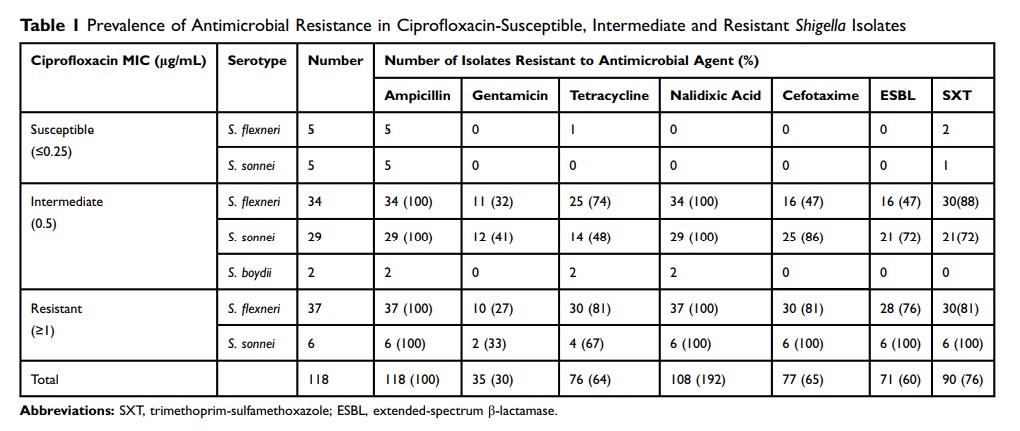
Results: A total of 118 Shigella isolates were collected, including 76 S. flexneri isolates, 40 S. sonnei isolates, and 2 S. boydii isolates. Ciprofloxacin susceptibility test identified 10 (9%) susceptible, 65 (55%) intermediate, and 43 (36%) resistant isolates. Of 76 S. flexneri isolates, 37 were ciprofloxacin resistant, a prevalence significantly higher than 6 of 40 S. sonnei isolates (P =0.01). The isolates collected during 2014– 2018 displayed a significant increase in the prevalence of ciprofloxacin resistance (P =0.05) than those collected during 2011– 2013. All the ciprofloxacin-intermediate and resistant isolates had mutations of gyrA (S83L) and parC (S80I), whereas only the ciprofloxacin-resistant isolates had gyrA (D87N) mutation and qnrB gene. Additionally, 30% of the ciprofloxacin-resistant isolates were positive for aac(6´)-Ib-cr gene.
Conclusion: This study shows the currently increasing prevalence of ciprofloxacin resistance. The reduced fluoroquinolone susceptibility is highly associated with gyrA (S83L) and parC (S80I) mutations, while the fluoroquinolone resistance is highly associated with gyrA (D87N) mutation, qnrB gene and perhaps aac(6´)-Ib-cr gene.
Keywords: Shigella , ciprofloxacin resistance, gyrA mutations, plasmid-mediated quinolone resistance, PMQR, quinolone resistance-determining region, QRDR