115195
论文已发表
注册即可获取德孚的最新动态
IF 收录期刊
- 3.6 Breast Cancer (Dove Med Press)
- 4.3 Clin Epidemiol
- 2.6 Cancer Manag Res
- 3.2 Infect Drug Resist
- 4.1 Clin Interv Aging
- 6.1 Drug Des Dev Ther
- 4.1 Int J Chronic Obstr
- 8.7 Int J Nanomed
- 2.5 Int J Women's Health
- 3.2 Neuropsych Dis Treat
- 2.4 OncoTargets Ther
- 2.6 Patient Prefer Adher
- 2.6 Ther Clin Risk Manag
- 3.1 J Pain Res
- 3.5 Diabet Metab Synd Ob
- 4.5 Psychol Res Behav Ma
- 3.4 Nat Sci Sleep
- 2.4 Pharmgenomics Pers Med
- 2.6 Risk Manag Healthc Policy
- 4.6 J Inflamm Res
- 2.3 Int J Gen Med
- 3.9 J Hepatocell Carcinoma
- 3.3 J Asthma Allergy
- 2.5 Clin Cosmet Investig Dermatol
- 3.0 J Multidiscip Healthc

通过下调 AMPK-PGC-1α-SIRT3 轴来抑制大鼠肌筋膜疼痛综合征骨骼肌模型中线粒体功能
Authors Ye L, Li M, Wang Z, Yang Z, Zhang J, Fang H, He Z, Wang X
Received 6 October 2019
Accepted for publication 23 May 2020
Published 13 July 2020 Volume 2020:13 Pages 1747—1756
DOI https://doi.org/10.2147/JPR.S233583
Checked for plagiarism Yes
Review by Single-blind
Peer reviewer comments 2
Editor who approved publication: Dr Michael A Überall
Purpose: The causative mechanisms triggering myofascial pain syndrome (MPS) are still in debate. It is becoming evident that mitochondrial dysfunction may regulate pathways controlling MPS. The aim of this study was to investigate whether AMPK-PGC-1α-SIRT3 axis is associated with depression of mitochondrial function in the rat MPS model.
Methods: A total of 32 Sprague–Dawley rats were randomly divided into control group and experimental group. The expression level of mRNA and protein of gastrocnemius medialis (GM) was analyzed by Western blot and RT-PCR. The histopathological findings were investigated through electron microscopes in GM of all groups.
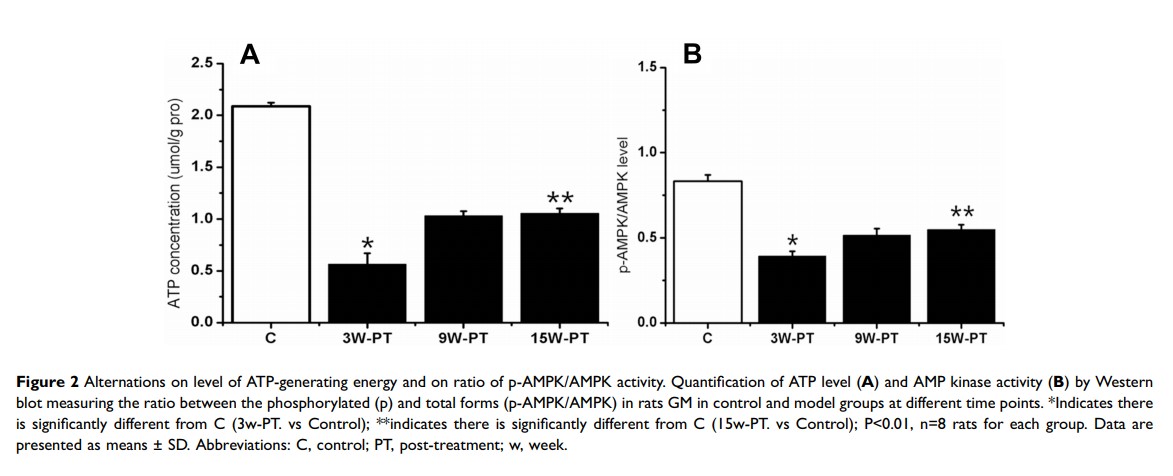
Results: Our results showed that MPS induces continuous depression of mitochondrial biogenesis and function via down-regulation of PGC-1α-SIRT3 axis accompanying with ATP fuel crisis as compared to control group. However, the expression level of SIRT3 mRNA did not change. Additionally, a correlated reduction of the mRNA and protein expression level of NRF-1 and TFAM, known as the downstream target of PGC-1α, suggesting further transcription of nuclear genes encoding mitochondria functional proteins for promoting mitochondria proliferation, oxidative phosphorylation and energy production is continuously depressed. Furthermore, phosphorylation extent of AMPK is also declined following MPS, and it is negatively correlated with reduction of ATP generation, suggesting that the complex network involves different inhibition in transcription, post-translational modification and a plethora of other effectors that mediate the inhibition roles.
Conclusion: We here suggested that the down-regulation in AMPK-PGC-1α-SIRT3 axis network may be the basis for the association between mitochondrial dysfunction and MPS, where a vicious circle further aggravates the disease symptoms with ongoing ATP energy crisis.
Keywords: myofascial pain syndrome, mitochondrial biogenesis, myofascial trigger points, PGC-1α, ATP crisis, gastrocnemius medialis muscle