115195
论文已发表
注册即可获取德孚的最新动态
IF 收录期刊
- 3.6 Breast Cancer (Dove Med Press)
- 4.3 Clin Epidemiol
- 2.6 Cancer Manag Res
- 3.2 Infect Drug Resist
- 4.1 Clin Interv Aging
- 6.1 Drug Des Dev Ther
- 4.1 Int J Chronic Obstr
- 8.7 Int J Nanomed
- 2.5 Int J Women's Health
- 3.2 Neuropsych Dis Treat
- 2.4 OncoTargets Ther
- 2.6 Patient Prefer Adher
- 2.6 Ther Clin Risk Manag
- 3.1 J Pain Res
- 3.5 Diabet Metab Synd Ob
- 4.5 Psychol Res Behav Ma
- 3.4 Nat Sci Sleep
- 2.4 Pharmgenomics Pers Med
- 2.6 Risk Manag Healthc Policy
- 4.6 J Inflamm Res
- 2.3 Int J Gen Med
- 3.9 J Hepatocell Carcinoma
- 3.3 J Asthma Allergy
- 2.5 Clin Cosmet Investig Dermatol
- 3.0 J Multidiscip Healthc

昂丹司琼的过早或过晚静脉注射是否会影响苯肾上腺素的剂量,用以防止剖腹产脊髓麻醉引起的低血压?
Authors Qian J, Liu L, Zheng X, Xiao F
Received 12 April 2020
Accepted for publication 23 June 2020
Published 16 July 2020 Volume 2020:14 Pages 2789—2795
DOI https://doi.org/10.2147/DDDT.S257880
Checked for plagiarism Yes
Review by Single-blind
Peer reviewer comments 2
Editor who approved publication: Professor Manfred Ogris
Background: There was controversy about ondansetron can reduce the incidence of spinal-induced hypotension and decrease the consumption of vasopressor in cesarean delivery with spinal anesthesia. We hypothesized that different timing of ondansetron administration may contribute to the controversy. Therefore, we aimed to determine the effect of different timing of ondansetron administration on the dose requirement of preventing phenylephrine via comparing the ED50 of prophylactic phenylephrine.
Methods: Seventy-five parturients were finally enrolled in this prospective, randomized, double-blinded dose finding study. Ondansetron or placebo was administered 5 min or 15 min before intrathecal injection. Up-down allocation method was used to determine the dose of prophylactic phenylephrine for each parturient in the three groups. The initial infusion rate of first patient was 0.5 μg/kg/min. Then, the rate for next patient was varied with increasing or decreasing of 0.05 μg/kg/min according to the response of the previous patient. An effective dose was defined as no hypotension occurred during the study period. An ineffective dose was defined as hypotension occurred during the study period. Study period in this study is from intrathecal injection to neonatal delivery. ED50 of phenylephrine infusion was calculated by probit regression.
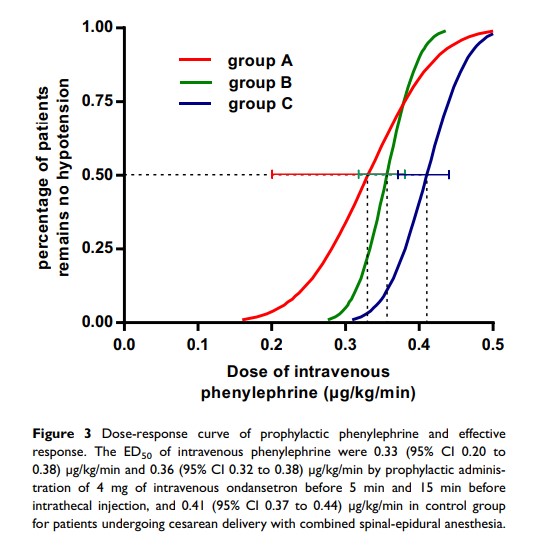
Results: The ED50 of intravenous phenylephrine calculated by probit analysis was 0.33 (95% CI 0.20 to 0.38) μg/kg/min and 0.36 (95% CI 0.32 to 0.38) μg/kg/min in group A and B, and 0.41 (95% CI 0.37 to 0.44) μg/kg/min in group C for patients undergoing cesarean delivery with combined spinal-epidural anesthesia.
Conclusion: An earlier administration of 4 mg prophylactic ondansetron contributed no benefits for lowing the dose of prophylactic phenylephrine compared to a late administration, but can decrease the dose of preventing phenylephrine in patients undergoing cesarean delivery with combined spinal-epidural anesthesia. This finding may be useful for clinical practice and further studies.
Keywords: ondansetron, phenylephrine, cesarean delivery, spinal anesthesia, hypotension