115195
论文已发表
注册即可获取德孚的最新动态
IF 收录期刊
- 3.6 Breast Cancer (Dove Med Press)
- 4.3 Clin Epidemiol
- 2.6 Cancer Manag Res
- 3.2 Infect Drug Resist
- 4.1 Clin Interv Aging
- 6.1 Drug Des Dev Ther
- 4.1 Int J Chronic Obstr
- 8.7 Int J Nanomed
- 2.5 Int J Women's Health
- 3.2 Neuropsych Dis Treat
- 2.4 OncoTargets Ther
- 2.6 Patient Prefer Adher
- 2.6 Ther Clin Risk Manag
- 3.1 J Pain Res
- 3.5 Diabet Metab Synd Ob
- 4.5 Psychol Res Behav Ma
- 3.4 Nat Sci Sleep
- 2.4 Pharmgenomics Pers Med
- 2.6 Risk Manag Healthc Policy
- 4.6 J Inflamm Res
- 2.3 Int J Gen Med
- 3.9 J Hepatocell Carcinoma
- 3.3 J Asthma Allergy
- 2.5 Clin Cosmet Investig Dermatol
- 3.0 J Multidiscip Healthc

甲状腺功能正常的糖尿病患者的甲状腺激素变化
Authors Qin K, Zhang F, Wu Q, Liu Z, Huang Y, Tan J, Zhou Y, An Z, Li S, Li S
Received 26 April 2020
Accepted for publication 23 June 2020
Published 16 July 2020 Volume 2020:13 Pages 2533—2540
DOI https://doi.org/10.2147/DMSO.S260039
Checked for plagiarism Yes
Review by Single-blind
Peer reviewer comments 4
Editor who approved publication: Dr Konstantinos Tziomalos
Background: Thyroid dysfunction is associated with diabetes, but it is unclear if the thyroid hormone levels change in euthyroid adults with diabetes.
Objective: To investigate the association between thyroid hormone levels and diabetes in euthyroid adults.
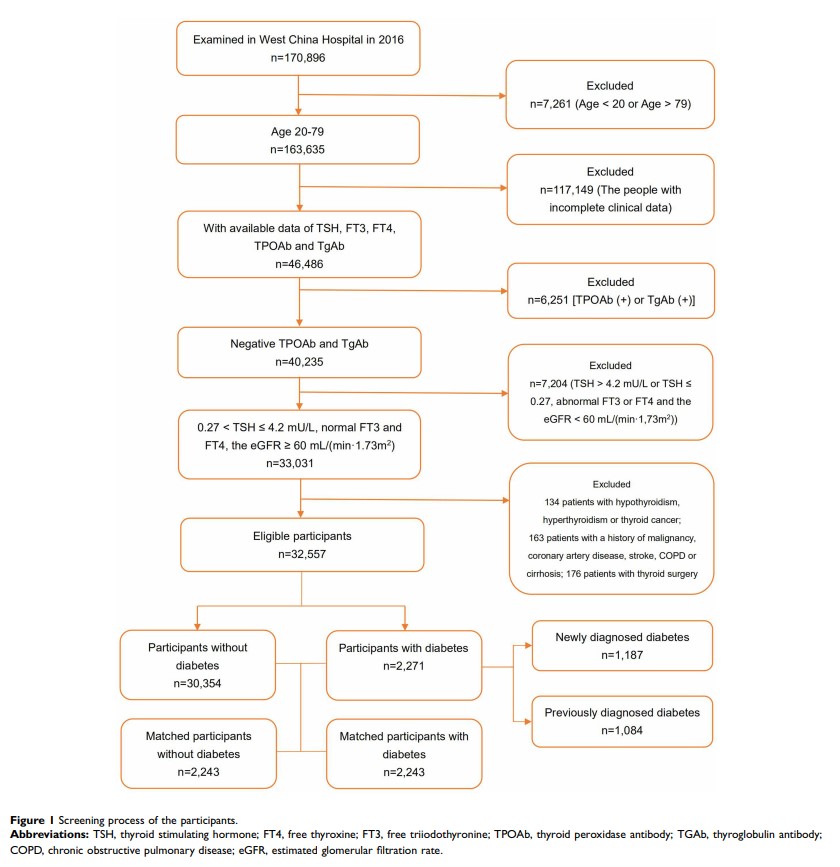
Methods: Among the euthyroid adults who underwent health examination in West China Hospital of Sichuan University in 2016, patients with diabetes were identified according to the medical history, fasting blood glucose and HbA1c. Age and sex matched controls were identified from the population. The patients with diabetes group was further divided into two subgroups: patients with newly diagnosed diabetes (NDD) and with previously diagnosed diabetes (PDD). Independent t-test and multivariate logistic regression models were used to investigate the difference in the levels of thyroid stimulating hormone (TSH), free thyroxine (FT4), free triiodothyronine (FT3) and the ratio of FT4/FT3 between groups.
Results: We included 32,557 participants, 2,271 with diabetes. Compared to the adults without diabetes, the odds ratios (ORs) per one unit elevation of TSH, FT4, FT4/FT3 ratio and FT3 in patients with diabetes were 0.88 [95% confidence interval (CI): 0.82– 0.95], 1.11 (95% CI: 1.08– 1.14), 2.05 (95% CI: 1.81– 2.32) and 0.85 (95% CI: 0.78– 0.93), respectively. Compared to the NDD group, the ORs per one unit elevation of TSH, FT4, FT4/FT3 ratio and FT3 of the PDD group were 0.81 (95% CI: 0.71– 0.92), 1.08 (95% CI: 1.04– 1.12), 1.76 (95% CI: 1.49– 2.08) and 1.01 (95% CI: 0.92– 1.12), respectively.
Conclusion: In euthyroid adults, diabetes was associated with increased FT4/FT3 ratio, which is linked to the peripheral turnover of the thyroid hormones.
Keywords: diabetes mellitus, thyroid hormones, triiodothyronine, thyroxine