115195
论文已发表
注册即可获取德孚的最新动态
IF 收录期刊
- 3.6 Breast Cancer (Dove Med Press)
- 4.3 Clin Epidemiol
- 2.6 Cancer Manag Res
- 3.2 Infect Drug Resist
- 4.1 Clin Interv Aging
- 6.1 Drug Des Dev Ther
- 4.1 Int J Chronic Obstr
- 8.7 Int J Nanomed
- 2.5 Int J Women's Health
- 3.2 Neuropsych Dis Treat
- 2.4 OncoTargets Ther
- 2.6 Patient Prefer Adher
- 2.6 Ther Clin Risk Manag
- 3.1 J Pain Res
- 3.5 Diabet Metab Synd Ob
- 4.5 Psychol Res Behav Ma
- 3.4 Nat Sci Sleep
- 2.4 Pharmgenomics Pers Med
- 2.6 Risk Manag Healthc Policy
- 4.6 J Inflamm Res
- 2.3 Int J Gen Med
- 3.9 J Hepatocell Carcinoma
- 3.3 J Asthma Allergy
- 2.5 Clin Cosmet Investig Dermatol
- 3.0 J Multidiscip Healthc

在吗啡耐受大鼠小胶质细胞活化过程中脊髓 PDGFRβ 和 μ 阿片受体之间的相互作用
Authors Li Z, Jia X, Peng X, Gao F
Received 24 March 2020
Accepted for publication 7 July 2020
Published 17 July 2020 Volume 2020:13 Pages 1803—1810
DOI https://doi.org/10.2147/JPR.S255221
Checked for plagiarism Yes
Review by Single-blind
Peer reviewer comments 2
Editor who approved publication: Dr Michael A Überall
Purpose: Opioid tolerance remains a challenging problem, which limits prolonged drug usage in clinics. Previous studies have shown a fundamental role of platelet-derived growth factor receptor β submit (PDGFRβ) in morphine tolerance. The aim of this study was to investigate the mechanisms of spinal PDGFRβ activation in morphine tolerance.
Methods: Rats were treated with morphine for 7 days and the effect of drug was evaluated by tail-flick latency test. By using Western blot and real-time PCR, the interaction between μ opioid receptor (MOR) and PDGFRβ in microglia activation, as well as related signaling pathways during morphine tolerance were investigated.
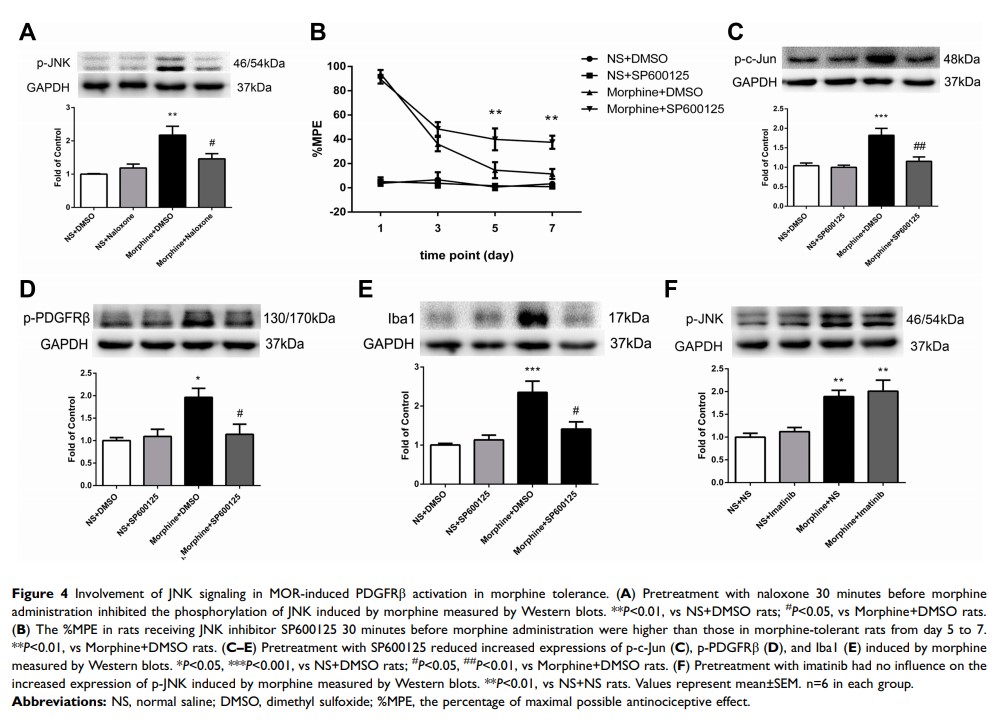
Results: Chronic PDGFRβ agonist could induce microglia activation in spinal cord and decrease the analgesic effect of morphine. PDGFRβ inhibitor suppressed microglia activation during the development of morphine tolerance. Furthermore, antagonizing MOR could effectively inhibit the phosphorylations of PDGFRβ and JNK. Blocking PDGFRβ had no influence on JNK signaling, while JNK inhibitor could decrease the phosphorylation of PDGFRβ.
Conclusion: These results provide direct evidence that repeatedly activating MOR by morphine could induce the transactivation of PDGFRβ via JNK MAPK in spinal cord, which leads to microglia activation during the development of morphine tolerance.
Keywords: mu opioid receptor, platelet-derived growth factor receptor β, microglia, JNK signaling, morphine tolerance