115195
论文已发表
注册即可获取德孚的最新动态
IF 收录期刊
- 3.6 Breast Cancer (Dove Med Press)
- 4.3 Clin Epidemiol
- 2.6 Cancer Manag Res
- 3.2 Infect Drug Resist
- 4.1 Clin Interv Aging
- 6.1 Drug Des Dev Ther
- 4.1 Int J Chronic Obstr
- 8.7 Int J Nanomed
- 2.5 Int J Women's Health
- 3.2 Neuropsych Dis Treat
- 2.4 OncoTargets Ther
- 2.6 Patient Prefer Adher
- 2.6 Ther Clin Risk Manag
- 3.1 J Pain Res
- 3.5 Diabet Metab Synd Ob
- 4.5 Psychol Res Behav Ma
- 3.4 Nat Sci Sleep
- 2.4 Pharmgenomics Pers Med
- 2.6 Risk Manag Healthc Policy
- 4.6 J Inflamm Res
- 2.3 Int J Gen Med
- 3.9 J Hepatocell Carcinoma
- 3.3 J Asthma Allergy
- 2.5 Clin Cosmet Investig Dermatol
- 3.0 J Multidiscip Healthc

海棠叶黄酮类化合物通过调节 IL-17 信号通路对 C57BL/6J 小鼠食道癌的预防作用
Authors Jia XB, Zhang Q, Xu L, Yao WJ, Wei L
Received 3 May 2020
Accepted for publication 26 June 2020
Published 17 July 2020 Volume 2020:13 Pages 6987—6996
DOI https://doi.org/10.2147/OTT.S261033
Checked for plagiarism Yes
Review by Single-blind
Peer reviewer comments 2
Editor who approved publication: Prof. Dr. Takuya Aoki
Background: The aim of this study was to observe the preventive effect of flavonoids extracted from Malus asiatica Nakai leaves (FMANL) on esophageal cancer in mice, especially the ability of FMANL to regulate the interleukin 17 (IL-17) signaling pathway during this process.
Materials and Methods: The C57BL/6J mice were treated with 4-nitroquinoline N-oxide (4NQO) to induce esophageal cancer, and the visceral tissue index and the serum and esophageal tissue indexes of mice were used to verify the effect of FMANL.
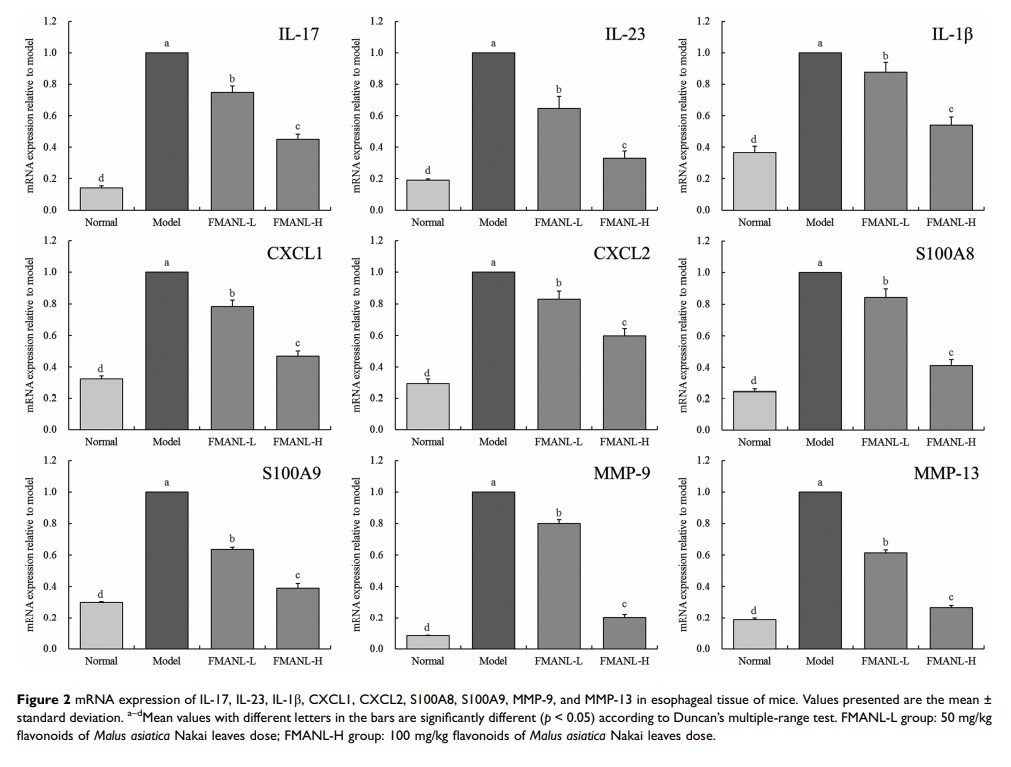
Results: The experimental results showed that FMANL can effectively control the changes in visceral tissue caused by esophageal cancer. FMANL could increase the cytokine levels of interleukin 10 (IL-10), monocyte chemotactic protein 1 (MCP-1) and decrease the cytokine levels of tumor necrosis factor alpha (TNF-α), interferon-γ (IFN-γ), interleukin 6 (IL-6), and interleukin 12p70 (IL-12p70) in serum of mice with esophageal cancer. FMANL could also reduce CD3+, CD4+, and CD8+ and enhance CD19+ mouse peripheral blood lymphocytes. The results of qPCR and Western blot analysis showed that FMANL could down-regulate the mRNA and protein expression levels of IL-17, interleukin 23 (IL-23), interleukin 1 beta (IL-1β), chemokine (C-X-C) ligand 1 (CXCL1), chemokine (C-X-C) ligand 2 (CXCL2), S100 calcium-binding protein A8 (S100A8), S100 calcium-binding protein A9 (S100A9), matrix metalloprotein 9 (MMP-9), and matrix metalloprotein 13 (MMP-1) in mice with esophageal cancer. High-performance liquid chromatography (HPLC) detection showed that FMANL contained 10 chemicals, including rutin, hyperoside, isoquercitrin, dihydroquercetin, quercitrin, hesperidin, myricetin, baicalin, neohesperidin dihydrochalcone, and quercetin.
Conclusion: It could be concluded that FMANL can effectively prevent experimentally induced esophageal cancer in mice, and its effects might be obtained from 10 compounds present in FMANL.
Keywords: Malus asiatica Nakai leaves, flavonoid, esophageal cancer, C57BL/6J mice, mRNA IL-17 signaling pathway