115195
论文已发表
注册即可获取德孚的最新动态
IF 收录期刊
- 3.6 Breast Cancer (Dove Med Press)
- 4.3 Clin Epidemiol
- 2.6 Cancer Manag Res
- 3.2 Infect Drug Resist
- 4.1 Clin Interv Aging
- 6.1 Drug Des Dev Ther
- 4.1 Int J Chronic Obstr
- 8.7 Int J Nanomed
- 2.5 Int J Women's Health
- 3.2 Neuropsych Dis Treat
- 2.4 OncoTargets Ther
- 2.6 Patient Prefer Adher
- 2.6 Ther Clin Risk Manag
- 3.1 J Pain Res
- 3.5 Diabet Metab Synd Ob
- 4.5 Psychol Res Behav Ma
- 3.4 Nat Sci Sleep
- 2.4 Pharmgenomics Pers Med
- 2.6 Risk Manag Healthc Policy
- 4.6 J Inflamm Res
- 2.3 Int J Gen Med
- 3.9 J Hepatocell Carcinoma
- 3.3 J Asthma Allergy
- 2.5 Clin Cosmet Investig Dermatol
- 3.0 J Multidiscip Healthc

人工神经网络模型用于乙型肝炎病毒相关肝细胞癌患者的肝硬化诊断
Authors Mai R, Zeng J, Mo Y, Liang R, Lin Y, Wu S, Piao X, Gao X, Wu G, Li L, Ye J
Received 8 April 2020
Accepted for publication 22 May 2020
Published 17 July 2020 Volume 2020:16 Pages 639—649
DOI https://doi.org/10.2147/TCRM.S257218
Checked for plagiarism Yes
Review by Single-blind
Peer reviewer comments 2
Editor who approved publication: Professor Deyun Wang
Background: Testing for the presence of liver cirrhosis (LC) is one of the most critical diagnostic and prognostic assessments for patients with hepatitis B virus (HBV)-related hepatocellular carcinoma (HCC). More non-invasive tools are needed to diagnose LC but the predictive abilities of current models are still inconclusive. This study aimed to develop and validate a novel and non-invasive artificial neural network (ANN) model for diagnosing LC in patients with HBV-related HCC using routine laboratory serological indicators.
Methods: A total of 1152 HBV-related HCC patients who underwent hepatectomy were included and randomly divided into the training set (n = 864, 75%) and validation set (n = 288, 25%). The ANN model was constructed from the training set using multivariate Logistic regression analysis and then verified in the validation set.
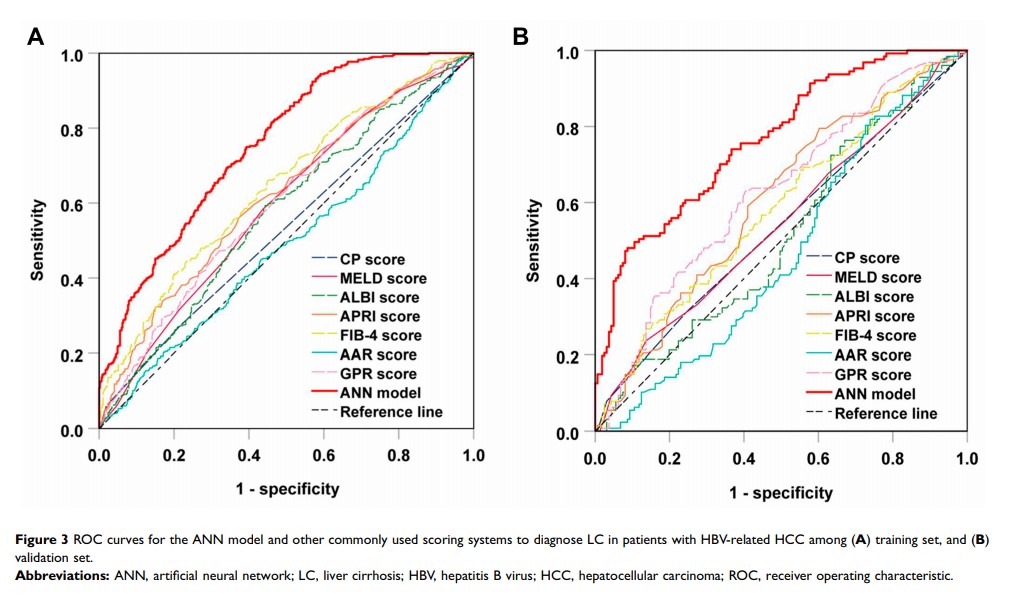
Results: The morbidity of LC in the training and validation sets was 41.2% and 46.8%, respectively. Multivariate analysis showed that age, platelet count, prothrombin time and total bilirubin were independent risk factors for LC (P < 0.05). The area under the ROC curve (AUC) analyses revealed that the ANN model had higher predictive accuracy than the Logistic model (ANN: 0.757 vs Logistic: 0.721; P < 0.001), and other scoring systems (ANN: 0.757 vs CP: 0.532, MELD: 0.594, ALBI: 0.575, APRI: 0.621, FIB-4: 0.644, AAR: 0.491, and GPR: 0.604; P < 0.05 for all) in diagnosing LC. Similar results were obtained in the validation set.
Conclusion: The ANN model has better diagnostic capabilities than other commonly used models and scoring systems in assessing LC risk in patients with HBV-related HCC.
Keywords: chronic hepatitis B, hepatocellular carcinoma, liver cirrhosis, serological indicators, non-invasive assessment, artificial neural network