115195
论文已发表
注册即可获取德孚的最新动态
IF 收录期刊
- 3.6 Breast Cancer (Dove Med Press)
- 4.3 Clin Epidemiol
- 2.6 Cancer Manag Res
- 3.2 Infect Drug Resist
- 4.1 Clin Interv Aging
- 6.1 Drug Des Dev Ther
- 4.1 Int J Chronic Obstr
- 8.7 Int J Nanomed
- 2.5 Int J Women's Health
- 3.2 Neuropsych Dis Treat
- 2.4 OncoTargets Ther
- 2.6 Patient Prefer Adher
- 2.6 Ther Clin Risk Manag
- 3.1 J Pain Res
- 3.5 Diabet Metab Synd Ob
- 4.5 Psychol Res Behav Ma
- 3.4 Nat Sci Sleep
- 2.4 Pharmgenomics Pers Med
- 2.6 Risk Manag Healthc Policy
- 4.6 J Inflamm Res
- 2.3 Int J Gen Med
- 3.9 J Hepatocell Carcinoma
- 3.3 J Asthma Allergy
- 2.5 Clin Cosmet Investig Dermatol
- 3.0 J Multidiscip Healthc

磁盘扩散法测试是中国临床实践中针对头孢菌素耐药淋病菌株的不适当筛选工具
Authors Han Y, Yin YP, Xu WQ, Zhu XY, Chen SC, Dai XQ, Yang LG, Zhu BY, Zhong N, Cao WL, Zhang XH, Wu ZZ, Yuan LF, Zheng ZJ, Liu J, Chen XS
Received 1 February 2020
Accepted for publication 16 June 2020
Published 20 July 2020 Volume 2020:13 Pages 2417—2423
DOI https://doi.org/10.2147/IDR.S248030
Checked for plagiarism Yes
Review by Single-blind
Peer reviewer comments 3
Editor who approved publication: Professor Suresh Antony
Purpose: Injectable ceftriaxone and oral cefixime are the last agents effective against Neisseria gonorrhoeae . In vitro antimicrobial-susceptibility testing (AST) is done to identify the most efficacious antibiotic needed to combat the infection in that particular individual. The objective of this study was to evaluate whether Kirby–Bauer (KB) disk-diffusion tests can detect N. gonorrhoeae isolates that have decreased susceptibility to ceftriaxone and cefixime for appropriate clinical management.
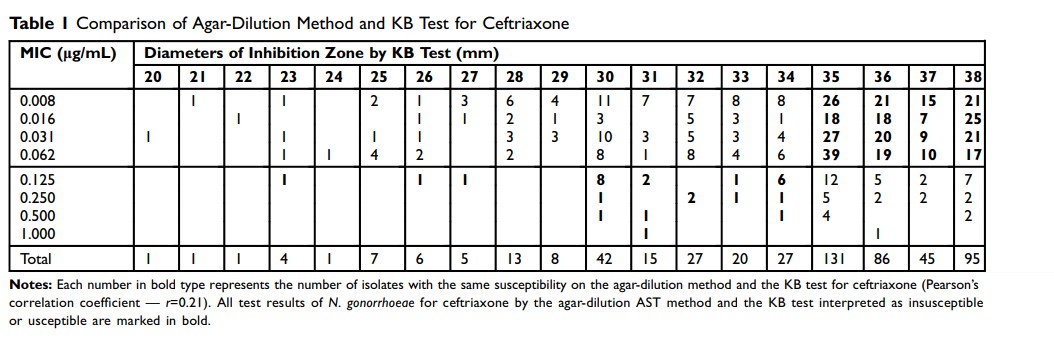
Methods: A total of 1,633 consecutive clinical isolates of N. gonorrhoeae were collected from January 1, 2013 to December 31, 2017 from seven dermatology clinics located in five provinces in China. Consistency between KB disk-diffusion tests and the agar-dilution method, as well as sensitivity of the KB test for detecting N. gonorrhoeae isolates with decreased susceptibility to ceftriaxone and cefixime, were determined using 1,306 clinical isolates that had been recovered to complete agar-dilution AST.
Results: The prevalence of isolates with decreased susceptibility to ceftriaxone and cefixime was 12.1% (198 of 1,633) and 12.7% (208 of 1,633), respectively, using KB disk-diffusion tests. The prevalence of isolates with decreased susceptibility was 9.9% (129 of 1,306) for ceftriaxone and 9.9% (129 of 1,305) for cefixime using agar-dilution AST. The categorical agreement of these two methods was 80.9% for both ceftriaxone and cefixime. Compared to agar-dilution AST, the sensitivity of the KB test for detecting N. gonorrhoeae isolates with decreased susceptibility was 22.5% (29 of 129) for ceftriaxone and 29.5% (38 of 129) for cefixime, and its specificity 87.3% (1,028 of 1,177) for ceftriaxone and 86.7% (1,018 of 1,176) for cefixime.
Conclusion: Although KB tests are easy to carry out in clinical practice, their ability to detect cephalosporin-resistant gonorrhoea strains is limited. This method is not an appropriate selection for screening cephalosporin-resistant gonorrhoea strains in clinical practice in China.
Keywords: Neisseria gonorrhoeae , Kirby–Bauer disk-diffusion tests, agar-dilution method, susceptibility, screen