115195
论文已发表
注册即可获取德孚的最新动态
IF 收录期刊
- 3.6 Breast Cancer (Dove Med Press)
- 4.3 Clin Epidemiol
- 2.6 Cancer Manag Res
- 3.2 Infect Drug Resist
- 4.1 Clin Interv Aging
- 6.1 Drug Des Dev Ther
- 4.1 Int J Chronic Obstr
- 8.7 Int J Nanomed
- 2.5 Int J Women's Health
- 3.2 Neuropsych Dis Treat
- 2.4 OncoTargets Ther
- 2.6 Patient Prefer Adher
- 2.6 Ther Clin Risk Manag
- 3.1 J Pain Res
- 3.5 Diabet Metab Synd Ob
- 4.5 Psychol Res Behav Ma
- 3.4 Nat Sci Sleep
- 2.4 Pharmgenomics Pers Med
- 2.6 Risk Manag Healthc Policy
- 4.6 J Inflamm Res
- 2.3 Int J Gen Med
- 3.9 J Hepatocell Carcinoma
- 3.3 J Asthma Allergy
- 2.5 Clin Cosmet Investig Dermatol
- 3.0 J Multidiscip Healthc

侵袭性念珠菌症的物种分布和抗真菌药敏性:2016-2017 年中国北京多中心监测研究
Authors Guo LN, Yu SY, Xiao M, Yang CX, Bao CM, Yu YH, Ye LY, Yang Y, Zhang G, Liu J, Liang GW, Min R, Zhu Y, Lei H, Liu YL, Liu LJ, Hu YJ, Hsueh PR, Xu YC
Received 7 April 2020
Accepted for publication 1 July 2020
Published 20 July 2020 Volume 2020:13 Pages 2443—2452
DOI https://doi.org/10.2147/IDR.S255843
Checked for plagiarism Yes
Review by Single-blind
Peer reviewer comments 2
Editor who approved publication: Dr Sahil Khanna
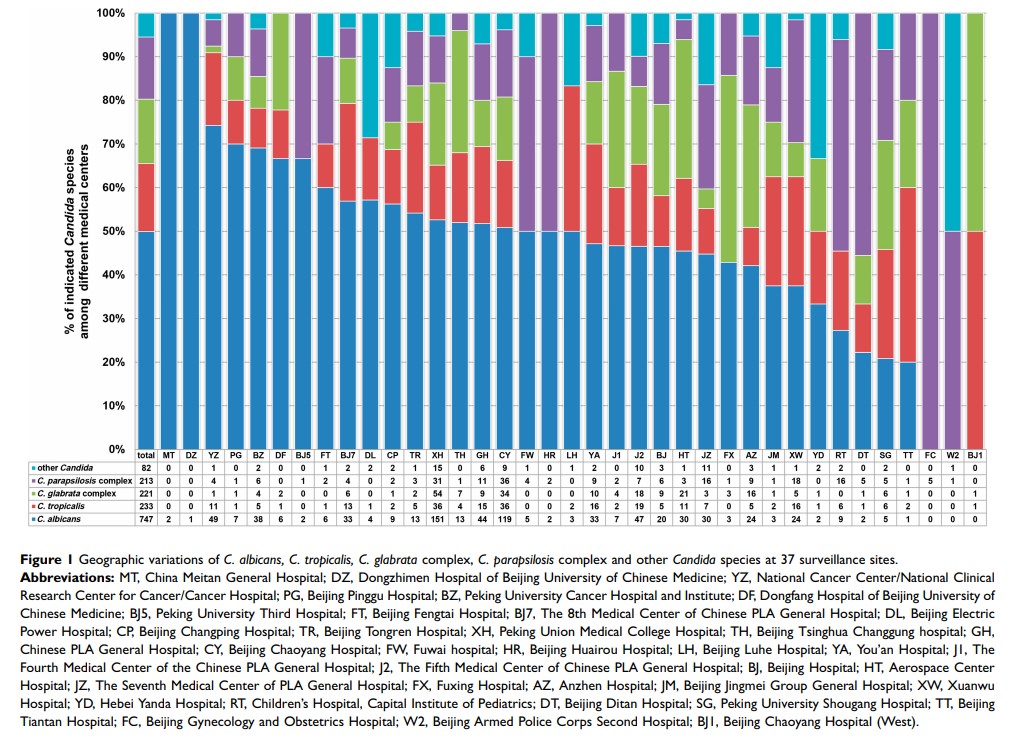
Objective: Invasive candidiasis (IC), a life-threatening fungal infection prevalent among hospitalized patients, has highly variable regional epidemiology. We conducted a multicenter surveillance study to investigate recent trends in species distribution and antifungal susceptibility patterns among IC-associated Candida spp. in Beijing, China, from 2016 to 2017.
Materials and Methods: A total of 1496 non-duplicate Candida isolates, recovered from blood and other sterile body fluids of IC patients, were identified using matrix-assisted laser desorption/ionization time of flight mass spectrometry combined with ribosomal DNA internal transcribed spacer (ITS) region sequencing. Broth microdilution-based susceptibility testing using six antifungal agents was also conducted.
Results: Candida albicans was the most frequently isolated species (49.9%), followed by Candida tropicalis (15.5%), Candida glabrata (14.7%) and Candida parapsilosis (14.2%). No significant differences in species distribution were observed when compared with a 2012– 2013 dataset. Overall, the rates of susceptibility to fluconazole and voriconazole were high among C. albicans (98% and 97.2%, respectively) and C. parapsilosis species complex (91.1% and 92%, respectively) isolates but low among C. tropicalis (81.5% and 81.1%, respectively) isolates. In addition, the rate of azole resistance among C. tropicalis isolates increased significantly (1.8-fold, P < 0.05) compared with that observed in 2012– 2013, while micafungin resistance rates were < 5% for all tested Candida species.
Conclusion: Our results suggest that species distribution has remained stable among IC-associated Candida isolates in Beijing. Resistance to micafungin was rare, but increased azole resistance among C. tropicalis isolates was noted. Our study provides information on local epidemiology that will be important for the selection of empirical antifungal agents and contributes to global assessments of antifungal resistance.
Keywords: invasive fungal infections, Candida , species distribution, antifungal resistance, surveillance, Beijing