115195
论文已发表
注册即可获取德孚的最新动态
IF 收录期刊
- 3.6 Breast Cancer (Dove Med Press)
- 4.3 Clin Epidemiol
- 2.6 Cancer Manag Res
- 3.2 Infect Drug Resist
- 4.1 Clin Interv Aging
- 6.1 Drug Des Dev Ther
- 4.1 Int J Chronic Obstr
- 8.7 Int J Nanomed
- 2.5 Int J Women's Health
- 3.2 Neuropsych Dis Treat
- 2.4 OncoTargets Ther
- 2.6 Patient Prefer Adher
- 2.6 Ther Clin Risk Manag
- 3.1 J Pain Res
- 3.5 Diabet Metab Synd Ob
- 4.5 Psychol Res Behav Ma
- 3.4 Nat Sci Sleep
- 2.4 Pharmgenomics Pers Med
- 2.6 Risk Manag Healthc Policy
- 4.6 J Inflamm Res
- 2.3 Int J Gen Med
- 3.9 J Hepatocell Carcinoma
- 3.3 J Asthma Allergy
- 2.5 Clin Cosmet Investig Dermatol
- 3.0 J Multidiscip Healthc

在腹腔镜肝切除术的 ERAS 方案中超声引导的双侧腹壁腹横肌平面(BD-TAP)阻滞的安全性和有效性:一项前瞻性、随机、对照、单盲临床研究
Authors Zhang J, Liu T, Zhou H, Fei Y, Yu X
Received 2 April 2020
Accepted for publication 23 June 2020
Published 21 July 2020 Volume 2020:14 Pages 2889—2898
DOI https://doi.org/10.2147/DDDT.S255385
Checked for plagiarism Yes
Review by Single-blind
Peer reviewer comments 2
Editor who approved publication: Dr Tin Wui Wong
Purpose: Postoperative pain management for patients undergoing hepatic resection is still a challenge due to the risk of perioperative liver dysfunction. The transversus abdominis plane (TAP) block is a promising regional analgesic technique. However, the correct guidelines regarding the dose and regimen of local anesthetics in patients undergoing hepatic resection have yet to be established completely. This study aimed to evaluate the safety and efficacy of ultrasound-guided BD-TAP block with a large dose of ropivacaine in laparoscopic hepatectomy.
Patients and Methods: This prospective, blinded, randomized, controlled study was conducted with 50 patients who were scheduled for selective laparoscopic hepatectomy. Patients who received a BD-TAP block (3 mg/kg of ropivacaine diluted to 60 mL) with general anesthesia were categorized into the BD-TAP block group (n = 25), and those who received general anesthesia were categorized into the control group (n = 25). The primary outcomes were consumption of sufentanil within 48 hours post-operation and plasma ropivacaine concentration. The secondary outcomes were the severity of pain (at rest and upon coughing), nausea and/or vomiting, and quality of recovery.
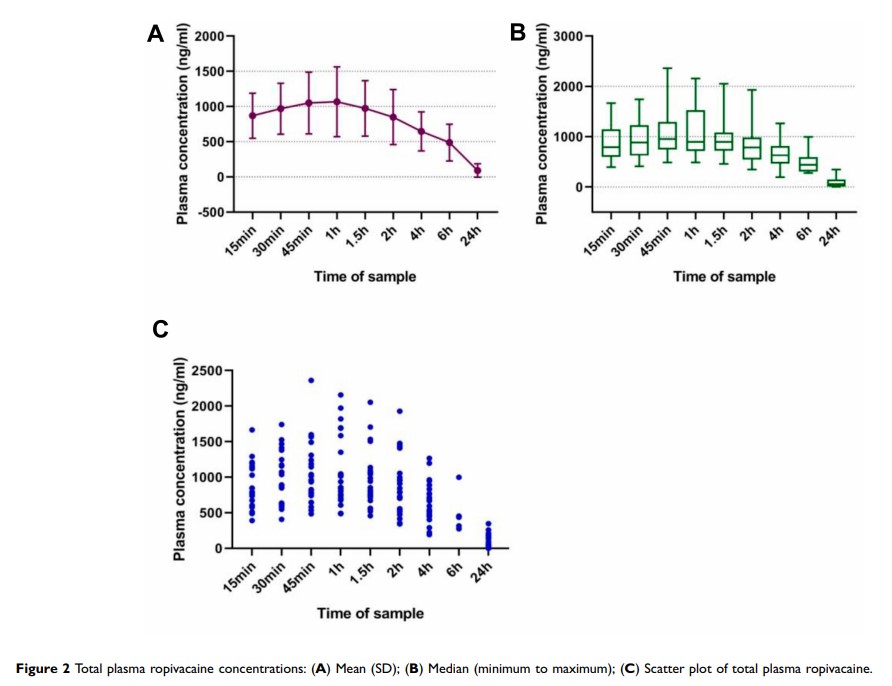
Results: Compared with the control group, the patients in BD-TAP block group had a significant reduction of postoperative sufentanil consumption at 2 hours (P = 0.019), 24 hours (P = 0.001), and 48 hours (P = 0.001), and the visual analog scale (VAS) scores on coughing were significantly lower at postoperative 2 hours (P = 0.004). There were no statistically significant differences in postoperative nausea and/or vomiting, flatus, catheter removal, off-bed activity, liver function, or postoperative hospital stay. The mean peak total ropivacaine concentration was 1,067.85 ng/mL, which occurred 1 hour after administering the block, and mean free ropivacaine concentration was 52.32 ng/mL. The highest individual peak plasma concentration was 2,360.90 ng/mL at 45 min postinjection, and the free ropivacaine concentration was 139.29 ng/mL.
Conclusion: Ultrasound-guided BD-TAP block provides effective postoperative analgesia after laparoscopic hepatectomy. This study also confirms that ultrasound-guided BD-TAP blocks with 3 mg/kg ropivacaine during laparoscopic hepatectomy almost never results in the plasma ropivacaine concentrations associated with neurotoxicity.
Keywords: ropivacaine, laparoscopic hepatectomy, BD-TAP block, neurotoxicity