115195
论文已发表
注册即可获取德孚的最新动态
IF 收录期刊
- 3.6 Breast Cancer (Dove Med Press)
- 4.3 Clin Epidemiol
- 2.6 Cancer Manag Res
- 3.2 Infect Drug Resist
- 4.1 Clin Interv Aging
- 6.1 Drug Des Dev Ther
- 4.1 Int J Chronic Obstr
- 8.7 Int J Nanomed
- 2.5 Int J Women's Health
- 3.2 Neuropsych Dis Treat
- 2.4 OncoTargets Ther
- 2.6 Patient Prefer Adher
- 2.6 Ther Clin Risk Manag
- 3.1 J Pain Res
- 3.5 Diabet Metab Synd Ob
- 4.5 Psychol Res Behav Ma
- 3.4 Nat Sci Sleep
- 2.4 Pharmgenomics Pers Med
- 2.6 Risk Manag Healthc Policy
- 4.6 J Inflamm Res
- 2.3 Int J Gen Med
- 3.9 J Hepatocell Carcinoma
- 3.3 J Asthma Allergy
- 2.5 Clin Cosmet Investig Dermatol
- 3.0 J Multidiscip Healthc

电针治疗抑郁症相关失眠的疗效:一项随机对照试验
Authors Yin X, Li W, Wu H, Dong B, Ma J, Li S, Lao L, Xu S
Received 22 March 2020
Accepted for publication 6 July 2020
Published 21 July 2020 Volume 2020:12 Pages 497—508
DOI https://doi.org/10.2147/NSS.S253320
Checked for plagiarism Yes
Review by Single-blind
Peer reviewer comments 2
Editor who approved publication: Dr Sutapa Mukherjee
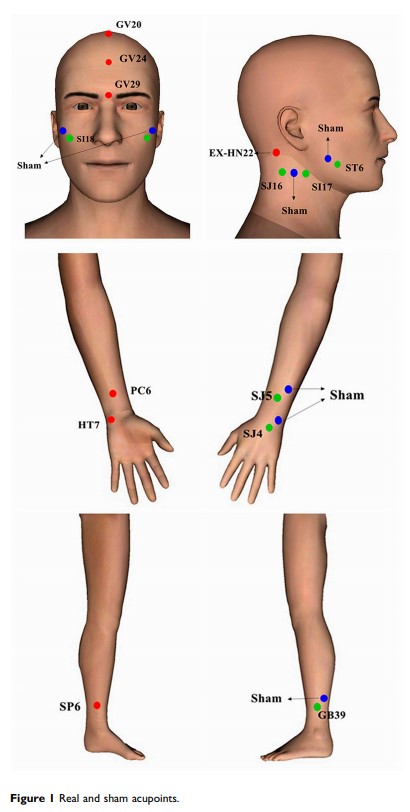
Objective: To evaluate the efficacy of electroacupuncture (EA) on treating insomnia in patients with depression.
Patients and Methods: In a patient-assessor-blind, randomized and sham controlled trial, 90 depression patients with insomnia were assigned into three different groups, receiving EA in the treatment group, superficial acupuncture at sham points in the control group A, or Streitberger non-insertion sham acupuncture in the control group B. Treatment was applied 3 times weekly for 8 consecutive weeks. The primary outcome was measured using the Pittsburgh Sleep Quality Index (PSQI). Secondary outcomes were sleep parameters including sleep efficiency (SE), total sleep time (TST) and numbers of sleep awakenings (SA) recorded in the actigraphy, as well as applying the Hamilton Rating Scale for Depression (HAMD-17), Self-Rating Depression Scale (SDS) and Hamilton Rating Scale for Anxiety (HAMA). Assessments were performed at the baseline (week 0), week 4, week 8, and week 12. Linear mixed-effects models were used for analyses and all statistical tests were two-sided.
Results: Patients in the EA group had more significant improvement in PSQI scores than those in the control groups over time (respectively p < 0.001 and p =0.04 for treatment and time interaction). At 8-week posttreatment, the EA group reported a reduction of − 6.64 points in PSQI scores compared with − 2.23 points in the control group A (95% CI= − 5.74 to − 2.39) and − 2.94 points in the control group B (95% CI= − 5.73 to − 2.47). Compared with the two control groups, significant between-group differences were seen in SE (both p < 0.01) and TST (both p < 0.01) at week 8; similar results can be found in HAMD-17, SDS, and HAMA scores as well. However, there were no between-group differences in SA (respectively p =0.24 and p =0.08) after 8-weeks of treatment.
Conclusion: Electroacupuncture may improve the sleep quality of patients with depression.
Trial Registration: Chinese Clinical Trial Registry (ChiCTR); URL: http://www.chictr.org.cn/showproj.aspx?proj=12327; Trial ID: ChiCTR-IIR-16008058.
Keywords: insomnia, depression, electroacupuncture, randomized controlled trial