115195
论文已发表
注册即可获取德孚的最新动态
IF 收录期刊
- 3.6 Breast Cancer (Dove Med Press)
- 4.3 Clin Epidemiol
- 2.6 Cancer Manag Res
- 3.2 Infect Drug Resist
- 4.1 Clin Interv Aging
- 6.1 Drug Des Dev Ther
- 4.1 Int J Chronic Obstr
- 8.7 Int J Nanomed
- 2.5 Int J Women's Health
- 3.2 Neuropsych Dis Treat
- 2.4 OncoTargets Ther
- 2.6 Patient Prefer Adher
- 2.6 Ther Clin Risk Manag
- 3.1 J Pain Res
- 3.5 Diabet Metab Synd Ob
- 4.5 Psychol Res Behav Ma
- 3.4 Nat Sci Sleep
- 2.4 Pharmgenomics Pers Med
- 2.6 Risk Manag Healthc Policy
- 4.6 J Inflamm Res
- 2.3 Int J Gen Med
- 3.9 J Hepatocell Carcinoma
- 3.3 J Asthma Allergy
- 2.5 Clin Cosmet Investig Dermatol
- 3.0 J Multidiscip Healthc

MiR-887-3p 负调控 STARD13 并促进胰腺癌进展
Authors Xu X, Zheng S
Received 29 April 2020
Accepted for publication 27 June 2020
Published 22 July 2020 Volume 2020:12 Pages 6137—6147
DOI https://doi.org/10.2147/CMAR.S260542
Checked for plagiarism Yes
Review by Single-blind
Peer reviewer comments 2
Editor who approved publication: Dr Ahmet Emre Eskazan
Purpose: STARD13 is regulated by various miRNAs. However, there are relatively few reports describing the relationship between miRNAs and STARD13 in pancreatic cancer. Therefore, the aim of this study was to explore the relationship between miRNA and STARD13 in pancreatic cancer.
Patients and Methods: By analyzing the data from Gene Expression Omnibus (GEO) database, the relationship between STARD13 expression and pancreatic cancer was explored. Then, through sequence alignment, the sequence complementary to miR-887-3p in the 3ʹUTR of STARD13 mRNA was found, mutated and cloned. Dual-luciferase reporter assay was used to test the relationship between STARD13 and miR-887-3p. Pancreatic cancer tumor tissue and its adjacent tissues collected, and the expression of STARD13 and miR-887-3p in pancreatic cancer tissues was analyzed by RT-qPCR. After, miR-887-3p and its inhibitor were transfected into PANC-1 cells to further confirm the regulatory relationship between miR-887-3 and STARD13 by RT-qPCR, and CCK-8, colony formation assays, cell cycle analysis, apoptosis detection and transwell analysis were used to detect changes of proliferation, apoptosis, migration and invasion in PANC-1 cells. Finally, through in vivo experiments, the effect of miR-887-3p on tumor growth was researched.
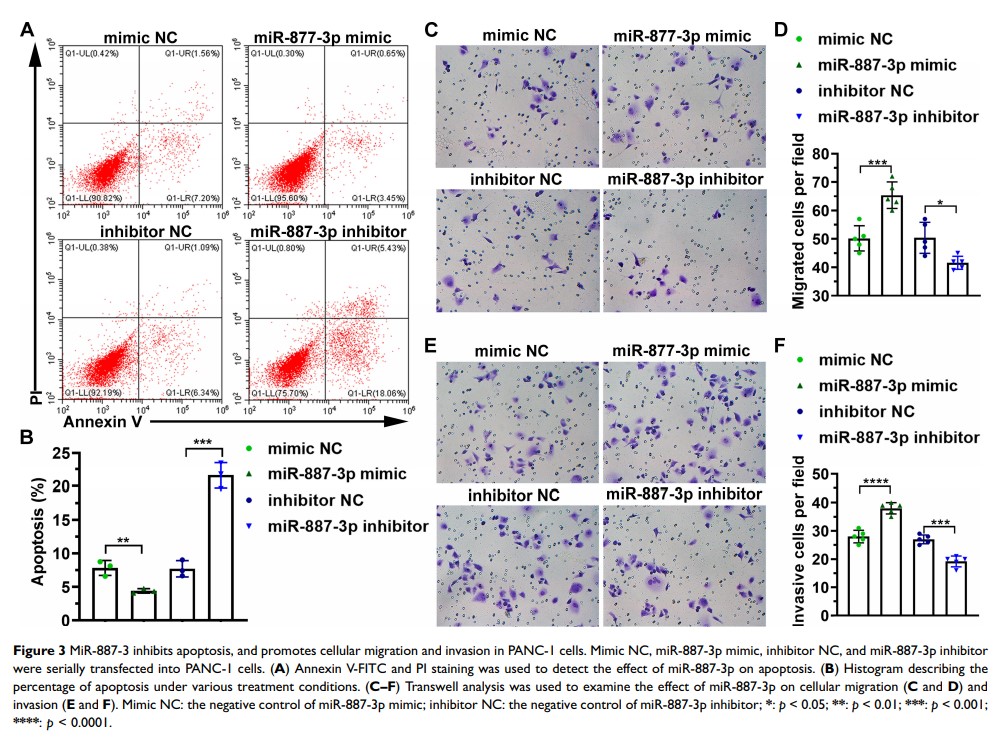
Results: We found that STARD13 expression is lower in pancreatic cancer tissues, with the level of miR-887-3p being higher in these tissues. Pancreatic cancer patients with particularly low levels of STARD13 presented with a poor prognosis. MiR-887-3p negatively regulates the expression of STARD13. Increasing levels of miR-887-3p decreased the expression of STARD13, which promoted the proliferation, cell cycle process, cell migration and invasion, and inhibited the apoptosis of pancreatic cancer cells. Inhibition of miR-887-3p in SCID mice could inhibit tumor growth and promote tumor cell apoptosis.
Conclusion: In conclusion, STARD13 is negatively regulated by miR-887-3p in pancreatic cancer. MiR-877-3p may act to promote cancer progression, and as such, it is a viable target for intervention and diagnostic development.
Keywords: microRNAs, StAR-related lipid transfer protein 13, pancreatic cancer, miR-887-3p, poor prognosis