115195
论文已发表
注册即可获取德孚的最新动态
IF 收录期刊
- 3.6 Breast Cancer (Dove Med Press)
- 4.3 Clin Epidemiol
- 2.6 Cancer Manag Res
- 3.2 Infect Drug Resist
- 4.1 Clin Interv Aging
- 6.1 Drug Des Dev Ther
- 4.1 Int J Chronic Obstr
- 8.7 Int J Nanomed
- 2.5 Int J Women's Health
- 3.2 Neuropsych Dis Treat
- 2.4 OncoTargets Ther
- 2.6 Patient Prefer Adher
- 2.6 Ther Clin Risk Manag
- 3.1 J Pain Res
- 3.5 Diabet Metab Synd Ob
- 4.5 Psychol Res Behav Ma
- 3.4 Nat Sci Sleep
- 2.4 Pharmgenomics Pers Med
- 2.6 Risk Manag Healthc Policy
- 4.6 J Inflamm Res
- 2.3 Int J Gen Med
- 3.9 J Hepatocell Carcinoma
- 3.3 J Asthma Allergy
- 2.5 Clin Cosmet Investig Dermatol
- 3.0 J Multidiscip Healthc

新型白蛋白纳米颗粒可增强二甲双胍的抗胰岛素抗性-肝癌活性
Authors Lu Z, Qi L, Lin Y, Sun L, Zhang L, Wang G, Li J, Yu J
Received 19 March 2020
Accepted for publication 9 June 2020
Published 23 July 2020 Volume 2020:15 Pages 5203—5215
DOI https://doi.org/10.2147/IJN.S253094
Checked for plagiarism Yes
Review by Single-blind
Peer reviewer comments 3
Editor who approved publication: Dr Linlin Sun
Introduction: Metformin is an ideal candidate to treat the liver tumor with insulin resistance because of its good performance in the treatment of type 2 diabetes and the advantage in cancer therapy. We aim to develop a delivery system with higher efficiency than free drug.
Methods: Metformin-bovine serum albumin (met-BSA) nanoparticles (NPs) were prepared using the anti-solvent precipitation method with a stabilizer of BSA for particle growth. The therapeutic effect of the drug was tested by the insulin-resistant HepG2 cells and C57BL/6J mice at a glucose starvation condition. The interaction mechanism of the drug and the protein during the formation of the NPs was tested using a series of spectroscopy.
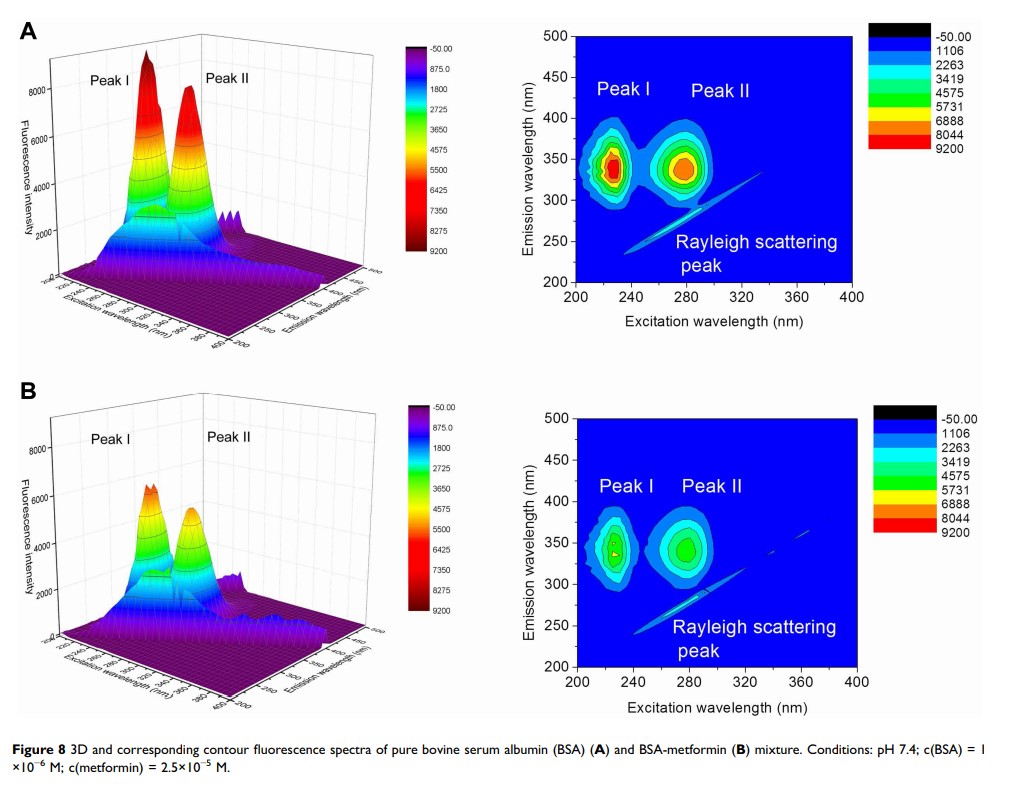
Results: Metformin and BSA formed nonporous and spherical particles of about 200 nm with proper lognormal distribution and thermostability. The cellular uptake, as well as the anti-liver cancer activities of met-BSA, was enhanced dramatically compared with the free drug. The thermodynamic studies suggested that the weak binding of metformin to BSA was governed by hydrogen bonds and van der Waals forces. Moreover, the results of synchronous, circular dichroism (CD) and three-dimensional fluorescence demonstrated that the BSA skeleton and chromophore microenvironments were changed in the presence of metformin.
Conclusion: Therefore, met-BSA has been proved as a simple yet effective therapeutic agent for cancer with insulin resistance, promising for future clinic translations in cancer treatment.
Keywords: liver cancer, metformin, bovine serum albumin, nanoparticle, spectroscopy