115195
论文已发表
注册即可获取德孚的最新动态
IF 收录期刊
- 3.6 Breast Cancer (Dove Med Press)
- 4.3 Clin Epidemiol
- 2.6 Cancer Manag Res
- 3.2 Infect Drug Resist
- 4.1 Clin Interv Aging
- 6.1 Drug Des Dev Ther
- 4.1 Int J Chronic Obstr
- 8.7 Int J Nanomed
- 2.5 Int J Women's Health
- 3.2 Neuropsych Dis Treat
- 2.4 OncoTargets Ther
- 2.6 Patient Prefer Adher
- 2.6 Ther Clin Risk Manag
- 3.1 J Pain Res
- 3.5 Diabet Metab Synd Ob
- 4.5 Psychol Res Behav Ma
- 3.4 Nat Sci Sleep
- 2.4 Pharmgenomics Pers Med
- 2.6 Risk Manag Healthc Policy
- 4.6 J Inflamm Res
- 2.3 Int J Gen Med
- 3.9 J Hepatocell Carcinoma
- 3.3 J Asthma Allergy
- 2.5 Clin Cosmet Investig Dermatol
- 3.0 J Multidiscip Healthc

PLA2G6 遗传变异和帕金森氏病之间缺乏联系:系统回顾
Authors Liu H, Yao Y, Liu H, Peng Y, Ren J, Wu X, Mao R, Zhao J, Zhu Y, Niu Z, Yang T, Sun X, Jiang P, Zhang C, Fang Y
Received 15 March 2020
Accepted for publication 6 June 2020
Published 23 July 2020 Volume 2020:16 Pages 1755—1763
DOI https://doi.org/10.2147/NDT.S254065
Checked for plagiarism Yes
Review by Single-blind
Peer reviewer comments 2
Editor who approved publication: Professor Jun Chen
Background: The phospholipase A2 Group 6 (PLA2G6 , also known as PLA2, PARK14 , and iPLA2 ) gene encodes a group VIA calcium-independent phospholipase A2. Genetic polymorphism of PLA2G6 has been indicated to be involved in conferring susceptibility for Parkinson’s disease (PD), whereas conclusive results have not been obtained. Thus, we intended to conduct a systematic review to determine if PLA2G6 genetic variation confers a greater susceptibility to PD.
Methods: All case-control studies that investigated the association of the PLA2G6 polymorphisms with the risk of PD published before 15 July 2018 were included. The literature was comprehensively searched and identified in five English databases (EBSCO, Pubmed, OVID, EMBASE and ISI Web of Knowledge) and four Chinese databases (Wanfang database, Chinese Biomedical Literature Database, China Academic Journals Database and VIP database). We performed analyses of study characteristics, heterogeneity, and forest plot in analyses analogous to dominant, codominant and additive models with the pooled odds ratio (OR) in fixed- or random-effects models as the measure of association.
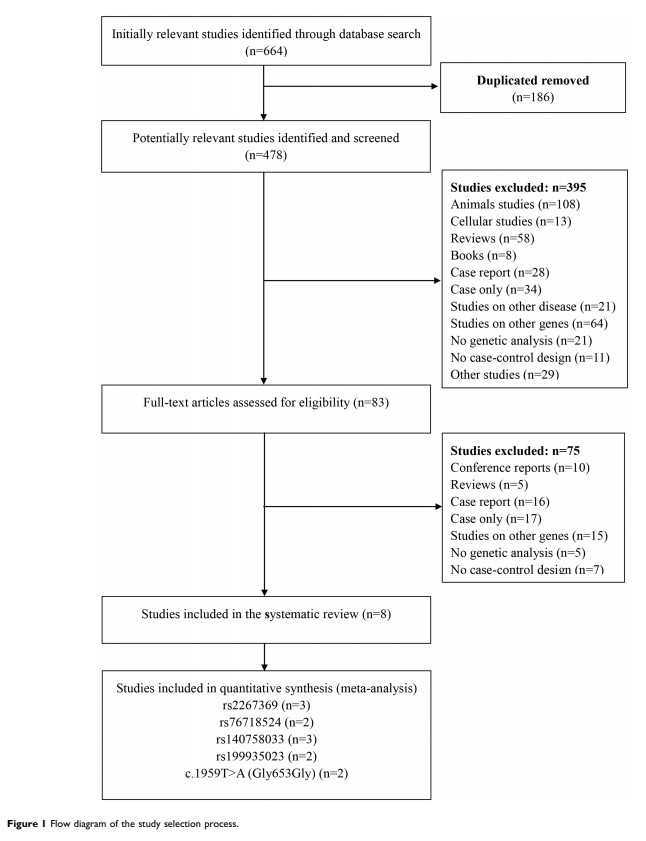
Results: A total of 664 potentially relevant studies were retrieved with the initial search, of which eight studies fulfilled the inclusion criteria, and included 2,779 PD patients and 3,291 control participants,. Among all the reported 27 genetic variants, 15 single nucleotide polymorphisms (SNPs) were present only in patients, and only five available SNPs (rs2267369, rs140758033, c.1959T>A (Gly653Gly), rs76718524, rs199935023) were pooled in the meta-analysis. However, there was no evidence for a significant association between the five SNPs and PD risk in dominant, codominant and allele models, suggesting a lack of association between PLA2G6 genetic variation and PD susceptibility.
Conclusion: The present study assessed the association of PLA2G6 genetic polymorphism with the risk PD, and the result strongly demonstrates that PLA2G6 polymorphism is not associated with PD susceptibility.
Keywords: Parkinson’s disease, PD, PLA2G6 , systematic review