115195
论文已发表
注册即可获取德孚的最新动态
IF 收录期刊
- 3.6 Breast Cancer (Dove Med Press)
- 4.3 Clin Epidemiol
- 2.6 Cancer Manag Res
- 3.2 Infect Drug Resist
- 4.1 Clin Interv Aging
- 6.1 Drug Des Dev Ther
- 4.1 Int J Chronic Obstr
- 8.7 Int J Nanomed
- 2.5 Int J Women's Health
- 3.2 Neuropsych Dis Treat
- 2.4 OncoTargets Ther
- 2.6 Patient Prefer Adher
- 2.6 Ther Clin Risk Manag
- 3.1 J Pain Res
- 3.5 Diabet Metab Synd Ob
- 4.5 Psychol Res Behav Ma
- 3.4 Nat Sci Sleep
- 2.4 Pharmgenomics Pers Med
- 2.6 Risk Manag Healthc Policy
- 4.6 J Inflamm Res
- 2.3 Int J Gen Med
- 3.9 J Hepatocell Carcinoma
- 3.3 J Asthma Allergy
- 2.5 Clin Cosmet Investig Dermatol
- 3.0 J Multidiscip Healthc

神经生长因子在颌面部疼痛中的作用
Authors Mai L, Huang F, Zhu X, He H, Fan W
Received 16 February 2020
Accepted for publication 6 July 2020
Published 24 July 2020 Volume 2020:13 Pages 1875—1882
DOI https://doi.org/10.2147/JPR.S250030
Checked for plagiarism Yes
Review by Single-blind
Peer reviewer comments 2
Editor who approved publication: Dr Michael A Überall
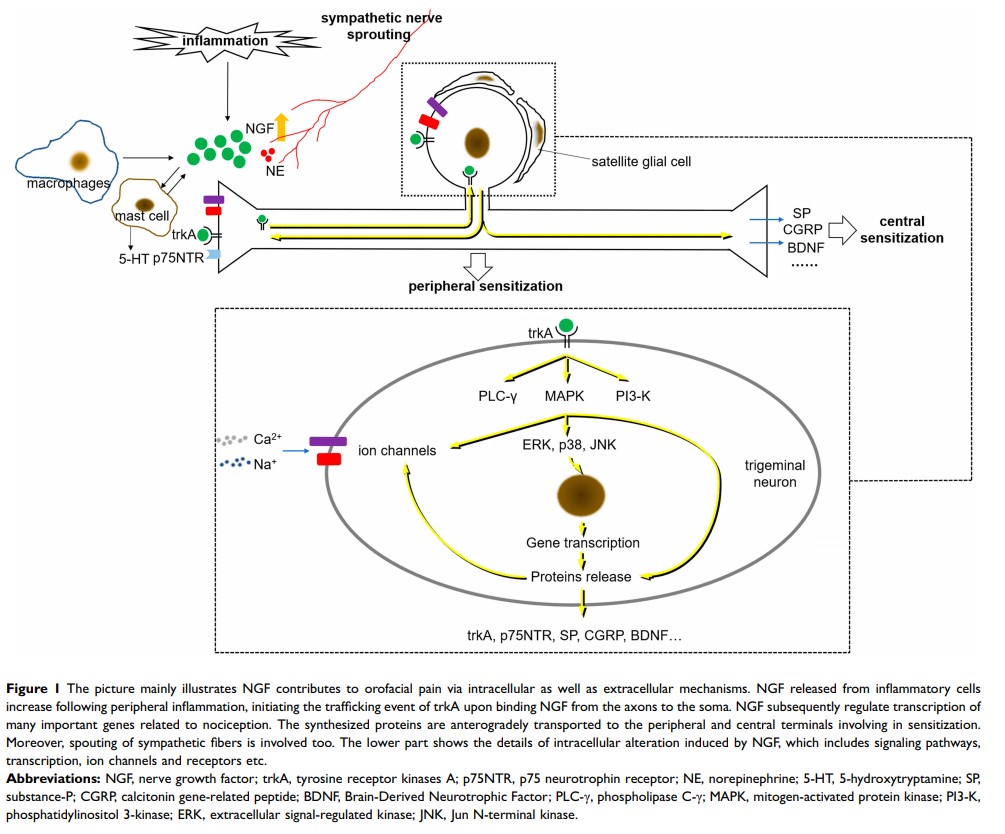
Abstract: Some chronic pain conditions in the orofacial region are common and the mechanisms underlying orofacial pain are unresolved. Nerve growth factor (NGF) is a member of a family of neurotrophins and regulates the growth, maintenance and development of neurons. Increasing evidence suggests that NGF plays a crucial role in the generation of pain and hyperalgesia in different pain states. This review investigates the role of NGF in orofacial pain and their underlying cellular mechanisms, which may provide essential guidance to drug-discovery programmes. A systemic literature search was conducted in Pubmed focusing on NGF and orofacial pain. Articles were reviewed, and those discussing in vitro studies, animal evidence, clinical course, and possible mechanisms were summarized. We found a hyperalgesic effect of NGF in peripheral sensitization in orofacial pain models. We also summarize the current knowledge regarding NGF-dependent pain mechanism, which is initiated by retrograde transport of the ligand-receptor complex, ensuing transcriptional regulation of many important nociceptor genes involved in nociceptive processing. Phase III trials suggest that anti-NGF drug is endorsed with anti-inflammatory and pain-relieving effects with good tolerance in a variety of pain conditions, including pain associated with osteoarthritis and chronic lower back pain. Based on the data reviewed herein, NGF is believed to be an important hyperalgesic mediator in orofacial pain. The identification of underlying mechanisms and pathways of orofacial pain opens new frontiers for pain management.
Keywords: nerve growth factor, orofacial region, pain, tyrosine receptor kinases A, mechanisms