115195
论文已发表
注册即可获取德孚的最新动态
IF 收录期刊
- 3.6 Breast Cancer (Dove Med Press)
- 4.3 Clin Epidemiol
- 2.6 Cancer Manag Res
- 3.2 Infect Drug Resist
- 4.1 Clin Interv Aging
- 6.1 Drug Des Dev Ther
- 4.1 Int J Chronic Obstr
- 8.7 Int J Nanomed
- 2.5 Int J Women's Health
- 3.2 Neuropsych Dis Treat
- 2.4 OncoTargets Ther
- 2.6 Patient Prefer Adher
- 2.6 Ther Clin Risk Manag
- 3.1 J Pain Res
- 3.5 Diabet Metab Synd Ob
- 4.5 Psychol Res Behav Ma
- 3.4 Nat Sci Sleep
- 2.4 Pharmgenomics Pers Med
- 2.6 Risk Manag Healthc Policy
- 4.6 J Inflamm Res
- 2.3 Int J Gen Med
- 3.9 J Hepatocell Carcinoma
- 3.3 J Asthma Allergy
- 2.5 Clin Cosmet Investig Dermatol
- 3.0 J Multidiscip Healthc

LINC00501 通过介导 miR-129-5p/HMGB1 抑制肺癌的生长和转移
Authors Wang RT, Zhang Y, Yao SY, Tan XG
Received 20 March 2020
Accepted for publication 17 May 2020
Published 24 July 2020 Volume 2020:13 Pages 7137—7149
DOI https://doi.org/10.2147/OTT.S254735
Checked for plagiarism Yes
Review by Single-blind
Peer reviewer comments 2
Editor who approved publication: Prof. Dr. Takuya Aoki
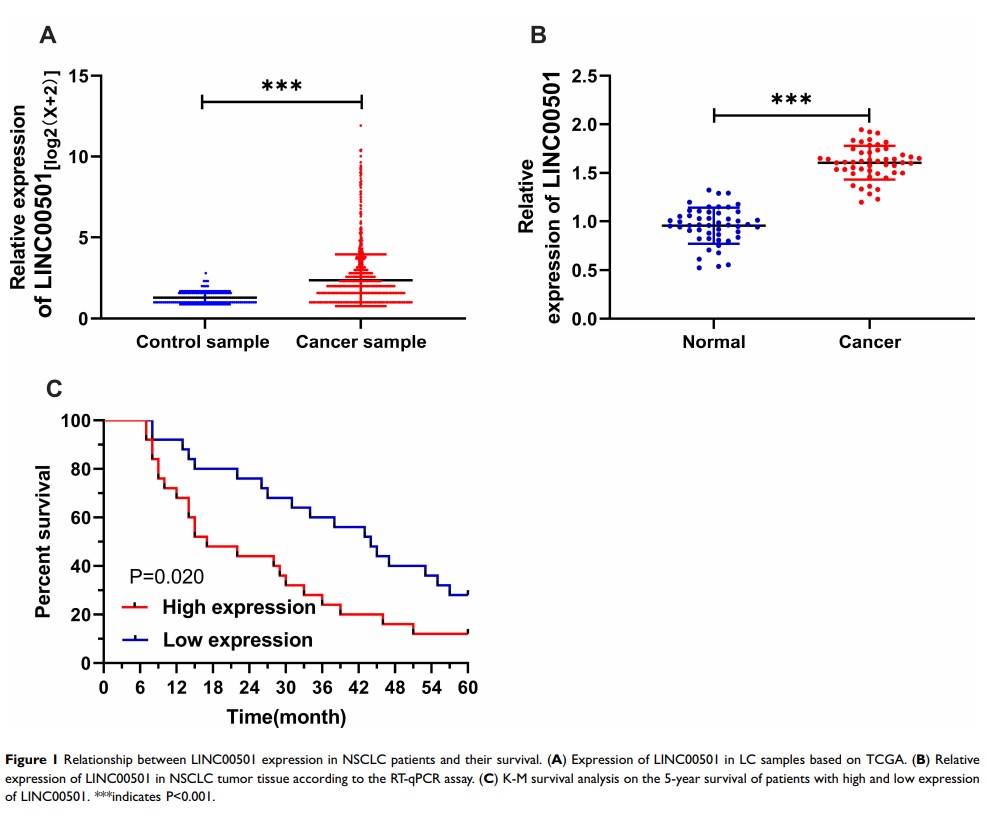
Background: The function of LINC00501, a long-non-coding RNA (lncRNA), is unclear at present. According to the Cancer Genome Atlas (TCGA), LINC00501 is highly expressed in lung cancer (LC), but whether it can be adopted as a potential therapy target for LC still needs further research.
Methods: The expression of LINC00501 in LC was analyzed based on the TCGA, and a real-time fluorescent quantitative PCR assay was carried out to quantify LINC00501 in non-small-cell lung cancer (NSCLC). Additionally, bioinformatics analysis, luciferase reporter gene technique, and RNA immunoprecipitation (RIP) were employed to analyze the direct interaction between LINC00501 and miR-129-5p, and CCK-8 and Transwell assays and flow cytometry were employed to analyze the effects of LINC00501 on cell proliferation, invasion, and apoptosis. Furthermore, a Western blot assay was carried out to determine the protein level of HMGB1.
Results: LINC00501 was highly expressed in LC according to the database, and it was found that LINC00501 was upregulated in NSCLC specimens and cells, and the up-regulation indicated an unfavorable prognosis. Besides, knockdown of LINC00501 hindered the proliferation and invasion of NSCLC cells and intensified their apoptosis, and LINC00501 could be adopted as competitive endogenous RNA to regulate HMGB1 and tumorigenesis through miR-129-5p.
Conclusion: LINC00501 is overexpressed in LC and the overexpression indicates poor prognosis of patients. In addition, LINC00501 can inhibit the invasion and migration of LC by mediating miR-129-5p/HMGB1.
Keywords: LINC00501, HMGB1, miR-129-5p, lung cancer, invasion, migration