115195
论文已发表
注册即可获取德孚的最新动态
IF 收录期刊
- 3.6 Breast Cancer (Dove Med Press)
- 4.3 Clin Epidemiol
- 2.6 Cancer Manag Res
- 3.2 Infect Drug Resist
- 4.1 Clin Interv Aging
- 6.1 Drug Des Dev Ther
- 4.1 Int J Chronic Obstr
- 8.7 Int J Nanomed
- 2.5 Int J Women's Health
- 3.2 Neuropsych Dis Treat
- 2.4 OncoTargets Ther
- 2.6 Patient Prefer Adher
- 2.6 Ther Clin Risk Manag
- 3.1 J Pain Res
- 3.5 Diabet Metab Synd Ob
- 4.5 Psychol Res Behav Ma
- 3.4 Nat Sci Sleep
- 2.4 Pharmgenomics Pers Med
- 2.6 Risk Manag Healthc Policy
- 4.6 J Inflamm Res
- 2.3 Int J Gen Med
- 3.9 J Hepatocell Carcinoma
- 3.3 J Asthma Allergy
- 2.5 Clin Cosmet Investig Dermatol
- 3.0 J Multidiscip Healthc

厚朴酚介孔二氧化硅纳米颗粒通过抑制 TGF-β 信号通路遏制血管再狭窄
Authors Wei X, Fang Z, Sheng J, Wang Y, Lu P
Received 22 February 2020
Accepted for publication 1 June 2020
Published 24 July 2020 Volume 2020:15 Pages 5239—5252
DOI https://doi.org/10.2147/IJN.S250911
Checked for plagiarism Yes
Review by Single-blind
Peer reviewer comments 2
Editor who approved publication: Dr Lei Yang
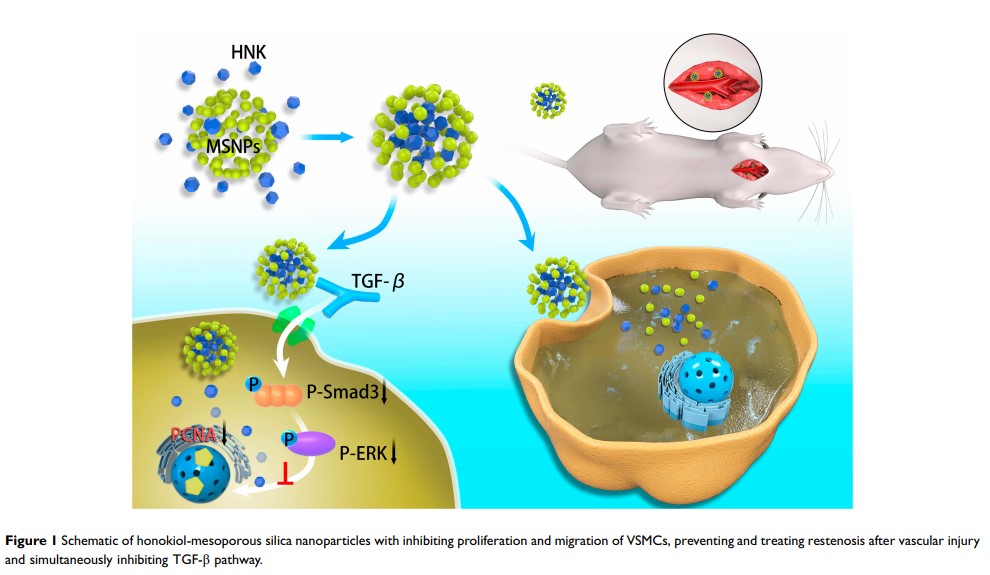
Introduction: The main pathological mechanism of restenosis after percutaneous coronary intervention (PCI) is intimal hyperplasia, which is mainly caused by proliferation and migration of vascular smooth muscle cells (VSMCs). Our previous study found that honokiol (HNK), a small-molecule polyphenol, can inhibit neointimal hyperplasia after balloon injury, but its specific mechanism is still unclear. Moreover, poor water solubility as well as low bioavailability of honokiol has limited its practical use.
Methods: We used mesoporous silica nanoparticles (MSNPs) as a standard substance to encapsulate HNK and then assemble into honokiol-mesoporous silica nanoparticles, and we investigated the effect of these nanoparticles on the process of restenosis after common carotid artery injury in rats.
Results: We report a promising delivery system that loads HNK into MSNPs and finally assembles it into a nanocomposite particle. These HNK-MSNPs not merely inhibited proliferation and migration of VSMCs by reducing phosphorylation of Smad3, but also showed a higher suppression of intimal thickening than the free-honokiol-treated group in a rat model of balloon injury.
Conclusion: To sum up, this drug delivery system supplies a potent nano-platform for improving the biological effects of HNK and provides a promising strategy for preventing vascular restenosis.
Keywords: mesoporous silica nanoparticles, honokiol, vascular smooth muscle cells, TGF-β pathway, balloon injury, intimal thickening, restenosis