115195
论文已发表
注册即可获取德孚的最新动态
IF 收录期刊
- 3.6 Breast Cancer (Dove Med Press)
- 4.3 Clin Epidemiol
- 2.6 Cancer Manag Res
- 3.2 Infect Drug Resist
- 4.1 Clin Interv Aging
- 6.1 Drug Des Dev Ther
- 4.1 Int J Chronic Obstr
- 8.7 Int J Nanomed
- 2.5 Int J Women's Health
- 3.2 Neuropsych Dis Treat
- 2.4 OncoTargets Ther
- 2.6 Patient Prefer Adher
- 2.6 Ther Clin Risk Manag
- 3.1 J Pain Res
- 3.5 Diabet Metab Synd Ob
- 4.5 Psychol Res Behav Ma
- 3.4 Nat Sci Sleep
- 2.4 Pharmgenomics Pers Med
- 2.6 Risk Manag Healthc Policy
- 4.6 J Inflamm Res
- 2.3 Int J Gen Med
- 3.9 J Hepatocell Carcinoma
- 3.3 J Asthma Allergy
- 2.5 Clin Cosmet Investig Dermatol
- 3.0 J Multidiscip Healthc

长非编码 RNA ST7-AS1 通过海绵化 microRNA-543 上调 TRPM7 表达,以促进宫颈癌进展
Authors Qi H, Lu L, Wang L
Received 6 April 2020
Accepted for publication 21 June 2020
Published 27 July 2020 Volume 2020:13 Pages 7257—7269
DOI https://doi.org/10.2147/OTT.S253868
Checked for plagiarism Yes
Review by Single anonymous peer review
Peer reviewer comments 3
Editor who approved publication: Prof. Dr. Geoffrey Pietersz
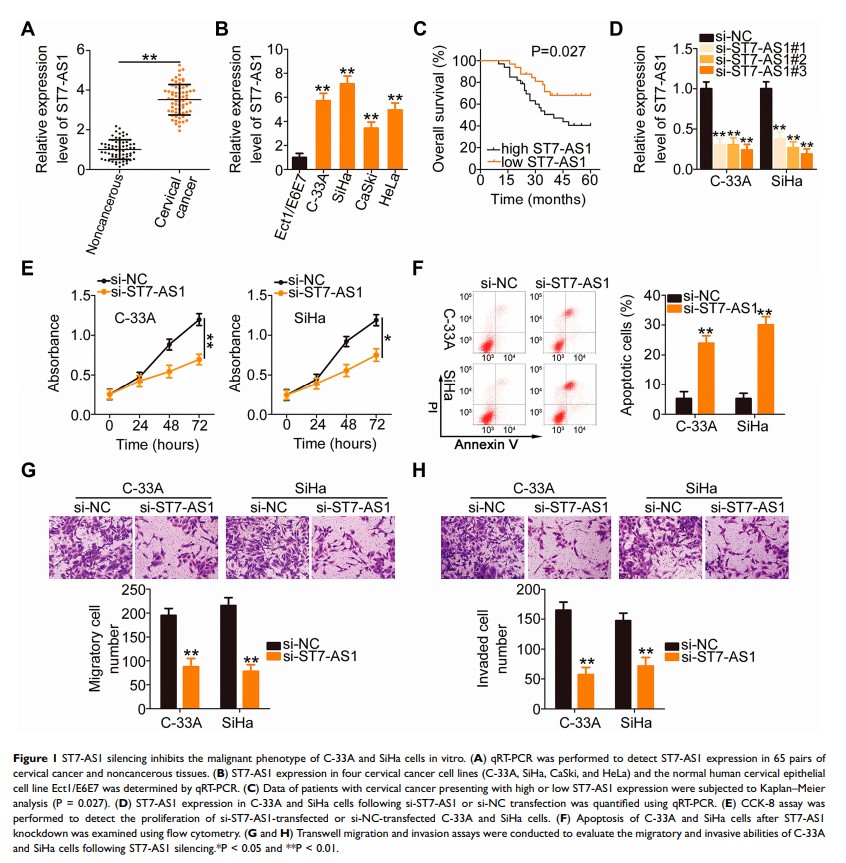
Purpose: ST7 antisense RNA 1 (ST7-AS1) is a long noncoding RNA that affects the progression of gastric cancer and laryngeal squamous cell carcinoma. Herein, ST7-AS1 expression was detected in cervical cancer tissues and cell lines. In addition, its biological roles in inducing the aggressive phenotype of cervical cancer and its associated mechanisms of action were illustrated.
Patients and Methods: ST7-AS1 expression in cervical cancer tissues and cell lines was detected using quantitative real-time polymerase chain reaction (qRT-PCR). Malignancy was determined using Cell Counting Kit-8 assay, flow cytometry, transwell migration and invasion assays, and xenograft experiments. Bioinformatics analysis was performed to predict the interaction between ST7-AS1 and microRNA-543 (miR-543). Luciferase reporter assay, RNA immunoprecipitation assay, Western blotting, qRT-PCR, and rescue experiments were performed to further identify the interactions among ST7-AS1, miR-543, and transient receptor potential melastatin 7 (TRPM7).
Results: ST7-AS1 was upregulated in cervical cancer tissues and cell lines. ST7-AS1 overexpression was correlated with a high International Federation of Gynecology and Obstetrics stage, frequent lymph node metastasis, deep cervical invasion, and short overall survival in patients with cervical cancer. ST7-AS1 inhibition hindered cervical cancer cell proliferation, migration, and invasion; ST7-AS1 downregulation resulted in marked cell apoptosis. Additionally, ST7-AS1 deficiency restricted cervical tumor growth in vivo. Mechanistically, ST7-AS1 functioned as competing endogenous RNA to increase TRPM7 expression by sponging miR-543. Intriguingly, rescue experiments revealed that miR-543 downregulation or TRPM7 overexpression abrogated the inhibitory actions of ST7-AS1 knockdown in the aggressive phenotype of cervical cancer cells.
Conclusion: The newly identified ST7-AS1/miR-543/TRPM7 axis promoted the oncogenicity of cervical cancer cells both in vitro and in vivo. Our study highlighted the importance of this novel axis in cervical cancer progression, suggesting that this pathway can serve as a promising therapeutic target for cervical cancer.
Keywords: ST7 antisense RNA 1, cervical cancer, transient receptor potential melastatin 7, microRNA-543