115195
论文已发表
注册即可获取德孚的最新动态
IF 收录期刊
- 3.6 Breast Cancer (Dove Med Press)
- 4.3 Clin Epidemiol
- 2.6 Cancer Manag Res
- 3.2 Infect Drug Resist
- 4.1 Clin Interv Aging
- 6.1 Drug Des Dev Ther
- 4.1 Int J Chronic Obstr
- 8.7 Int J Nanomed
- 2.5 Int J Women's Health
- 3.2 Neuropsych Dis Treat
- 2.4 OncoTargets Ther
- 2.6 Patient Prefer Adher
- 2.6 Ther Clin Risk Manag
- 3.1 J Pain Res
- 3.5 Diabet Metab Synd Ob
- 4.5 Psychol Res Behav Ma
- 3.4 Nat Sci Sleep
- 2.4 Pharmgenomics Pers Med
- 2.6 Risk Manag Healthc Policy
- 4.6 J Inflamm Res
- 2.3 Int J Gen Med
- 3.9 J Hepatocell Carcinoma
- 3.3 J Asthma Allergy
- 2.5 Clin Cosmet Investig Dermatol
- 3.0 J Multidiscip Healthc

新型 mTOR 抑制剂可增强肝细胞癌细胞对分子靶向剂的敏感性
Authors Feng YQ, Li BA, Feng F, Chen YS, Ren YX, Zhang H, Cao S
Received 4 January 2020
Accepted for publication 2 July 2020
Published 27 July 2020 Volume 2020:13 Pages 7165—7176
DOI https://doi.org/10.2147/OTT.S244474
Checked for plagiarism Yes
Review by Single anonymous peer review
Peer reviewer comments 2
Editor who approved publication: Prof. Dr. Jianmin Xu
Background: Although molecular-targeted agents are still the first choice for advanced hepatocellular carcinoma (HCC) treatment, the therapeutic efficacy of these agents is not satisfactory. Recently, the mammalian target of rapamycin (mTOR) is considered to be a promising molecular target that can enhance the sensitivity of HCC cells to antitumor therapy. However, the reported mTOR inhibitors have some shortcomings, and novel mTOR inhibitors need to be developed to enhance the antitumor effect of molecularly targeted agents on advanced HCC.
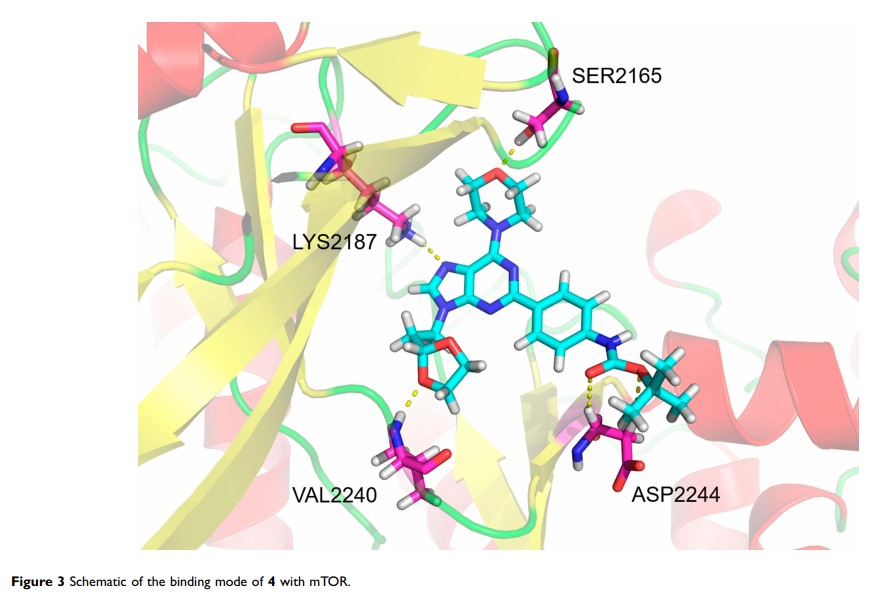
Methods: In this study, five small-molecular compounds that could serve as potential mTOR-specific inhibitors were identified by virtual screening. The activity of tert-butyl (4-(9-(2-(1,3-dioxolan-2-yl)ethyl)-6-morpholino-9H-purin-2-yl)phenyl)carbamate (compound 4) was measured by enzyme test and Western blot, and its antitumor effect on HCC was examined in nude mice subcutaneous tumor model.
Results: The results showed that 4 is the most effective one in inhibiting the activation of mTOR kinase (mTOR IC50 = 17.52± 3.67 nmol/L) among the five lead compounds. Further research in this study indicated that treatment with 4 enhanced the sensitivity of HCC cells to the molecular-targeted agents, such as sorafenib, regorafenib, lenvatinib, anlotinib, and apatinib. In addition, this research indicated that mTOR was correlated with the poor prognosis in patients with advanced HCC who received sorafenib.
Conclusion: Our study identified a new type of small-molecular inhibitors of mTOR and confirmed their ability to enhance the antitumor effect of molecular-targeted agents on advanced HCC.
Keywords: hepatocellular carcinoma, mTOR, molecular-targeted agents, virtual screening