112158
论文已发表
注册即可获取德孚的最新动态
IF 收录期刊
- 3.4 Breast Cancer (Dove Med Press)
- 3.2 Clin Epidemiol
- 2.6 Cancer Manag Res
- 2.9 Infect Drug Resist
- 3.7 Clin Interv Aging
- 5.1 Drug Des Dev Ther
- 3.1 Int J Chronic Obstr
- 6.6 Int J Nanomed
- 2.6 Int J Women's Health
- 2.9 Neuropsych Dis Treat
- 2.8 OncoTargets Ther
- 2.0 Patient Prefer Adher
- 2.2 Ther Clin Risk Manag
- 2.5 J Pain Res
- 3.0 Diabet Metab Synd Ob
- 3.2 Psychol Res Behav Ma
- 3.4 Nat Sci Sleep
- 1.8 Pharmgenomics Pers Med
- 2.0 Risk Manag Healthc Policy
- 4.1 J Inflamm Res
- 2.0 Int J Gen Med
- 3.4 J Hepatocell Carcinoma
- 3.0 J Asthma Allergy
- 2.2 Clin Cosmet Investig Dermatol
- 2.4 J Multidiscip Healthc

本文章已被撤回:miR-96-5p 通过靶向 CDK1 抑制鼻咽癌的进展
Authors Luo X, He X, Liu X, Zhong L, Hu W
Received 4 February 2020
Accepted for publication 2 July 2020
Published 30 July 2020 Volume 2020:13 Pages 7467—7477
DOI https://doi.org/10.2147/OTT.S248338
Checked for plagiarism Yes
Review by Single anonymous peer review
Peer reviewer comments 3
Editor who approved publication: Dr William Cho
***本文章已被撤回***
Background: Nasopharyngeal carcinoma (NPC) is a malignant tumor that occurs in the nasopharyngeal mucosa. Clinically, radiotherapy is the preferred treatment for NPC, and cervical lymph node metastasis is easy to emerge in the early stage. Therefore, this study aimed to investigate the role and potential molecular mechanisms of miR-96-5p in NPC cells to develop new therapeutic horizons.
Methods: The expression of miR-96-5p and CDK1 was measured by RT-qPCR or Western blot. The target relationship between miR-96-5p and CDK1 was confirmed by luciferase reporter assay. CCK-8, sphere formation, flow cytometry and colony formation assay were employed to examine cell viability, stem-like property, apoptosis and cycle, respectively. Male BALB/c nude mice model (6– 8 weeks, weigh 18– 20 g) was used to evaluate the effect of miR-96-5p on tumor growth in vivo.
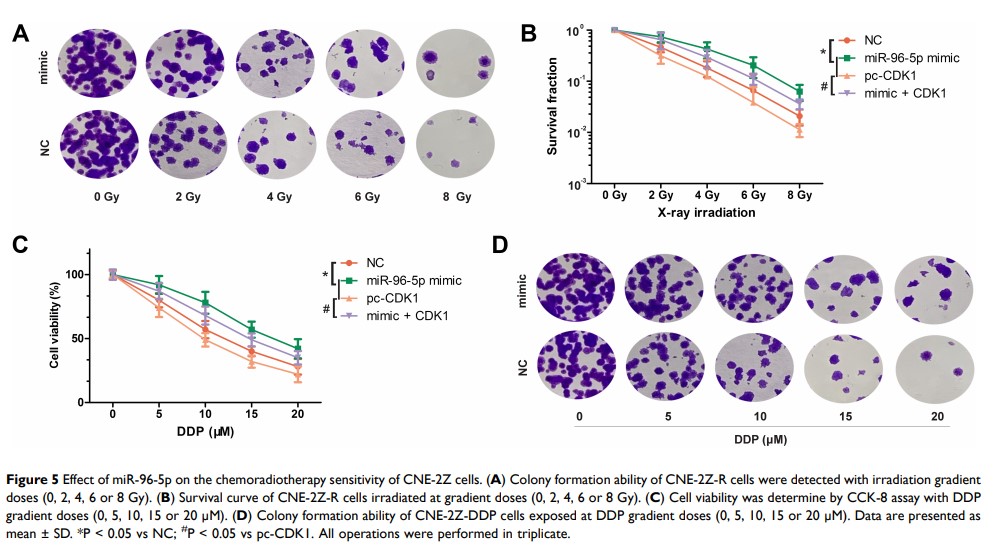
Results: miR-96-5p was lowly expressed and CDK1 was highly expressed in NPC tissues and cell lines. CDK1 was identified as a direct target of miR-96-5p, and its expression was negatively regulated by miR-96-5p. By targeting CDK1, miR-96-5p overexpression significantly inhibited tumor sphere formation, promoted apoptosis and cell cycle arrest in CNE-2Z cells. Importantly, CCK-8 and colony formation assay demonstrated that elevated miR-96-5p enhanced the radiotherapy and chemotherapy sensitivity of CNE-2Z cells. Animal experiments showed that the overexpression of miR-96-5p reduced tumor weight and size in tumor-bearing mice and inhibited the expression of stem-like marker proteins and apoptosis-related proteins.
Conclusion: These results, together, suggested that miR-96-5p induced cell cycle arrest and apoptosis, inhibited stem-like property, and enhanced the radiochemical sensitivity of NPC by targeting CDK1. In short, miR-96-5p may be a diagnostic and therapeutic target for NPC.
Keywords: nasopharyngeal carcinoma, miR-96-5p, CDK1, stem-like property, radio-chemosensitivity