115195
论文已发表
注册即可获取德孚的最新动态
IF 收录期刊
- 3.6 Breast Cancer (Dove Med Press)
- 4.3 Clin Epidemiol
- 2.6 Cancer Manag Res
- 3.2 Infect Drug Resist
- 4.1 Clin Interv Aging
- 6.1 Drug Des Dev Ther
- 4.1 Int J Chronic Obstr
- 8.7 Int J Nanomed
- 2.5 Int J Women's Health
- 3.2 Neuropsych Dis Treat
- 2.4 OncoTargets Ther
- 2.6 Patient Prefer Adher
- 2.6 Ther Clin Risk Manag
- 3.1 J Pain Res
- 3.5 Diabet Metab Synd Ob
- 4.5 Psychol Res Behav Ma
- 3.4 Nat Sci Sleep
- 2.4 Pharmgenomics Pers Med
- 2.6 Risk Manag Healthc Policy
- 4.6 J Inflamm Res
- 2.3 Int J Gen Med
- 3.9 J Hepatocell Carcinoma
- 3.3 J Asthma Allergy
- 2.5 Clin Cosmet Investig Dermatol
- 3.0 J Multidiscip Healthc

放射疗法可提高食管癌细胞的 12-LOX 和 CCL5 水平,并通过 THP-1 衍生的巨噬细胞促进癌症转移
Authors Mi S, Qu Y, Chen X, Wen Z, Chen P, Cheng Y
Received 11 April 2020
Accepted for publication 15 July 2020
Published 5 August 2020 Volume 2020:13 Pages 7719—7733
DOI https://doi.org/10.2147/OTT.S257852
Checked for plagiarism Yes
Review by Single anonymous peer review
Peer reviewer comments 2
Editor who approved publication: Dr Leo Jen-Liang Su
Background: Dioxygenase 12-lipoxygenase (12-LOX) plays an important role in tumorigenesis and promotes angiogenesis and proliferation in several tumors, including prostate and breast tumors. Radiotherapy enhances the expression of 12-LOX in esophageal squamous cell carcinoma (ESCC). Two types of macrophages can be found in the tumor microenvironment. The M2 subtype accelerates tumor progression; however, the relationship between 12-LOX and macrophages is not well established. Here, we explore this interaction and its effect on ESCC to induce tumor progression.
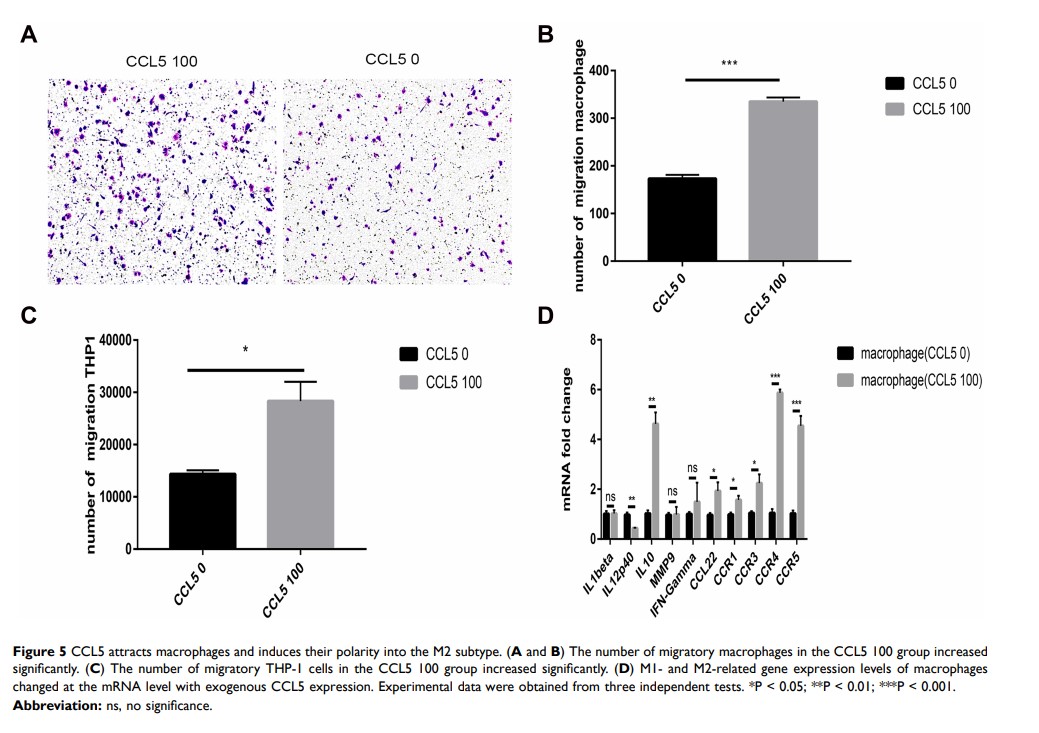
Methods and Results: RT-qPCR and Western blot analyses were used to evaluate the mRNA and protein expression levels of 12-LOX and chemokine (C-C motif) ligand 5 (CCL5) in ESCC after radiotherapy. CCL5 expression was increased by 12-LOX upregulation but was suppressed by the well-established 12-LOX inhibitor, baicalein. Furthermore, CCL5 attracted and repolarized human myeloid leukemia mononuclear cells (THP-1)-derived macrophages. Finally, ESCC co-culture with THP-1-derived macrophages led to a strong cancer migratory capacity.
Conclusion: Radiation-induced 12-LOX overexpression in ESCC upregulates CCL5 expression, thereby attracting THP-1-derived macrophages and promoting their polarization to the M2 subtype, which enhances cellular metastasis.
Keywords: radiotherapy, 12-LOX, CCL5, macrophage