115195
论文已发表
注册即可获取德孚的最新动态
IF 收录期刊
- 3.6 Breast Cancer (Dove Med Press)
- 4.3 Clin Epidemiol
- 2.6 Cancer Manag Res
- 3.2 Infect Drug Resist
- 4.1 Clin Interv Aging
- 6.1 Drug Des Dev Ther
- 4.1 Int J Chronic Obstr
- 8.7 Int J Nanomed
- 2.5 Int J Women's Health
- 3.2 Neuropsych Dis Treat
- 2.4 OncoTargets Ther
- 2.6 Patient Prefer Adher
- 2.6 Ther Clin Risk Manag
- 3.1 J Pain Res
- 3.5 Diabet Metab Synd Ob
- 4.5 Psychol Res Behav Ma
- 3.4 Nat Sci Sleep
- 2.4 Pharmgenomics Pers Med
- 2.6 Risk Manag Healthc Policy
- 4.6 J Inflamm Res
- 2.3 Int J Gen Med
- 3.9 J Hepatocell Carcinoma
- 3.3 J Asthma Allergy
- 2.5 Clin Cosmet Investig Dermatol
- 3.0 J Multidiscip Healthc

胡桃宁对脑缺血的保护作用可通过抑制 VEGF/VEGFR2 信号传导降低血脑屏障通透性
Authors Liu J, Chen L, Zhang X, Pan L, Jiang L
Received 22 February 2020
Accepted for publication 6 July 2020
Published 5 August 2020 Volume 2020:14 Pages 3165—3175
DOI https://doi.org/10.2147/DDDT.S250904
Checked for plagiarism Yes
Review by Single anonymous peer review
Peer reviewer comments 2
Editor who approved publication: Dr Yan Zhu
Introduction: Ischemic brain injury due to stroke or other pathologies is a major contributor to disability and mortality worldwide. Upon the occurrence of stroke, neuronal cells undergo apoptosis due to the deprivation of oxygen and nutrients and failure of the blood–brain barrier (BBB). In the moments immediately following a stroke, widespread perfusion resulting from hyperpermeability is accompanied by an acute inflammatory response, which induces neovascularization and often permanent neurological injury. Vascular endothelial growth factor (VEGF) and its receptor VEGF receptor 2 (VEGFR2) have been targeted to suppress cerebral ischemia. Recently, natural products including flavonoids, such as juglanin, have been receiving increasing attention for their impressive physiological effects.
Methods: Twenty mg/kg body weight juglanin was administrated for 3 weeks before inducing middle cerebral artery occlusion (MCAO) in mice. The animal brain infarction volume, neurological deficit score, blood–brain barrier permeability, and the expression of tight junction proteins were evaluated. Endothelial permeability and tight junction protein expression were also assessed in brain microvascular endothelial cells (HMBVECs) exposed to oxygen–glucose deprivation/reperfusion (OGD/R).
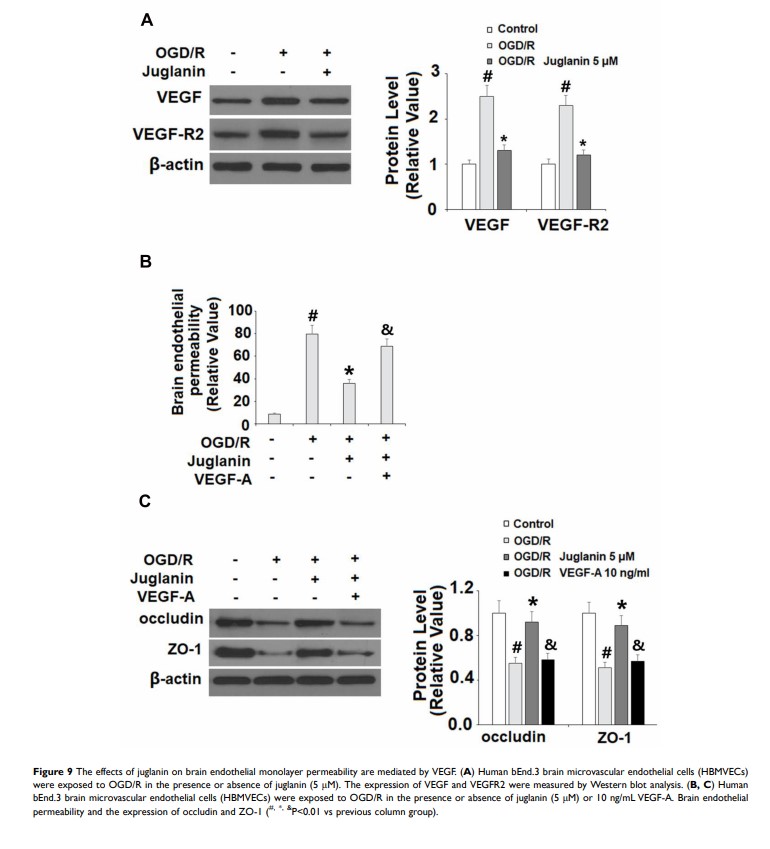
Results: Juglanin significantly reduced occlusion-induced infarct volume and improved neurological score by suppressing BBB hyperpermeability. Juglanin inhibited both the mRNA and protein expression of VEGF and VEGFR2 and restored the normal expression of occludin and zonula occludens-1 (ZO-1), two important tight junction proteins, in MCAO mice. Meanwhile, the results of in vitro experiments show that the protective effects of juglanin against increased BBB permeability and reduced tight junction functionality are dependent on the VEGF/VEGFR2 signaling pathway, as evidenced by the capacity of exogenous VEGF-A to abolish the effects of juglanin.
Conclusion: Our findings indicate a potent ability of juglanin to prevent neuronal injury resulting from cerebral ischemia by modulating the VEGF/VEGFR2 signaling pathway. Further research will help elucidate the exact mechanisms behind the protective effects of juglanin.
Keywords: cerebral ischemia, stroke, juglanin, VEGF, VEGFR2, tight junction proteins, blood–brain barrier, BBB permeability