115195
论文已发表
注册即可获取德孚的最新动态
IF 收录期刊
- 3.6 Breast Cancer (Dove Med Press)
- 4.3 Clin Epidemiol
- 2.6 Cancer Manag Res
- 3.2 Infect Drug Resist
- 4.1 Clin Interv Aging
- 6.1 Drug Des Dev Ther
- 4.1 Int J Chronic Obstr
- 8.7 Int J Nanomed
- 2.5 Int J Women's Health
- 3.2 Neuropsych Dis Treat
- 2.4 OncoTargets Ther
- 2.6 Patient Prefer Adher
- 2.6 Ther Clin Risk Manag
- 3.1 J Pain Res
- 3.5 Diabet Metab Synd Ob
- 4.5 Psychol Res Behav Ma
- 3.4 Nat Sci Sleep
- 2.4 Pharmgenomics Pers Med
- 2.6 Risk Manag Healthc Policy
- 4.6 J Inflamm Res
- 2.3 Int J Gen Med
- 3.9 J Hepatocell Carcinoma
- 3.3 J Asthma Allergy
- 2.5 Clin Cosmet Investig Dermatol
- 3.0 J Multidiscip Healthc

晨起症状与 COPD 未来加重风险的关系
Authors Sun T, Li X, Cheng W, Peng Y, Zhao Y, Liu C, Zeng Y, Chen Y, Cai S, Chen P
Received 25 March 2020
Accepted for publication 15 July 2020
Published 5 August 2020 Volume 2020:15 Pages 1899—1907
DOI https://doi.org/10.2147/COPD.S255030
Checked for plagiarism Yes
Review by Single anonymous peer review
Peer reviewer comments 2
Editor who approved publication: Dr Richard Russell
Background: The morning is the most troublesome time of day for patients with chronic obstructive pulmonary disease (COPD). However, the association of morning symptoms and COPD exacerbations in longitudinal follow-up has not been studied. In this study, we mainly aimed to investigate the relationship between morning symptoms and exacerbations over a one-year follow-up period. And the secondary aim was an investigation of the association between morning symptoms and baseline clinical features.
Patients and Methods: Ninety-two patients with stable COPD provided the baseline information. Morning symptoms were assessed with the Chinese version of Chronic Obstructive Pulmonary Disease Morning Symptom Diary (Ch-COPD-MSD); the median morning symptoms score was used as a cut-off to separate the study cohort in two groups. Modified Medical Research Council (mMRC), COPD assessment test (CAT), and Clinical COPD Questionnaire (CCQ) were used and exacerbation history of the previous year was recorded. Seventy-eight patients (84.8%) completed the longitudinal follow-up of exacerbations.
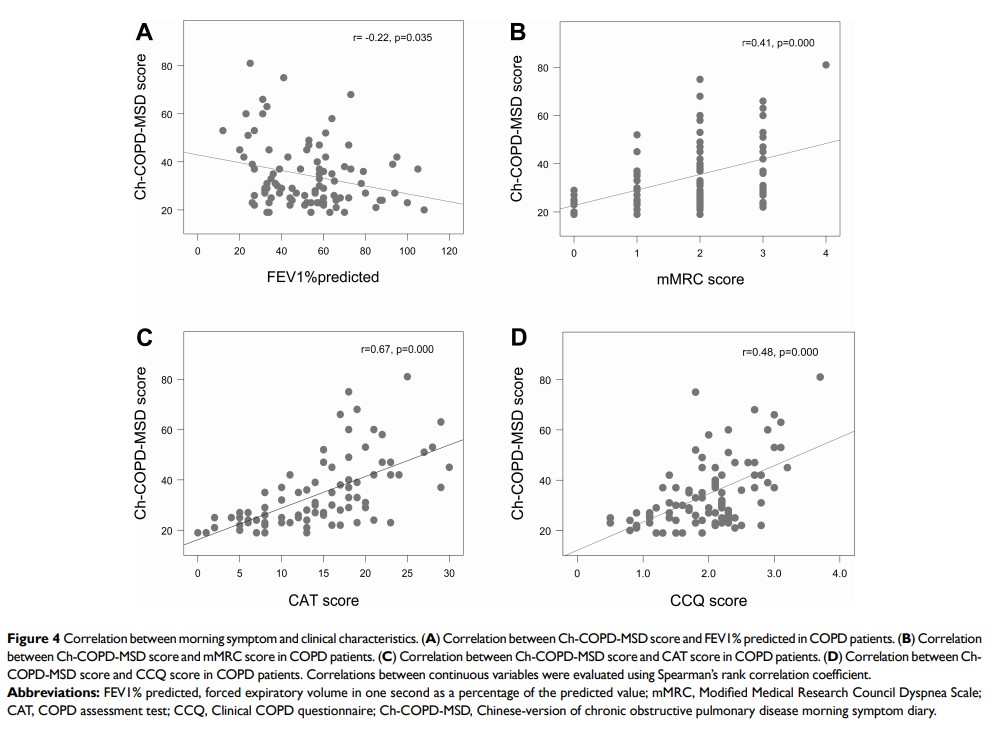
Results: The median morning symptoms score was 30 in stable COPD patients. Morning symptoms severity was different between COPD Global Initiative for Chronic Obstructive Lung Disease (GOLD) groups (p < 0.001). Patients with high morning symptoms (score > 30) had higher scores of mMRC, CAT, and CCQ (p < 0.05). CAT score was an independent risk factor of morning symptoms. During follow-up, 41% of patients experienced ≥ 1 exacerbation. The frequency of severe exacerbations was higher in patients with high morning symptoms compared to patients with low morning symptoms (p < 0.005). The Ch-COPD-MSD score could predict future severe exacerbations; the area under the ROC curve was 0.751 (95% CI: 0.633– 0.868, p =0.002).
Conclusion: Worse health status and more dyspnea symptom were associated with increased severity of morning symptoms. Morning symptoms were most strongly related to future severe exacerbations and could predict future exacerbations in patients with COPD.
Keywords: chronic obstructive pulmonary disease, morning symptoms, future exacerbations