119942
论文已发表
注册即可获取德孚的最新动态
IF 收录期刊
- 3.6 Breast Cancer (Dove Med Press)
- 4.3 Clin Epidemiol
- 2.6 Cancer Manag Res
- 3.2 Infect Drug Resist
- 4.1 Clin Interv Aging
- 6.1 Drug Des Dev Ther
- 4.1 Int J Chronic Obstr
- 8.7 Int J Nanomed
- 2.5 Int J Women's Health
- 3.2 Neuropsych Dis Treat
- 2.4 OncoTargets Ther
- 2.6 Patient Prefer Adher
- 2.6 Ther Clin Risk Manag
- 3.1 J Pain Res
- 3.5 Diabet Metab Synd Ob
- 4.5 Psychol Res Behav Ma
- 3.4 Nat Sci Sleep
- 2.4 Pharmgenomics Pers Med
- 2.6 Risk Manag Healthc Policy
- 4.6 J Inflamm Res
- 2.3 Int J Gen Med
- 3.9 J Hepatocell Carcinoma
- 3.3 J Asthma Allergy
- 2.5 Clin Cosmet Investig Dermatol
- 3.0 J Multidiscip Healthc

饥饿素额外的预后价值对老年急性心力衰竭患者的死亡率和再入院的影响
Authors Yuan Y, Huang F, Deng C, Zhu P
Received 29 April 2020
Accepted for publication 20 July 2020
Published 11 August 2020 Volume 2020:15 Pages 1353—1363
DOI https://doi.org/10.2147/CIA.S259889
Checked for plagiarism Yes
Review by Single anonymous peer review
Peer reviewer comments 2
Editor who approved publication: Dr Zhi-Ying Wu
Purpose: To evaluate the prognostic value of ghrelin, a growth hormone-releasing peptide, for mortality and readmission in elderly patients with acute heart failure (AHF).
Patients and Methods: We measured plasma ghrelin and pro B-type natriuretic peptide (NT-proBNP) levels upon emergency admission in 241 prospectively recruited elderly AHF patients (61.0% men). The outcomes were all-cause mortality and/or readmission due to heart failure (HF). Multivariate Cox proportional hazards regression analyses were used to evaluate the prognostic value of ghrelin. Discrimination, calibration, and reclassification indices were compared between models, with or without ghrelin.
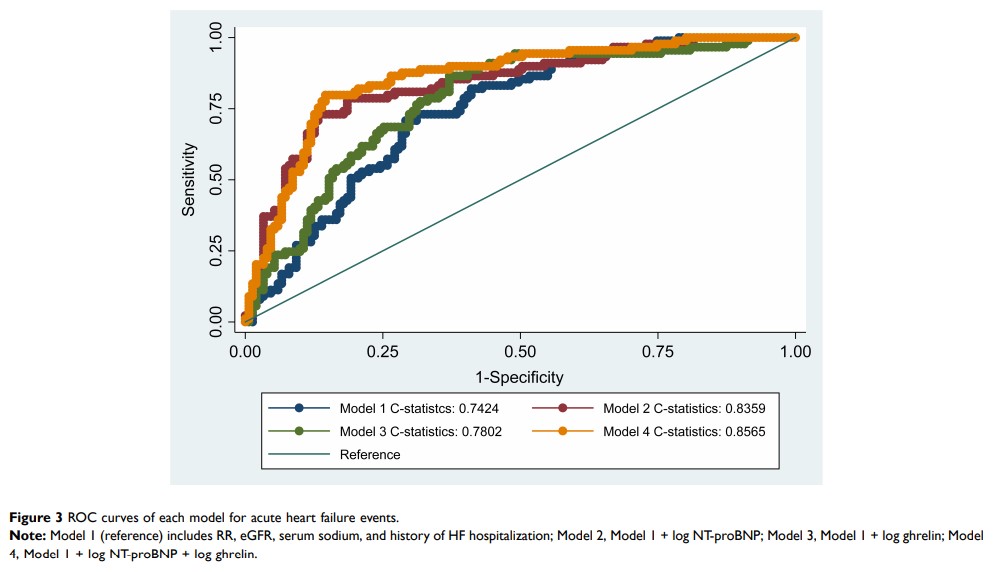
Results: During 1.2 years of follow-up, we observed 90 events (57 deaths and 33 readmissions due to HF). Plasma ghrelin levels were significantly elevated in elderly AHF patients, when compared to healthy control subjects (P < 0.001). Patients with events had significantly higher baseline ghrelin levels, when compared to those without (P < 0.001). Ghrelin levels were positively correlated with NT-proBNP levels and HF severity, whereas they were negatively correlated with nutritional status (all P < 0.05). Log transformed ghrelin levels were independently associated with AHF events (hazard ratio = 2.64, 95% confidence interval = 1.11– 6.25, P = 0.028). The incorporation of ghrelin into the reference model, or reference with the NT-proBNP model, both improved C-statistics (from 0.742– 0.780 and 0.836– 0.857; P = 0.074 and 0.044, respectively), resulting in an improvement in net reclassification index (14.42% and 10.45%, P = 0.020 and 0.025, respectively), and integrated discrimination index (5.64% and 3.60%, both P < 0.001). Patients who displayed the above NT-proBNP and ghrelin median levels had a markedly higher risk of AHF adverse events (P < 0.001).
Conclusion: Plasma ghrelin is an independent predictor of adverse events in elderly AHF patients. Ghrelin may provide additional value to clinical parameters or NT-proBNP for prognostic risk stratification in AHF.
Keywords: ghrelin, acute heart failure, prognosis, elderly