119942
论文已发表
注册即可获取德孚的最新动态
IF 收录期刊
- 3.6 Breast Cancer (Dove Med Press)
- 4.3 Clin Epidemiol
- 2.6 Cancer Manag Res
- 3.2 Infect Drug Resist
- 4.1 Clin Interv Aging
- 6.1 Drug Des Dev Ther
- 4.1 Int J Chronic Obstr
- 8.7 Int J Nanomed
- 2.5 Int J Women's Health
- 3.2 Neuropsych Dis Treat
- 2.4 OncoTargets Ther
- 2.6 Patient Prefer Adher
- 2.6 Ther Clin Risk Manag
- 3.1 J Pain Res
- 3.5 Diabet Metab Synd Ob
- 4.5 Psychol Res Behav Ma
- 3.4 Nat Sci Sleep
- 2.4 Pharmgenomics Pers Med
- 2.6 Risk Manag Healthc Policy
- 4.6 J Inflamm Res
- 2.3 Int J Gen Med
- 3.9 J Hepatocell Carcinoma
- 3.3 J Asthma Allergy
- 2.5 Clin Cosmet Investig Dermatol
- 3.0 J Multidiscip Healthc

负载酞菁铁 (II)并靶向 AS1411 适配体的纳米粒子:用于乳腺癌双模态成像和光热疗法的纳米复合物
Authors He Y, Wang M, Fu M, Yuan X, Luo Y, Qiao B, Cao J, Wang Z, Hao L, Yuan G
Received 16 March 2020
Accepted for publication 9 July 2020
Published 11 August 2020 Volume 2020:15 Pages 5927—5949
DOI https://doi.org/10.2147/IJN.S254108
Checked for plagiarism Yes
Review by Single anonymous peer review
Peer reviewer comments 2
Editor who approved publication: Dr Mian Wang
Purpose: A multi-functional nanoplatform with diagnostic imaging and targeted treatment functions has aroused much interest in the nanomedical research field and has been paid more attention in the field of tumor diagnosis and treatment. However, some existing nano-contrast agents have encountered difficulties in different aspects during clinical promotion, such as complicated preparation process and low specificity. Therefore, it is urgent to find a nanocomplex with good targeting effect, high biocompatibility and significant therapeutic effect for the integration of diagnosis and treatment and clinical transformation.
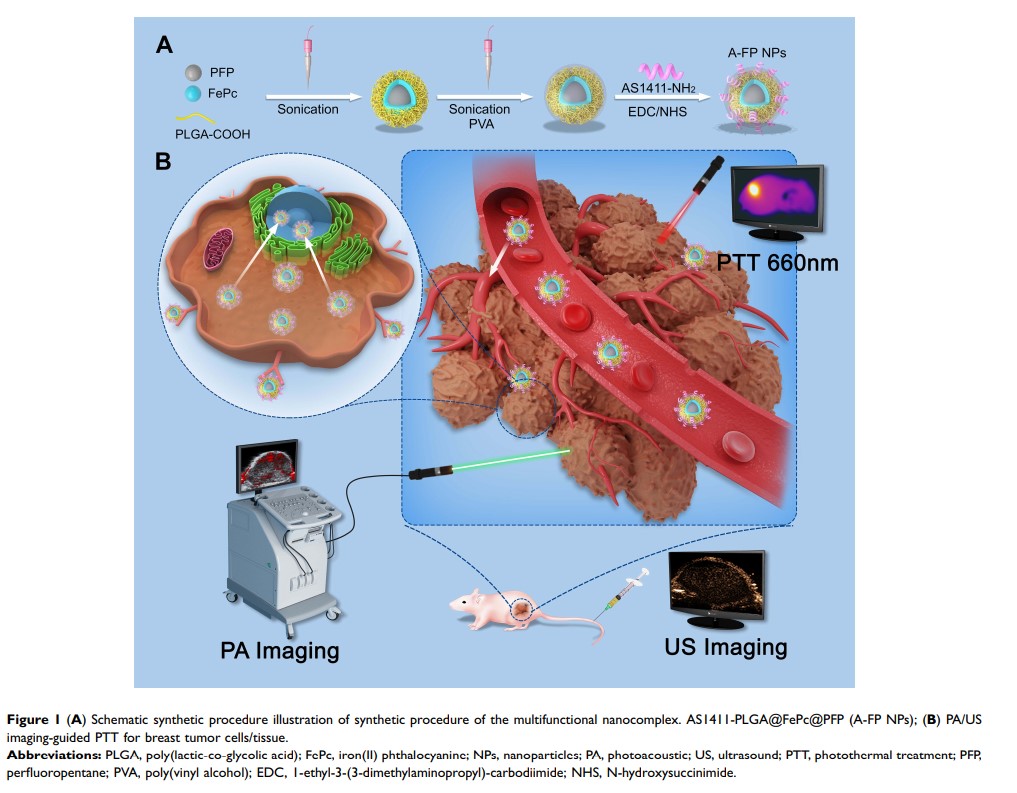
Materials and Methods: Nanoparticles (NPs) targeting breast cancer were synthesized by phacoemulsification which had liquid fluorocarbon perfluoropentane(PFP) in the core and were loaded with Iron(II) phthalocyanine (FePc) on the shell. The aptamer (APT) AS1411 was outside the shell used as a molecular probe. Basic characterization and targeting abilities of the NPs were tested, and their cytotoxicity and biological safety in vivo were evaluated through CCK-8 assay and blood bio-chemical analysis. The photoacoustic (PA) and ultrasound (US) imaging system were used to assess the effects of AS1411-PLGA@FePc@PFP (A-FP NPs) as dual modal contrast agent in vitro and in vivo. The effects of photothermal therapy (PTT) in vitro and in vivo were evaluated through MCF-7 cells and tumor-bearing nude mouse models.
Results: A-FP NPs, with good stability, great biocompatibility and low toxicity, were of 201.87 ± 1.60 nm in diameter, and have an active targeting effect on breast cancer cells and tissues. With the help of PA/US imaging, it was proved to be an excellent dual modal contrast agent for diagnosis and guidance of targeted therapy. Meanwhile, it can heat up under near-infrared (NIR) laser irradiation and has achieved obvious antitumor effect both in vitro and in vivo experiments.
Conclusion: As a kind of nanomedicine, A-FP NPs can be used in the integration of diagnosis and treatment. The treatment effects and biocompatibility in vivo may provide new thoughts in the clinical transformation of nanomedicine and early diagnosis and treatment of breast cancer.
Keywords: poly (lactic-co-glycolic) acid, theranostics, phase transition, photoacoustic imaging, ultrasound imaging, near infrared