119942
论文已发表
注册即可获取德孚的最新动态
IF 收录期刊
- 3.6 Breast Cancer (Dove Med Press)
- 4.3 Clin Epidemiol
- 2.6 Cancer Manag Res
- 3.2 Infect Drug Resist
- 4.1 Clin Interv Aging
- 6.1 Drug Des Dev Ther
- 4.1 Int J Chronic Obstr
- 8.7 Int J Nanomed
- 2.5 Int J Women's Health
- 3.2 Neuropsych Dis Treat
- 2.4 OncoTargets Ther
- 2.6 Patient Prefer Adher
- 2.6 Ther Clin Risk Manag
- 3.1 J Pain Res
- 3.5 Diabet Metab Synd Ob
- 4.5 Psychol Res Behav Ma
- 3.4 Nat Sci Sleep
- 2.4 Pharmgenomics Pers Med
- 2.6 Risk Manag Healthc Policy
- 4.6 J Inflamm Res
- 2.3 Int J Gen Med
- 3.9 J Hepatocell Carcinoma
- 3.3 J Asthma Allergy
- 2.5 Clin Cosmet Investig Dermatol
- 3.0 J Multidiscip Healthc

摄入血清镁对恶性肿瘤患者急性肾脏损伤的影响
Authors Shen D, Wang Y, Xu J, Li Y, Chen X, Guo M, Geng X, Ding X, Xu X
Received 21 May 2020
Accepted for publication 22 July 2020
Published 11 August 2020 Volume 2020:12 Pages 7199—7207
DOI https://doi.org/10.2147/CMAR.S262674
Checked for plagiarism Yes
Review by Single anonymous peer review
Peer reviewer comments 2
Editor who approved publication: Dr Eileen O'Reilly
Purpose: This study aimed to explore the relationship between serum magnesium (Mg) levels and incidence of acute kidney injury (AKI) in patients with malignancy.
Patients and Methods: Hospitalized patients with malignancy between October 1, 2014 and September 30, 2015 in Zhongshan Hospital were recruited. All relevant data were extracted from the electronic database.
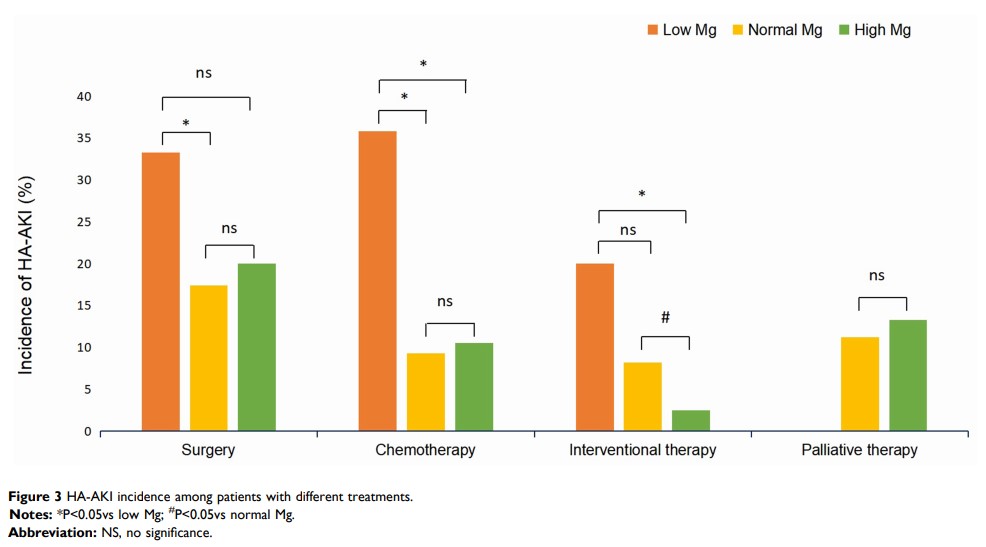
Results: All 99,845 patients were enrolled and 16,082 eligible patients were divided into three groups according to admission serum Mg levels in this study. Among them, 2383 (14.8%) cases were diagnosed as AKI. The incidence of AKI showed a V trend with the increase of serum Mg level. The effect of low serum Mg level on the onset of AKI seems to be greater than high serum Mg level. Patients with low serum Mg level spent a longer time in the hospital than those with normal serum Mg level and high serum Mg level. Further, multivariate logistic regression model was used to assess the importance of serum Mg level to influence AKI incidence. There was a higher AKI incidence in patients with magnesium level 0.66mmol/L or less (aOR=2.438, 95% CI=1.696, 3.505).
Conclusion: Low serum Mg level might be a independent risk factor for AKI in patients with malignancy. Appropriate clinical intervention for serum Mg disorder may contribute to decreasing the incidence of AKI and the possibility of poor outcomes in cancer patients.
Keywords: hypomagnesemia, cancer, acute kidney injury, electrolyte disorders