115195
论文已发表
注册即可获取德孚的最新动态
IF 收录期刊
- 3.6 Breast Cancer (Dove Med Press)
- 4.3 Clin Epidemiol
- 2.6 Cancer Manag Res
- 3.2 Infect Drug Resist
- 4.1 Clin Interv Aging
- 6.1 Drug Des Dev Ther
- 4.1 Int J Chronic Obstr
- 8.7 Int J Nanomed
- 2.5 Int J Women's Health
- 3.2 Neuropsych Dis Treat
- 2.4 OncoTargets Ther
- 2.6 Patient Prefer Adher
- 2.6 Ther Clin Risk Manag
- 3.1 J Pain Res
- 3.5 Diabet Metab Synd Ob
- 4.5 Psychol Res Behav Ma
- 3.4 Nat Sci Sleep
- 2.4 Pharmgenomics Pers Med
- 2.6 Risk Manag Healthc Policy
- 4.6 J Inflamm Res
- 2.3 Int J Gen Med
- 3.9 J Hepatocell Carcinoma
- 3.3 J Asthma Allergy
- 2.5 Clin Cosmet Investig Dermatol
- 3.0 J Multidiscip Healthc

在偏头痛治疗中,针灸及各种对照治疗的比较:过去 10 年随机对照试验的综述
Authors Ni X, Dong L, Tian T, Liu L, Li X, Li F, Zhao L
Received 22 April 2020
Accepted for publication 9 July 2020
Published 12 August 2020 Volume 2020:13 Pages 2033—2064
DOI https://doi.org/10.2147/JPR.S259390
Checked for plagiarism Yes
Review by Single anonymous peer review
Peer reviewer comments 2
Editor who approved publication: Dr Michael Schatman
Background: Migraine is defined as a recurrent headache of moderate to severe intensity that seriously affects the quality of life. Recent clinical trials have confirmed that acupuncture is effective in treating migraine. We aimed to review the effectiveness of acupuncture in the treatment of migraine by comparing treatment and various control groups in accordance with the newly published guidelines for systematic reviews.
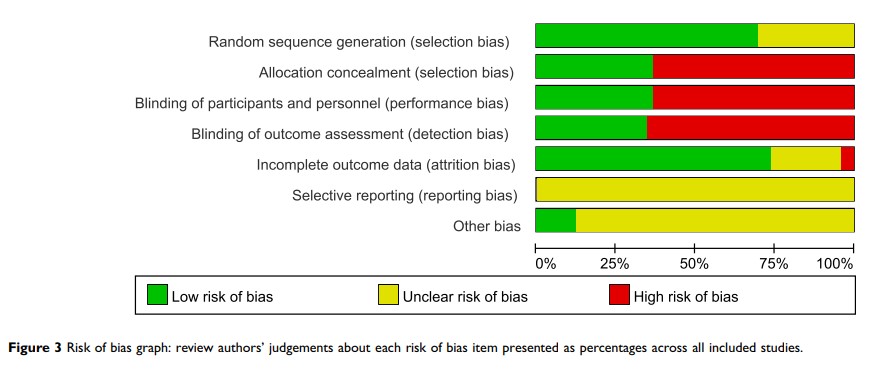
Materials and Methods: The following databases were searched for relevant articles published from January 1, 2010 to December 31, 2019: Embase, PubMed, Medline, Cochrane Library, and four Chinese databases. The present review included randomized controlled trials in which acupuncture was the sole treatment or an adjunctive treatment for migraine. Two researchers independently conducted the study selection, data extraction, and quality assessment processes. Disagreements between reviewers were solved by discussion and data reanalysis. The quality of each included study was evaluated using the Cochrane Collaboration risk-of-bias assessment method and the Standards for Reporting Interventions in Controlled Trials of Acupuncture (STRICTA) checklist.
Results: Forty-nine studies were analyzed and ranked based on the latest STRICTA and Cochrane Collaboration risk-of-bias assessment standards. The analysis revealed that acupuncture reduced headache frequency compared with no treatment (mean difference [MD] = − 1.80, P < 0.00001, 95% confidence interval [CI] − 2.34 to − 1.26) and western medicine (MD = − 1.75, P = 0.003, 95% CI − 2.91 to − 0.58). Headache frequency did not significantly differ between patients who received real acupuncture versus those who received sham acupuncture (MD = − 0.64, P = 0.24, 95% CI − 1.70 to 0.42).
Conclusion: The present review evaluated the current research on the use of acupuncture for migraine, compared with various control treatments. The evidence for the effectiveness of acupuncture in controlling migraine is still limited due to the low quality of the published studies.
Keywords: acupuncture, migraine, review