119661
论文已发表
注册即可获取德孚的最新动态
IF 收录期刊
- 3.6 Breast Cancer (Dove Med Press)
- 4.3 Clin Epidemiol
- 2.6 Cancer Manag Res
- 3.2 Infect Drug Resist
- 4.1 Clin Interv Aging
- 6.1 Drug Des Dev Ther
- 4.1 Int J Chronic Obstr
- 8.7 Int J Nanomed
- 2.5 Int J Women's Health
- 3.2 Neuropsych Dis Treat
- 2.4 OncoTargets Ther
- 2.6 Patient Prefer Adher
- 2.6 Ther Clin Risk Manag
- 3.1 J Pain Res
- 3.5 Diabet Metab Synd Ob
- 4.5 Psychol Res Behav Ma
- 3.4 Nat Sci Sleep
- 2.4 Pharmgenomics Pers Med
- 2.6 Risk Manag Healthc Policy
- 4.6 J Inflamm Res
- 2.3 Int J Gen Med
- 3.9 J Hepatocell Carcinoma
- 3.3 J Asthma Allergy
- 2.5 Clin Cosmet Investig Dermatol
- 3.0 J Multidiscip Healthc

对基于多层几何模型的纳米经皮给药系统的皮肤药代动力学进行预测的有限元分析
Authors Gu Y, Gu Q, Yang Q, Yang M, Wang S, Liu J
Received 8 May 2020
Accepted for publication 30 July 2020
Published 12 August 2020 Volume 2020:15 Pages 6007—6018
DOI https://doi.org/10.2147/IJN.S261386
Checked for plagiarism Yes
Review by Single anonymous peer review
Peer reviewer comments 2
Editor who approved publication: Dr Linlin Sun
Background: Skin pharmacokinetics is an indispensable indication for studying the drug fate after administration of transdermal drug delivery systems (TDDS). However, the heterogeneity and complex skin structured with stratum corneum, viable epidermis, dermis, and subcutaneous tissue inevitably leads the drug diffusion coefficient (K p) to vary depending on the skin depth, which seriously limits the development of TDDS pharmacokinetics in full thickness skin.
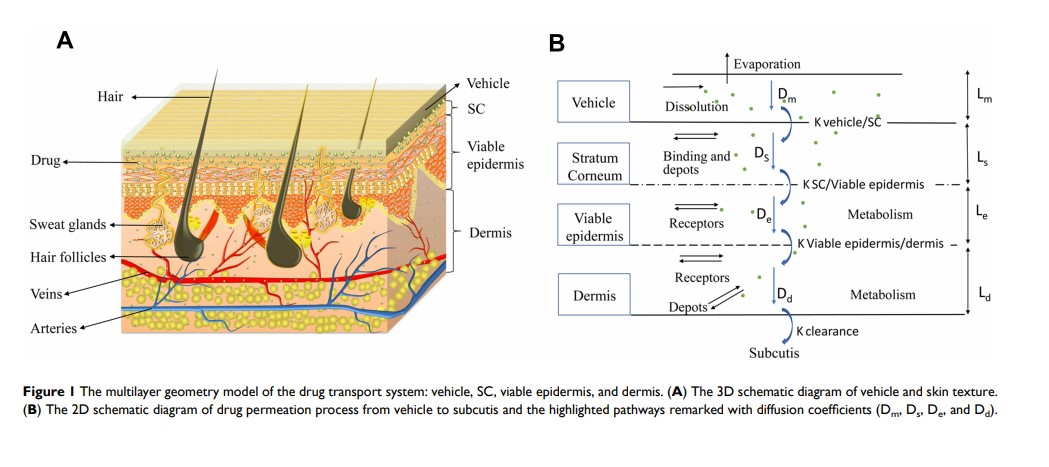
Methods: A multilayer geometry skin model was established and the K p of drug in SC, viable epidermis, and dermis was obtained using the technologies of molecular dynamics simulation, in vitro permeation experiments, and in vivo microdialysis, respectively. Besides, finite element analysis (FEA) based on drug K ps in different skin layers was applied to simulate the paeonol nanoemulsion (PAE-NEs) percutaneous dynamic penetration process in two and three dimensions. In addition, PAE-NEs skin pharmacokinetics profile obtained by the simulation was verified by in vivo experiment.
Results: Coarse-grained modeling of molecular dynamic simulation was successfully established and the K p of PAE in SC was 2.00× 10− 6 cm2/h. The K p of PAE-NE in viable epidermis and in dermis detected using penetration test and microdialysis probe technology, was 1.58× 10− 5 cm2/h and 3.20× 10− 5 cm2/h, respectively. In addition, the results of verification indicated that PAE-NEs skin pharmacokinetics profile obtained by the simulation was consistent with that by in vivo experiment.
Discussion: This study demonstrated that the FEA combined with the established multilayer geometry skin model could accurately predict the skin pharmacokinetics of TDDS.
Keywords: nano transdermal drug delivery system, skin pharmacokinetics, finite element analysis, multilayer geometry model, diffusion coefficient, paeonol nanoemulsion