115195
论文已发表
注册即可获取德孚的最新动态
IF 收录期刊
- 3.6 Breast Cancer (Dove Med Press)
- 4.3 Clin Epidemiol
- 2.6 Cancer Manag Res
- 3.2 Infect Drug Resist
- 4.1 Clin Interv Aging
- 6.1 Drug Des Dev Ther
- 4.1 Int J Chronic Obstr
- 8.7 Int J Nanomed
- 2.5 Int J Women's Health
- 3.2 Neuropsych Dis Treat
- 2.4 OncoTargets Ther
- 2.6 Patient Prefer Adher
- 2.6 Ther Clin Risk Manag
- 3.1 J Pain Res
- 3.5 Diabet Metab Synd Ob
- 4.5 Psychol Res Behav Ma
- 3.4 Nat Sci Sleep
- 2.4 Pharmgenomics Pers Med
- 2.6 Risk Manag Healthc Policy
- 4.6 J Inflamm Res
- 2.3 Int J Gen Med
- 3.9 J Hepatocell Carcinoma
- 3.3 J Asthma Allergy
- 2.5 Clin Cosmet Investig Dermatol
- 3.0 J Multidiscip Healthc

利用低频波动振幅测量糖尿病性视网膜病变患者异常的自发脑活动模式:一项静息态功能性磁共振成像研究
Authors Qi CX, Huang X, Shen Y
Received 22 April 2020
Accepted for publication 10 July 2020
Published 13 August 2020 Volume 2020:13 Pages 2833—2842
DOI https://doi.org/10.2147/DMSO.S259476
Checked for plagiarism Yes
Review by Single anonymous peer review
Peer reviewer comments 2
Editor who approved publication: Dr Antonio Brunetti
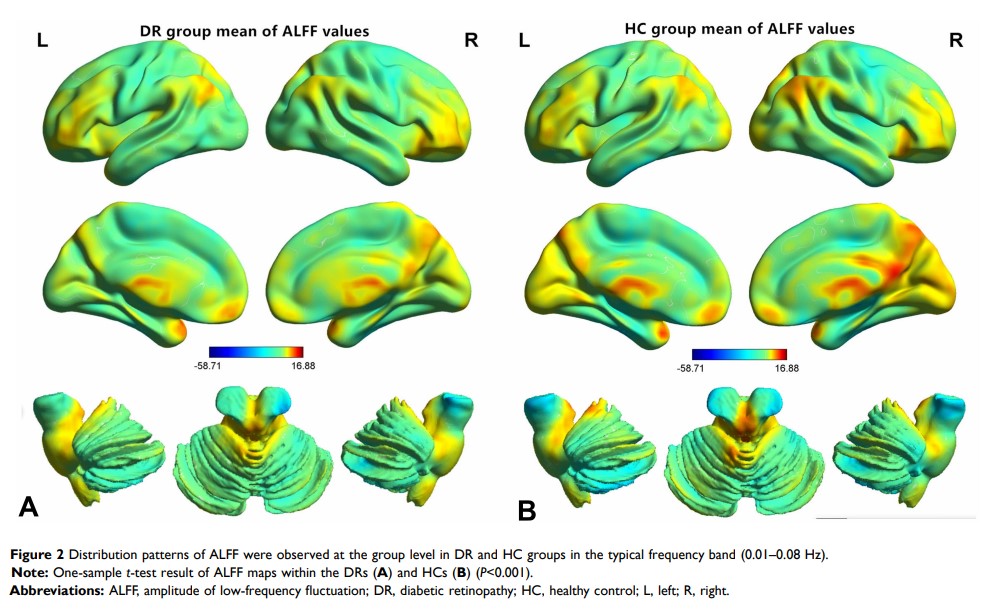
Objective: The current study aimed to apply the amplitude of low-frequency fluctuation (ALFF) method for investigating the spontaneous brain activity alterations and their relationships with clinical features in patients with diabetic retinopathy (DR).
Patients and Methods: In total, 35 patients with DR (18 males and 17 females) and 38 healthy control (HC) subjects (18 males and 20 females) were enrolled in this study. All participants underwent resting-state functional magnetic resonance imaging (rs-fMRI) scanning, respectively. The ALFF method was used to assess the spontaneous brain activity, while the mean ALFF signal values of patients with DR and HCs were classified by the receiver operating characteristic (ROC) curve. Correlation analysis was performed to calculate the relationship between the observed mean ALFF values of the altered regions in patients with DR and their clinical features.
Results: Compared with the HCs, patients with DR had significantly lower ALFF values in the left and right middle occipital gyrus (MOG). In contrast, patients with DR showed higher ALFF values in the left cerebellum (CER), left inferior temporal gyrus (ITG) and left hippocampus (Hipp). However, no relationship was observed between the mean ALFF signal values of the altered regions and clinical manifestations in the patients with DR.
Conclusion: We mainly found that patients with DR showed abnormal intrinsic brain activities in the left and right MOG, left CER, left ITG and left Hipp, which might provide useful information for explaining neural mechanisms in patients with DR.
Keywords: diabetic retinopathy, amplitude of low-frequency fluctuations, resting state, functional magnetic resonance imaging