119661
论文已发表
注册即可获取德孚的最新动态
IF 收录期刊
- 3.6 Breast Cancer (Dove Med Press)
- 4.3 Clin Epidemiol
- 2.6 Cancer Manag Res
- 3.2 Infect Drug Resist
- 4.1 Clin Interv Aging
- 6.1 Drug Des Dev Ther
- 4.1 Int J Chronic Obstr
- 8.7 Int J Nanomed
- 2.5 Int J Women's Health
- 3.2 Neuropsych Dis Treat
- 2.4 OncoTargets Ther
- 2.6 Patient Prefer Adher
- 2.6 Ther Clin Risk Manag
- 3.1 J Pain Res
- 3.5 Diabet Metab Synd Ob
- 4.5 Psychol Res Behav Ma
- 3.4 Nat Sci Sleep
- 2.4 Pharmgenomics Pers Med
- 2.6 Risk Manag Healthc Policy
- 4.6 J Inflamm Res
- 2.3 Int J Gen Med
- 3.9 J Hepatocell Carcinoma
- 3.3 J Asthma Allergy
- 2.5 Clin Cosmet Investig Dermatol
- 3.0 J Multidiscip Healthc

肉桂醛在治疗前列腺癌相关成纤维细胞时,可通过 Toll 样受体 4 阻止其对 T 细胞的抑制作用
Authors Mei J, Ma J, Xu Y, Wang Y, Hu M, Ma F, Qin Z, Xue R, Tao N
Received 7 December 2019
Accepted for publication 7 July 2020
Published 18 August 2020 Volume 2020:14 Pages 3363—3372
DOI https://doi.org/10.2147/DDDT.S241410
Checked for plagiarism Yes
Review by Single anonymous peer review
Peer reviewer comments 2
Editor who approved publication: Dr Yan Zhu
Introduction: Cancer-associated fibroblasts (CAFs) promote tumor progression; thus, drugs that can modify CAFs need to be identified.
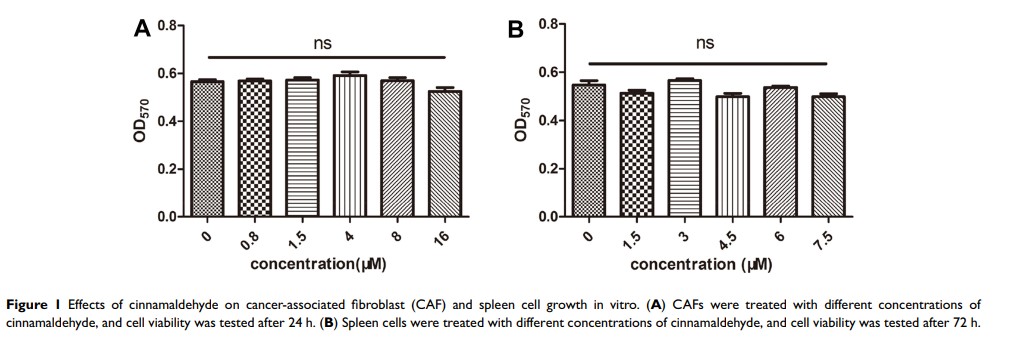
Methods: To test the effect of cinnamaldehyde on prostate CAFs, the 3-[4,5-dimethylthiazol-2-yl]-2,5-diphenyl-2H-tetrazolium bromide assay was used to determine their survival. When spleen cells were treated with CAF supernatant, the proliferation of T cells was inhibited as determined by flow cytometry. After cinnamaldehyde treatment, this immunosuppressive function of CAFs was partially reversed. To explore the molecular mechanism, Western blotting and the quantitative real-time polymerase chain reaction were applied, and TLR4-dependent signaling pathway-related protein and mRNA levels were quantified.
Results: Cinnamaldehyde acted on the TLR4-dependent signaling pathway, altering the function of CAFs such that its supernatant no longer inhibited the proliferation of T cells.
Conclusion: These data indicate that cinnamaldehyde can modify the functions of CAFs, which may be helpful for treating tumors. Cinnamaldehyde can suppress CAF T-cell inhibition.
Keywords: cinnamaldehyde, cancer-associated fibroblasts, prostate cancer, TLR4