119942
论文已发表
注册即可获取德孚的最新动态
IF 收录期刊
- 3.6 Breast Cancer (Dove Med Press)
- 4.3 Clin Epidemiol
- 2.6 Cancer Manag Res
- 3.2 Infect Drug Resist
- 4.1 Clin Interv Aging
- 6.1 Drug Des Dev Ther
- 4.1 Int J Chronic Obstr
- 8.7 Int J Nanomed
- 2.5 Int J Women's Health
- 3.2 Neuropsych Dis Treat
- 2.4 OncoTargets Ther
- 2.6 Patient Prefer Adher
- 2.6 Ther Clin Risk Manag
- 3.1 J Pain Res
- 3.5 Diabet Metab Synd Ob
- 4.5 Psychol Res Behav Ma
- 3.4 Nat Sci Sleep
- 2.4 Pharmgenomics Pers Med
- 2.6 Risk Manag Healthc Policy
- 4.6 J Inflamm Res
- 2.3 Int J Gen Med
- 3.9 J Hepatocell Carcinoma
- 3.3 J Asthma Allergy
- 2.5 Clin Cosmet Investig Dermatol
- 3.0 J Multidiscip Healthc

使用包括腰围和甘油三酸酯在内的综合连续指标来筛查代谢综合征:一项初步的横断面研究
Authors Liu PJ, Lou HP, Zhu YN
Received 24 April 2020
Accepted for publication 29 July 2020
Published 18 August 2020 Volume 2020:13 Pages 2899—2907
DOI https://doi.org/10.2147/DMSO.S259770
Checked for plagiarism Yes
Review by Single anonymous peer review
Peer reviewer comments 3
Editor who approved publication: Prof. Dr. Muthuswamy Balasubramanyam
Background: It has been suggested that hypertriglyceridemic waist (HW) phenotype is strongly associated with metabolic syndrome (MetS); however, there are very limited studies integrating triglyceride (TG) and waist circumference (WC) into a continuous variable to investigate the predictive power of this phenotype. Inspired from the triglyceride glucose index (TyG), we developed an integrated continuous index termed waist-triglyceride index (WTI) which was calculated as Ln [TG (mg/dl) WC (cm)/2].
Objective: We aimed to examine the potential of WTI in screening for MetS by comparing this quantitative index with the qualitative HW phenotype and other frequently used indices.
Methods: A cross-sectional study was conducted in a total of 3460 non-diabetic adults who participated in an annual health checkup. MetS was defined by the update National Cholesterol Education Program/Adult Treatment Panel ш criteria for Asian Americans. Receiving operating characteristic (ROC) curve and areas under the curve (AUC) were employed to evaluate the performance of the involved indices in screening for MetS. Statistical differences among the AUC values of the indices were compared.
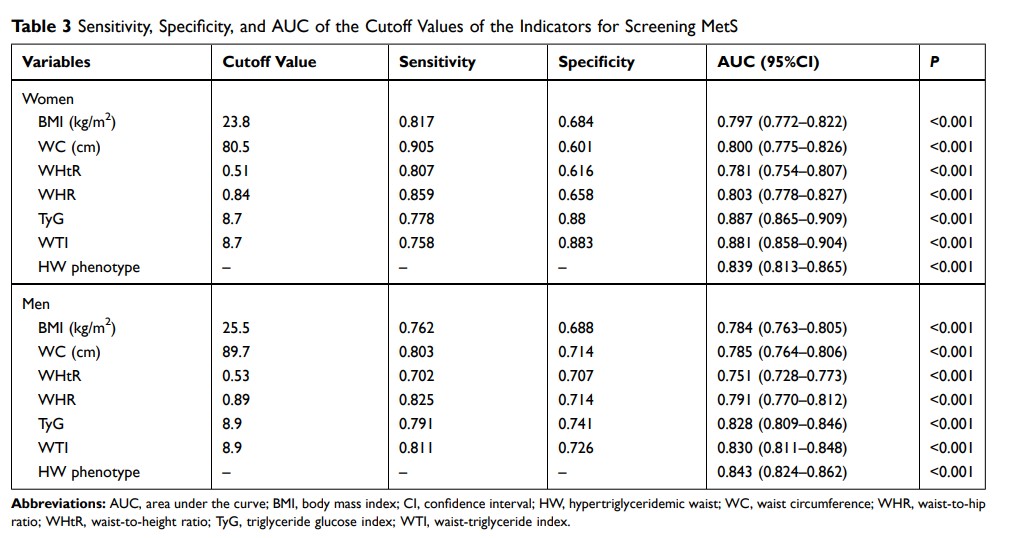
Results: In both genders, the AUC value of WTI, TyG or HW phenotype was markedly larger than that of each anthropometric index alone. In men, there were no statistical differences in the AUC values among WTI, TyG and HW phenotype, whereas in women, the AUC value of WTI was significantly larger than that of HW phenotype [difference between area (DBA): 0.042, 95% CI: 0.0224– 0.0617, P < 0.0001] and was nominally and significantly smaller than that of TyG (DBA: 0.00646, 95% CI: 0.000903– 0.012, P = 0.0227).
Conclusion: Our results suggest that there are discriminatory performance between the WTI and HW phenotype in the detection of MetS in women rather than in men. Appropriate markers for screening MetS in population study should be considered according to the genders.
Keywords: metabolic syndrome, hypertriglyceridemic, waist circumference, triglyceride glucose index, hypertriglyceridemic waist phenotype