119661
论文已发表
注册即可获取德孚的最新动态
IF 收录期刊
- 3.6 Breast Cancer (Dove Med Press)
- 4.3 Clin Epidemiol
- 2.6 Cancer Manag Res
- 3.2 Infect Drug Resist
- 4.1 Clin Interv Aging
- 6.1 Drug Des Dev Ther
- 4.1 Int J Chronic Obstr
- 8.7 Int J Nanomed
- 2.5 Int J Women's Health
- 3.2 Neuropsych Dis Treat
- 2.4 OncoTargets Ther
- 2.6 Patient Prefer Adher
- 2.6 Ther Clin Risk Manag
- 3.1 J Pain Res
- 3.5 Diabet Metab Synd Ob
- 4.5 Psychol Res Behav Ma
- 3.4 Nat Sci Sleep
- 2.4 Pharmgenomics Pers Med
- 2.6 Risk Manag Healthc Policy
- 4.6 J Inflamm Res
- 2.3 Int J Gen Med
- 3.9 J Hepatocell Carcinoma
- 3.3 J Asthma Allergy
- 2.5 Clin Cosmet Investig Dermatol
- 3.0 J Multidiscip Healthc

与体重增加有关的人体测量学指标与脂质过氧化标志物之间的关联:一项针对中国城市成年人的队列研究
Authors Xu T, Wang B, Cao L, Qiu W, Zhang Z, Chen A, Chen W
Received 21 April 2020
Accepted for publication 8 July 2020
Published 18 August 2020 Volume 2020:13 Pages 2877—2887
DOI https://doi.org/10.2147/DMSO.S259194
Checked for plagiarism Yes
Review by Single anonymous peer review
Peer reviewer comments 2
Editor who approved publication: Professor Ming-Hui Zou
Background: Obesity is reported to be associated with oxidative stress which can cause lipid peroxidation. However, the effects of gain in various weight-related anthropometric indices on lipid peroxidation remain unclear. We aimed to examine the cross-sectional and longitudinal associations between altered weight-related anthropometric indices and a marker of lipid peroxidation among urban adults in China.
Methods: A total of 3762 participants from the Wuhan-Zhuhai cohort were included in the present study, with a follow-up of 3 years. Six weight-related anthropometric indicators were measured and calculated, including waist circumference (WC), body mass index (BMI), waist-to-hip ratio (WHR), waist-to-height ratio (WHtR), a body shape index (ABSI), and body adiposity index (BAI). Individual urinary 8-iso-prostaglandin-F2α (8-iso-PGF2α) was determined via enzyme-linked immunosorbent assay to evaluate lipid peroxidation. We used generalized linear models to analyze the cross-sectional and longitudinal associations of weight-related anthropometric indices with a marker of lipid peroxidation and stratified analyses to estimate effect modification.
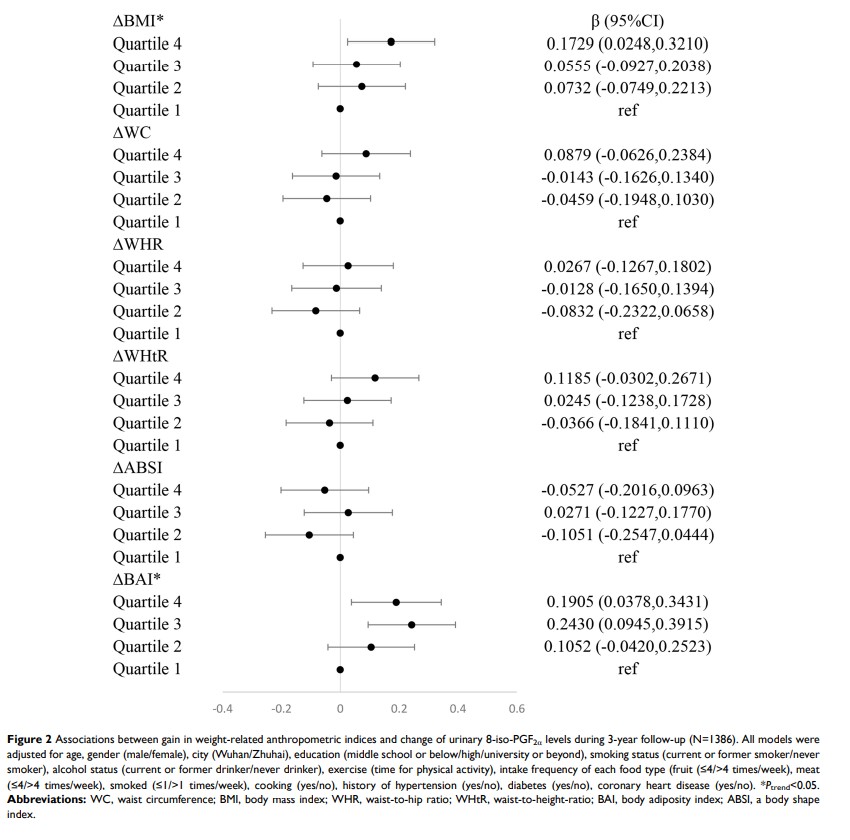
Results: We found significant relationships between WHR, WHtR, ABSI, and urinary 8-iso-PGF2α at baseline. Each 1% increase in WHR, WHtR, and ABSI was significantly associated with a 0.007, 0.004, and 0.104 increase in log-transformed 8-iso-PGF2α concentration, respectively (P < 0.05). In longitudinal analysis, positive dose–response relationships were observed between gains in BMI, BAI, and increased 8-iso-PGF2α after adjusting for potential confounders (P trend< 0.05). We also found that gender and smoking status modified the association of BMI gain and 8-iso-PGF2α increment, and such an association was more obvious in female and non-smokers.
Conclusion: Our research implied that gain in anthropometric indices may result in a higher level of lipid peroxidation.
Keywords: weight-related anthropometric indices, lipid peroxidation, obesity, cohort study