119661
论文已发表
注册即可获取德孚的最新动态
IF 收录期刊
- 3.6 Breast Cancer (Dove Med Press)
- 4.3 Clin Epidemiol
- 2.6 Cancer Manag Res
- 3.2 Infect Drug Resist
- 4.1 Clin Interv Aging
- 6.1 Drug Des Dev Ther
- 4.1 Int J Chronic Obstr
- 8.7 Int J Nanomed
- 2.5 Int J Women's Health
- 3.2 Neuropsych Dis Treat
- 2.4 OncoTargets Ther
- 2.6 Patient Prefer Adher
- 2.6 Ther Clin Risk Manag
- 3.1 J Pain Res
- 3.5 Diabet Metab Synd Ob
- 4.5 Psychol Res Behav Ma
- 3.4 Nat Sci Sleep
- 2.4 Pharmgenomics Pers Med
- 2.6 Risk Manag Healthc Policy
- 4.6 J Inflamm Res
- 2.3 Int J Gen Med
- 3.9 J Hepatocell Carcinoma
- 3.3 J Asthma Allergy
- 2.5 Clin Cosmet Investig Dermatol
- 3.0 J Multidiscip Healthc

根治性放化疗时,治疗中肿瘤体积的变化可预测食管癌患者的治疗结果
Authors Huang R, Guo H, Chen J, Zhai T, Chen J, Lin K, Chen Z, Li D, Chen C
Received 18 January 2020
Accepted for publication 13 July 2020
Published 18 August 2020 Volume 2020:12 Pages 7331—7339
DOI https://doi.org/10.2147/CMAR.S246500
Checked for plagiarism Yes
Review by Single anonymous peer review
Peer reviewer comments 3
Editor who approved publication: Professor Lu-Zhe Sun
Background: This study aimed to assess the predictive value of tumor volume changes of esophagus evaluated by serial computed tomography (CT) scans before, during, and after radical chemoradiotherapy (CRT) for treatment outcomes in patients with esophageal cancer (EC).
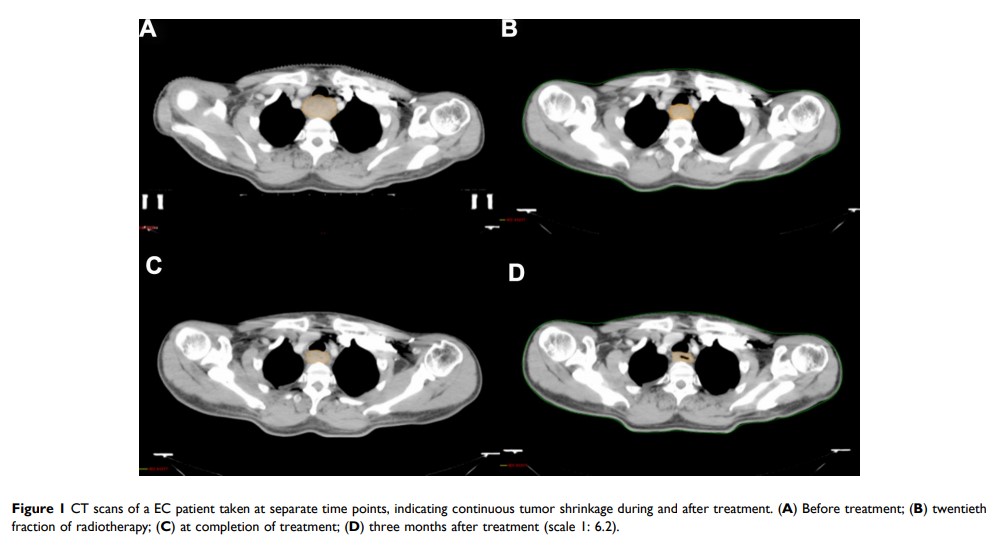
Methods: Fifty-three patients with histologically confirmed EC were included for analysis. Gross tumor volume of esophagus (GTVe) was manually contoured on the CT images before treatment, at a twentieth fraction of radiotherapy, at completion of CRT and three months after treatment. GTVe reduction ratio (RR) was calculated to reveal changes of tumor volume by time. The Kaplan–Meier method was used to estimate survival and for univariate analysis. The Cox regression model was performed for multivariate analysis.
Results: Predominant reduction of GTVe was observed during the first 20 fractions of radiotherapy. Age, pretreatment GTVe, GTVe three months after treatment and GTVe RR at twentieth fraction of radiotherapy were all significantly associated with overall survival (OS) in a univariate analysis. Gender was correlated with locoregional recurrence-free survival (LRRFS) in univariate analysis. Multivariate analysis showed that GTVe ≤ 20 cc, GTVe RR at twentieth fraction of radiotherapy ≥ 35% were positive predictive factors of OS and pretreatment GTVe ≤ 20 cc was prognostic for a favorable LRRFS.
Conclusion: Pretreatment tumor volume and intratreatment volume reduction ratio are reliable prognostic factors for esophageal cancer treated with definitive CRT.
Keywords: esophageal neoplasms, chemoradiotherapy, computed tomography, response evaluation, prognosis