119942
论文已发表
注册即可获取德孚的最新动态
IF 收录期刊
- 3.6 Breast Cancer (Dove Med Press)
- 4.3 Clin Epidemiol
- 2.6 Cancer Manag Res
- 3.2 Infect Drug Resist
- 4.1 Clin Interv Aging
- 6.1 Drug Des Dev Ther
- 4.1 Int J Chronic Obstr
- 8.7 Int J Nanomed
- 2.5 Int J Women's Health
- 3.2 Neuropsych Dis Treat
- 2.4 OncoTargets Ther
- 2.6 Patient Prefer Adher
- 2.6 Ther Clin Risk Manag
- 3.1 J Pain Res
- 3.5 Diabet Metab Synd Ob
- 4.5 Psychol Res Behav Ma
- 3.4 Nat Sci Sleep
- 2.4 Pharmgenomics Pers Med
- 2.6 Risk Manag Healthc Policy
- 4.6 J Inflamm Res
- 2.3 Int J Gen Med
- 3.9 J Hepatocell Carcinoma
- 3.3 J Asthma Allergy
- 2.5 Clin Cosmet Investig Dermatol
- 3.0 J Multidiscip Healthc

中国成年人饮食行为与握力之间的关系:一项基于人群的横断面研究
Authors Ding L, Yin J, Zhang W, Wu Z, Chen S
Received 3 May 2020
Accepted for publication 31 July 2020
Published 20 August 2020 Volume 2020:13 Pages 1245—1252
DOI https://doi.org/10.2147/RMHP.S261093
Checked for plagiarism Yes
Review by Single anonymous peer review
Peer reviewer comments 3
Editor who approved publication: Professor Marco Carotenuto
Purpose: Poor eating behaviors are associated with imbalances in energy and food intake, which may directly or indirectly contribute to muscle strength loss. This study aimed to investigate the association between eating behaviors and hand grip strength in Chinese adults.
Materials and Methods: We designed and conducted a cross-sectional study of 2009 Chinese individuals aged 25– 65 years in 2017. Eating behaviors, including breakfast consumption, snacking after dinner, and eating rate, were assessed using a self-administered questionnaire. Hand grip strength was assessed using a digital grip dynamometer. Age, sex, BMI, physical activity, educational level, occupation, living status, sleep duration, smoking and drinking status, hypertension, diabetes, and depressive symptoms were used as confounding factors.
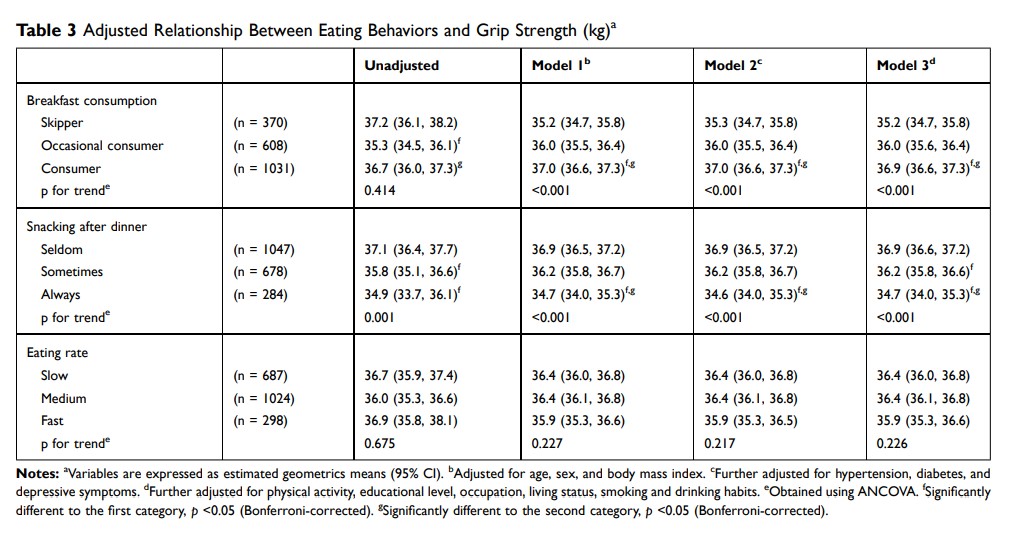
Results: After final adjustments for confounding factors, grip strength was measured as 35.2 (95% confidence interval [CI]: 34.7– 35.8), 36.0 (95% CI: 35.6– 36.4), and 36.9 (95% CI: 36.6– 37.3) for those who skipped, occasionally ate, and regularly ate breakfast, respectively (p for trend < 0.001). Those who always, sometimes, and seldom snacked after dinner (p for trend < 0.001) reported the following grip strength: 34.7 (95% CI: 34.0– 35.3), 36.2 (95% CI: 35.8– 36.6), and 36.9 (95% CI: 36.6– 37.2), respectively. Significant associations were not found between eating rate and grip strength.
Conclusion: This study showed that higher frequency of breakfast consumption and lower frequency of snacking after dinner were associated with higher grip strength in Chinese adults. Therefore, eating behaviors may be involved in muscle function.
Keywords: breakfast consumption, eating rate, snacking after dinner, grip strength, adult population