119942
论文已发表
注册即可获取德孚的最新动态
IF 收录期刊
- 3.6 Breast Cancer (Dove Med Press)
- 4.3 Clin Epidemiol
- 2.6 Cancer Manag Res
- 3.2 Infect Drug Resist
- 4.1 Clin Interv Aging
- 6.1 Drug Des Dev Ther
- 4.1 Int J Chronic Obstr
- 8.7 Int J Nanomed
- 2.5 Int J Women's Health
- 3.2 Neuropsych Dis Treat
- 2.4 OncoTargets Ther
- 2.6 Patient Prefer Adher
- 2.6 Ther Clin Risk Manag
- 3.1 J Pain Res
- 3.5 Diabet Metab Synd Ob
- 4.5 Psychol Res Behav Ma
- 3.4 Nat Sci Sleep
- 2.4 Pharmgenomics Pers Med
- 2.6 Risk Manag Healthc Policy
- 4.6 J Inflamm Res
- 2.3 Int J Gen Med
- 3.9 J Hepatocell Carcinoma
- 3.3 J Asthma Allergy
- 2.5 Clin Cosmet Investig Dermatol
- 3.0 J Multidiscip Healthc

伴重排丢失的肺腺癌在克唑替尼和赛瑞替尼治疗期间 COX7A2L–ALK 、LINC01210–ALK 、ATP13A4–ALK 及获得性 SLCO2A1–ALK 共存:一份病例报告
Authors Cai C, Long Y, Li Y, Huang M
Received 14 April 2020
Accepted for publication 3 August 2020
Published 20 August 2020 Volume 2020:13 Pages 8313—8316
DOI https://doi.org/10.2147/OTT.S258067
Checked for plagiarism Yes
Review by Single anonymous peer review
Peer reviewer comments 2
Editor who approved publication: Prof. Dr. Geoffrey Pietersz
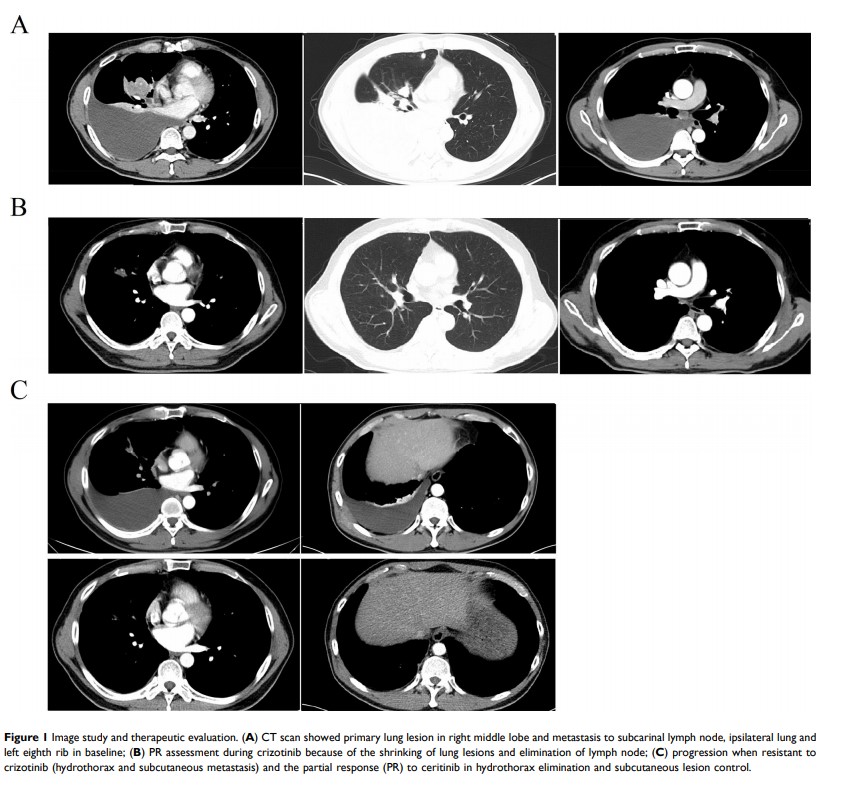
Abstract: ALK rearrangements account for ∼ 5% of non-small-cell lung cancer (NSCLC). Numerous rearrangement partners have been discovered. Here, we describe a 53-year-old nonsmoker with NSCLC, in whom we identified four novel rearrangements. The patient was diagnosed as adenocarcinoma in the right middle lobe of lung, with metastases in subcarinal lymph node, ipsilateral lung, pleura and contralateral rib (cT4N2M1, stage IV). Next-generation sequencing (NGS) identified three baseline ALK fusions: COX7A2L–ALK (C[intragenic]:A20), LINC01210–ALK (L[intergenic]:A20) and ATP13A4–ALK (A9:A19). The patient exhibited 12 months of progression-free survival (PFS) and a partial response (PR) to first-line crizotinib therapy. We then discovered a new SLCO2A1–ALK fusion (S[intergenic]:A18) and a missense mutation C1156Y after resistance developed. Sequential ceritinib resulted in further 8 months of PFS, after which NGS results demonstrated the loss of ATP13A4–ALK and SLCO2A1–ALK . This is the first description a NSCLC patient harbors four ALK fusions and was sensitive to tyrosine kinase inhibitors (TKIs). Acquisition and loss of ALK fusions after ALK inhibitors may account for resistance.
Keywords: NSCLC, intergenic ALK , intragenic ALK , non-EML4–ALK , target therapy