119661
论文已发表
注册即可获取德孚的最新动态
IF 收录期刊
- 3.6 Breast Cancer (Dove Med Press)
- 4.3 Clin Epidemiol
- 2.6 Cancer Manag Res
- 3.2 Infect Drug Resist
- 4.1 Clin Interv Aging
- 6.1 Drug Des Dev Ther
- 4.1 Int J Chronic Obstr
- 8.7 Int J Nanomed
- 2.5 Int J Women's Health
- 3.2 Neuropsych Dis Treat
- 2.4 OncoTargets Ther
- 2.6 Patient Prefer Adher
- 2.6 Ther Clin Risk Manag
- 3.1 J Pain Res
- 3.5 Diabet Metab Synd Ob
- 4.5 Psychol Res Behav Ma
- 3.4 Nat Sci Sleep
- 2.4 Pharmgenomics Pers Med
- 2.6 Risk Manag Healthc Policy
- 4.6 J Inflamm Res
- 2.3 Int J Gen Med
- 3.9 J Hepatocell Carcinoma
- 3.3 J Asthma Allergy
- 2.5 Clin Cosmet Investig Dermatol
- 3.0 J Multidiscip Healthc

确定长非编码 RNA SNHG 家族作为急性髓性白血病有希望的预后生物标志物
Authors Shi J, Ding W, Lu H
Received 3 June 2020
Accepted for publication 3 August 2020
Published 24 August 2020 Volume 2020:13 Pages 8441—8450
DOI https://doi.org/10.2147/OTT.S265853
Checked for plagiarism Yes
Review by Single anonymous peer review
Peer reviewer comments 3
Editor who approved publication: Dr Leo Jen-Liang Su
Background: Small nucleolar RNA host gene (SNHG ) family members are newly recognized lncRNAs, which have been revealed to be oncogenes in several cancers. However, little studies investigated the expression and clinical implications of SNHGs in AML.
Methods: Herein, we systemically determined the prognostic role of the expression of SNHG family members in acute myeloid leukemia (AML).
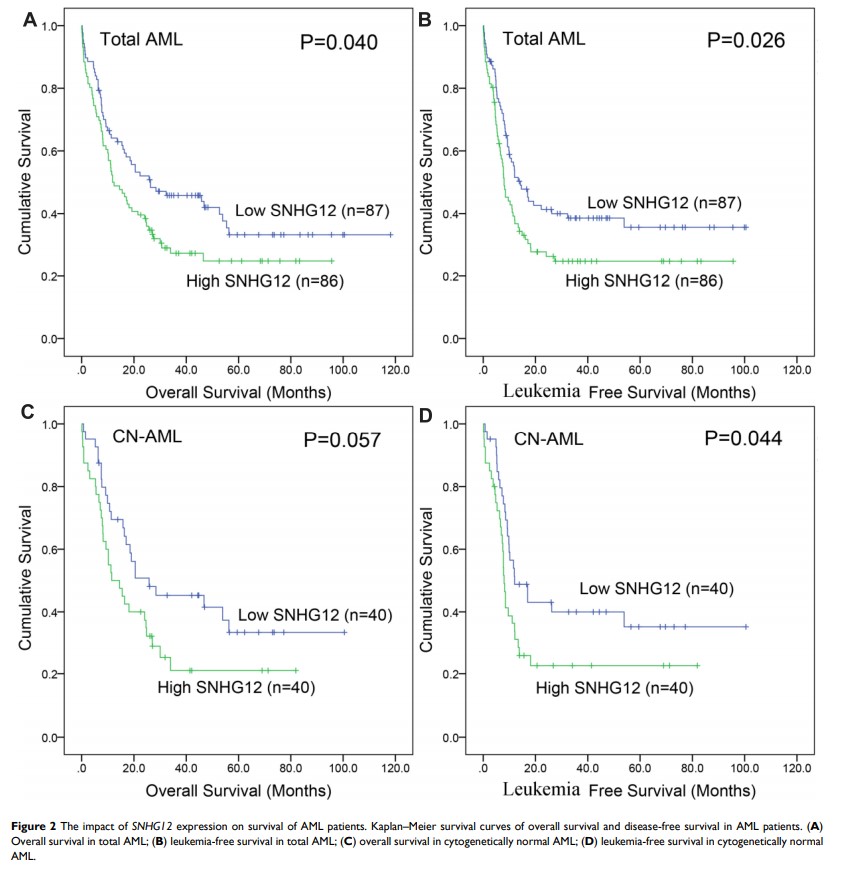
Results: Among the expression of all SNHG family members, we identified that only SNHG7 and SNHG12 expression were found to have prognostic effects on overall survival (OS) and leukemia-free survival (LFS) in AML by Cox regression univariate analysis. Furthermore, Kaplan–Meier analysis showed that SNHG7 higher-expressed cases had markedly longer OS and LFS time than SNHG7 lower-expressed cases, whereas SNHG12 higher-expressed cases had markedly shorter OS and LFS time than SNHG12 lower-expressed cases. Interestingly, SNHG7 and SNHG12 expression were also associated with several prognosis-related clinical/molecular features such as white blood cell counts, FAB/cytogenetic classifications, IDH1 mutation, RUNX1 mutation, and NPM1 mutation. Despite the associations, Cox regression multivariate analysis confirmed the independent prognostic impact of SNHG7 and SNHG12 expression in AML. Notably, we further validated that both SNHG7 and SNHG12 expression was significantly increased in newly diagnosed AML patients.
Conclusion: Our findings demonstrated that SNHG7 and SNHG12 expression act as independent prognostic indicators in AML.
Keywords: LncRNA, SNHG , expression, prognosis, AML