115195
论文已发表
注册即可获取德孚的最新动态
IF 收录期刊
- 3.6 Breast Cancer (Dove Med Press)
- 4.3 Clin Epidemiol
- 2.6 Cancer Manag Res
- 3.2 Infect Drug Resist
- 4.1 Clin Interv Aging
- 6.1 Drug Des Dev Ther
- 4.1 Int J Chronic Obstr
- 8.7 Int J Nanomed
- 2.5 Int J Women's Health
- 3.2 Neuropsych Dis Treat
- 2.4 OncoTargets Ther
- 2.6 Patient Prefer Adher
- 2.6 Ther Clin Risk Manag
- 3.1 J Pain Res
- 3.5 Diabet Metab Synd Ob
- 4.5 Psychol Res Behav Ma
- 3.4 Nat Sci Sleep
- 2.4 Pharmgenomics Pers Med
- 2.6 Risk Manag Healthc Policy
- 4.6 J Inflamm Res
- 2.3 Int J Gen Med
- 3.9 J Hepatocell Carcinoma
- 3.3 J Asthma Allergy
- 2.5 Clin Cosmet Investig Dermatol
- 3.0 J Multidiscip Healthc

从代谢组学角度综合评估脂多糖诱导的大鼠变化
Authors Geng C, Guo Y, Wang C, Cui C, Han W, Liao D, Jiang P
Received 3 June 2020
Accepted for publication 1 August 2020
Published 24 August 2020 Volume 2020:13 Pages 477—486
DOI https://doi.org/10.2147/JIR.S266012
Checked for plagiarism Yes
Review by Single anonymous peer review
Peer reviewer comments 3
Editor who approved publication: Dr Ning Quan
Purpose: Substantial evidence indicates that lipopolysaccharide (LPS) exposure can lead to systemic inflammatory response syndrome (SIRS) and multiple organ failure. Previous metabolomic studies have mainly focused on LPS-induced depression or hepatic and renal effects. However, no comprehensive metabolomics-based analysis of the serum, liver, kidney, hippocampus, and heart following exposure to LPS has been undertaken to date.
Material and Methods: Male Sprague–Dawley rats were randomly allocated to a control and a LPS-treated group (n=8). LPS for 2 weeks (0.5 mg/kg every other day) was given via intraperitoneal injection. Gas chromatography–mass spectrometry (GC–MS) was used for metabolite determination, while multivariate statistical analysis was performed to identify differentially expressed metabolites between the two groups.
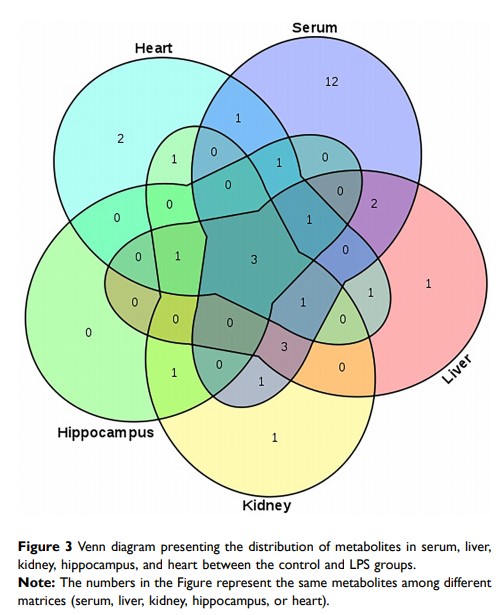
Results: Our study revealed that 24, 13, 12, 7, and 12 metabolites were differentially expressed between the LPS treatment group and the control group in the serum, liver, kidney, hippocampus, and heart, respectively. We further identified that these metabolic changes were mainly involved with aminoacyl-tRNA biosynthesis; glutathione metabolism; glyoxylate and dicarboxylate metabolism; glycine, serine, and threonine metabolism; arginine biosynthesis; bile acid biosynthesis; and glycerolipid metabolism.
Conclusion: We have systematically elucidated the metabolic changes underlying LPS-induced SIRS, thereby providing insight into the mechanisms associated with these alterations.
Keywords: systemic inflammatory response syndrome, metabolites, gas chromatography–mass spectrometry, multivariate statistical analysis