119661
论文已发表
注册即可获取德孚的最新动态
IF 收录期刊
- 3.6 Breast Cancer (Dove Med Press)
- 4.3 Clin Epidemiol
- 2.6 Cancer Manag Res
- 3.2 Infect Drug Resist
- 4.1 Clin Interv Aging
- 6.1 Drug Des Dev Ther
- 4.1 Int J Chronic Obstr
- 8.7 Int J Nanomed
- 2.5 Int J Women's Health
- 3.2 Neuropsych Dis Treat
- 2.4 OncoTargets Ther
- 2.6 Patient Prefer Adher
- 2.6 Ther Clin Risk Manag
- 3.1 J Pain Res
- 3.5 Diabet Metab Synd Ob
- 4.5 Psychol Res Behav Ma
- 3.4 Nat Sci Sleep
- 2.4 Pharmgenomics Pers Med
- 2.6 Risk Manag Healthc Policy
- 4.6 J Inflamm Res
- 2.3 Int J Gen Med
- 3.9 J Hepatocell Carcinoma
- 3.3 J Asthma Allergy
- 2.5 Clin Cosmet Investig Dermatol
- 3.0 J Multidiscip Healthc

术后 24 小时急性睡眠剥夺通过抑制脾切除大鼠海马神经元中的 Tau 蛋白磷酸化来改善学习和记忆
Authors Zhang Y, Li X, Tan W, Fang B, Ma H
Received 3 April 2020
Accepted for publication 11 August 2020
Published 24 August 2020 Volume 2020:12 Pages 603—613
DOI https://doi.org/10.2147/NSS.S254449
Checked for plagiarism Yes
Review by Single anonymous peer review
Peer reviewer comments 2
Editor who approved publication: Professor Steven A Shea
Purpose: As tau pathology is involved in impaired postoperative learning and memory in rats, we attempted to identify the possible mechanisms by which tau pathology affects postoperative sleep deprivation.
Methods: Adult male Sprague-Dawley rats were randomly assigned into six groups as follows: the Control group, Anaesthesia group, Surgery group, Sleep deprivation (SD) group: 24-h SD with the modified multiple platform method (MMPM), Anaesthesia and SD (ASD) group, and Surgery and SD (SSD) group. Tau396 and FOXQ1 protein expression levels in the hippocampal neurons of all groups were analysed. Changes following co-culture of hippocampal neurons with IL-6 were detected by flow cytometry.
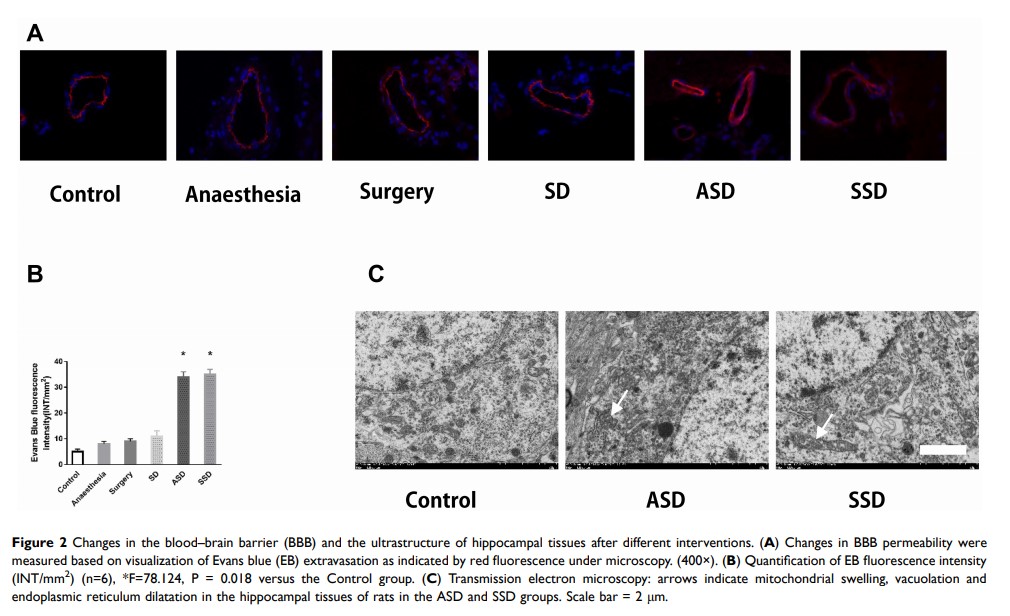
Results: Twenty-four hours of acute SD decreased the error scores on postoperative day 5 in the ASD and SSD groups compared with the Anaesthesia and Surgery groups. Compared with the tau levels in the Control group, tau levels in the Anaesthesia and Surgery groups were increased, but SD decreased the expression of tau in the ASD and SSD groups. The expression levels of tau and FOXQ1 were inversely regulated. When hippocampal neurons were co-cultured with IL-6, the same changes were observed.
Conclusion: Postoperative 24-h acute SD improves learning and memory through inhibition of tau phosphorylation and increases IL-6-induced expression of FOXQ1 in the hippocampal neurons of splenectomized rats.
Keywords: tau pathology, interleukin-6, postoperative sleep deprivation, FOXQ1, learning, memory