119661
论文已发表
注册即可获取德孚的最新动态
IF 收录期刊
- 3.6 Breast Cancer (Dove Med Press)
- 4.3 Clin Epidemiol
- 2.6 Cancer Manag Res
- 3.2 Infect Drug Resist
- 4.1 Clin Interv Aging
- 6.1 Drug Des Dev Ther
- 4.1 Int J Chronic Obstr
- 8.7 Int J Nanomed
- 2.5 Int J Women's Health
- 3.2 Neuropsych Dis Treat
- 2.4 OncoTargets Ther
- 2.6 Patient Prefer Adher
- 2.6 Ther Clin Risk Manag
- 3.1 J Pain Res
- 3.5 Diabet Metab Synd Ob
- 4.5 Psychol Res Behav Ma
- 3.4 Nat Sci Sleep
- 2.4 Pharmgenomics Pers Med
- 2.6 Risk Manag Healthc Policy
- 4.6 J Inflamm Res
- 2.3 Int J Gen Med
- 3.9 J Hepatocell Carcinoma
- 3.3 J Asthma Allergy
- 2.5 Clin Cosmet Investig Dermatol
- 3.0 J Multidiscip Healthc

非小细胞肺癌青年患者:相较于老年人的临床、病理和 TNM 分期特征的分析
Authors Jin X, Zhao X, Liu X, Han K, Lu G, Zhang Y
Received 9 June 2020
Accepted for publication 10 August 2020
Published 24 August 2020 Volume 2020:13 Pages 1301—1307
DOI https://doi.org/10.2147/RMHP.S264274
Checked for plagiarism Yes
Review by Single anonymous peer review
Peer reviewer comments 2
Editor who approved publication: Professor Marco Carotenuto
Purpose: To compare clinicopathologic factors including tumor-node-metastasis (TNM) stage between young and elderly patients with non-small cell lung cancer (NSCLC).
Methods: This retrospective study compared the following characteristics between 52 young patients with NSCLC (< 50 years of age) and 67 elderly patients with NSCLC (> 60 years): duration of symptoms before medical consultation, smoking index, family history of cancer, Ki-67 index, and pTNM stage. A binary logistic regression analysis was used to identify factors predictive of greater stage NSCLC (stage III/IV compared to stage I/II) within each age group.
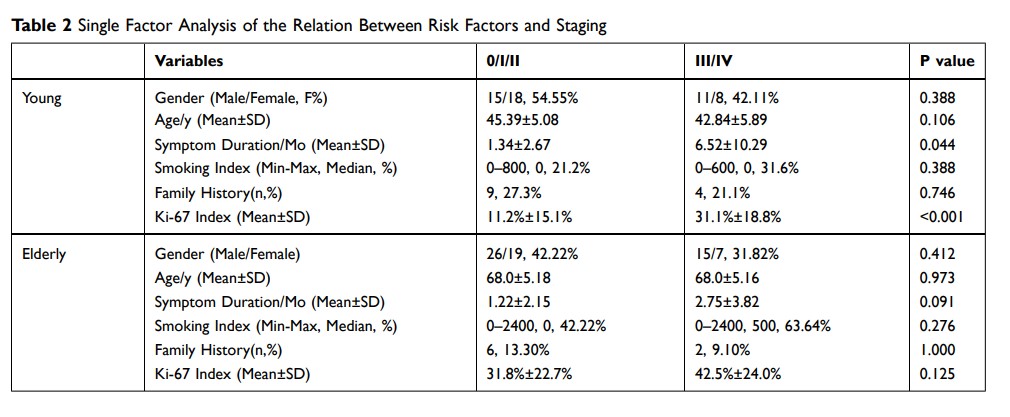
Results: The incidence of adenocarcinoma was higher in the young than in the elderly (P=0.006). Smoking index (P=0.002) and Ki-67 index (P< 0.001) were lower in the young than in the elderly. In young patients with NSCLC, delayed treatment (greater duration from symptoms to medical consultation, P=0.050) and active tumor proliferation (higher Ki-67 index, P=0.003) were predictive of more advanced cancer stage (III/IV), with only symptom duration being predictive of stage III/IV NSCLC among elderly patients. Among young patients, cough (P=0.021) and chest congestion (P=0.040) were the most significant warning symptoms of advanced-stage NSCLC.
Conclusion: High tumor proliferation and delayed treatment are predictive of advanced NSCLC on presentation among young individuals. Early diagnosis by imaging, such as with the use of low dose computed tomography (LDCT), for young individuals with coughing and chest congestion over 1 month might be effectiveto improve prognosis and outcomes.
Keywords: NSCLC, young adult patients, symptom assessment, Ki67